Modern data quality Last reviewed June 2026
DataKitchen TestGen vs Recce
TestGen writes your data quality tests for you and runs them in your database. Apache 2.0 from $0. Compare it to Recce on price, license, and capability.
You've got data errors in production, unhappy customers, no time or budget to fix it. TestGen runs free in your production stack in an hour.
Capability matrix
DataKitchen TestGen against Recce, sized for 10 users, 1,000 tables, 1 year.
| Capability | TestGen OSS | TestGen Enterprise | Recce |
|---|---|---|---|
| Pricing model | Open source | Per user / connection | Open-core (free OSS + Recce Cloud tiers) |
| Est. annual price 10 users, 1,000 tables, 1 year | $0 | $12K-$36K | $0-$3K |
| License | Apache 2.0 | Commercial | Apache 2.0 |
| Auto-generated tests | Yes | Yes | No |
| Data profiling | Yes | Yes | Yes |
| Anomaly detection | Yes | Yes | No |
| Freshness, volume, schema monitors | Yes | Yes | Partial (PR diffs only) |
| Data quality scoring | Yes | Yes | No |
| Data contracts | Partial | Partial | No |
| Column-level lineage | Partial | Partial | Yes |
| Process and pipeline observability | Via DataKitchen Observability | Via DataKitchen Observability | No |
| AI agent integration (MCP) | Yes | Yes | Yes |
| REST API for automation | Yes | Yes | Partial (CLI only) |
| Deployment | Self-host | Cloud, self-host, Docker | Self-host, SaaS |
How to read this: Yes means the capability ships out of the box. Partial means it exists but is limited, gated to enterprise, or needs significant configuration. No means absent.
TestGen profiles your tables and generates the tests for you, then runs them as SQL inside your warehouse. Recce expects you to define the checks yourself. TestGen is Apache 2.0 and runs behind your firewall; Recce is Apache 2.0.
Where TestGen pulls ahead
Open source you can actually run. Both DataKitchen and Recce ship open-source code. Where they differ: TestGen’s open source is the same engine the enterprise edition runs on. There’s no feature-gated cloud version that quietly does the real work. You can run all of TestGen on your laptop today. TestGen ships 55 test types, 34 of them auto-generated, covering integrity, hygiene, and quality. Same code in the open-source edition and the enterprise edition.
Fair, predictable pricing. TestGen Enterprise is a flat $100 per user per month plus $100 per database connection per month. No per-table tax, no credit metering, no negotiated mystery quote. Recce has an open-source edition too, but its commercial tier is where most teams end up at scale. Recce runs at $0-$3K a year for 10 users and 1,000 tables. TestGen Enterprise is $12,000 to $36,000 a year at the same size.
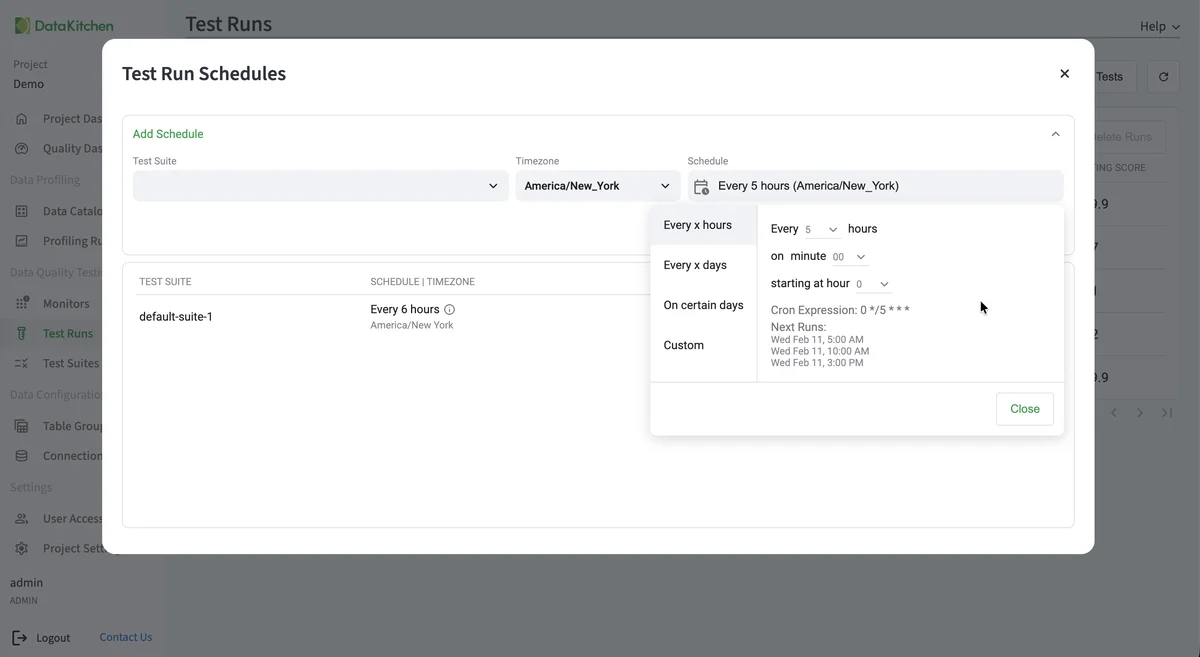
One-click test generation, in-database execution. Point TestGen at a database. It profiles every column, writes the tests, and pushes the queries into your database for speed and security. Your data never leaves the perimeter.
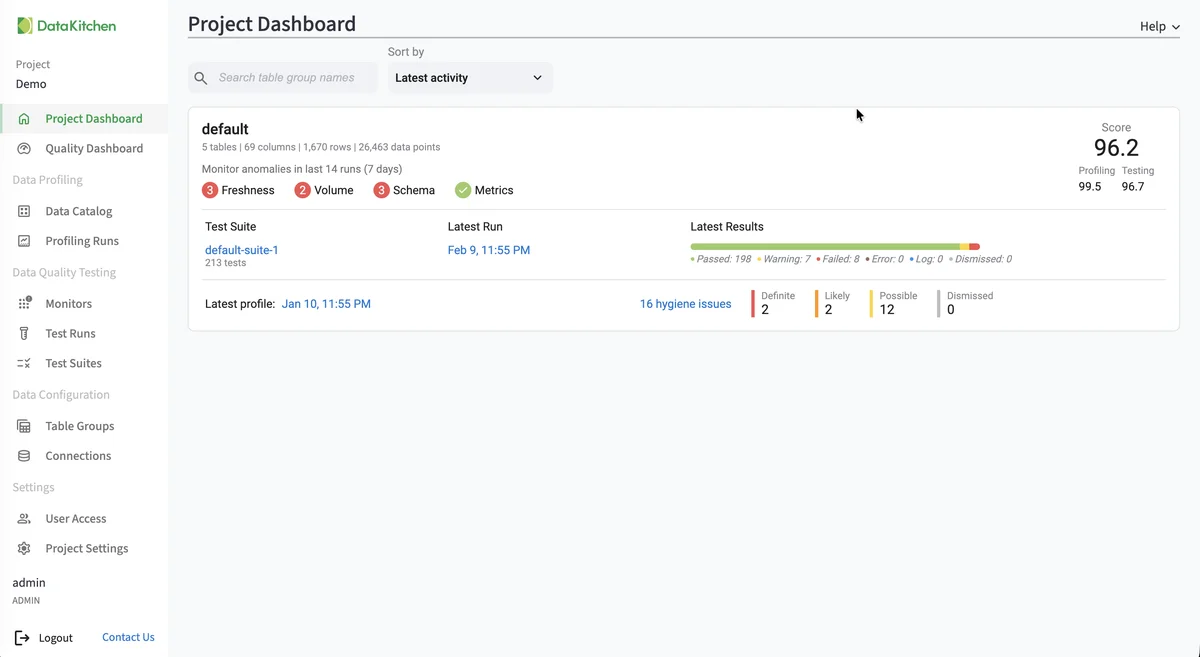
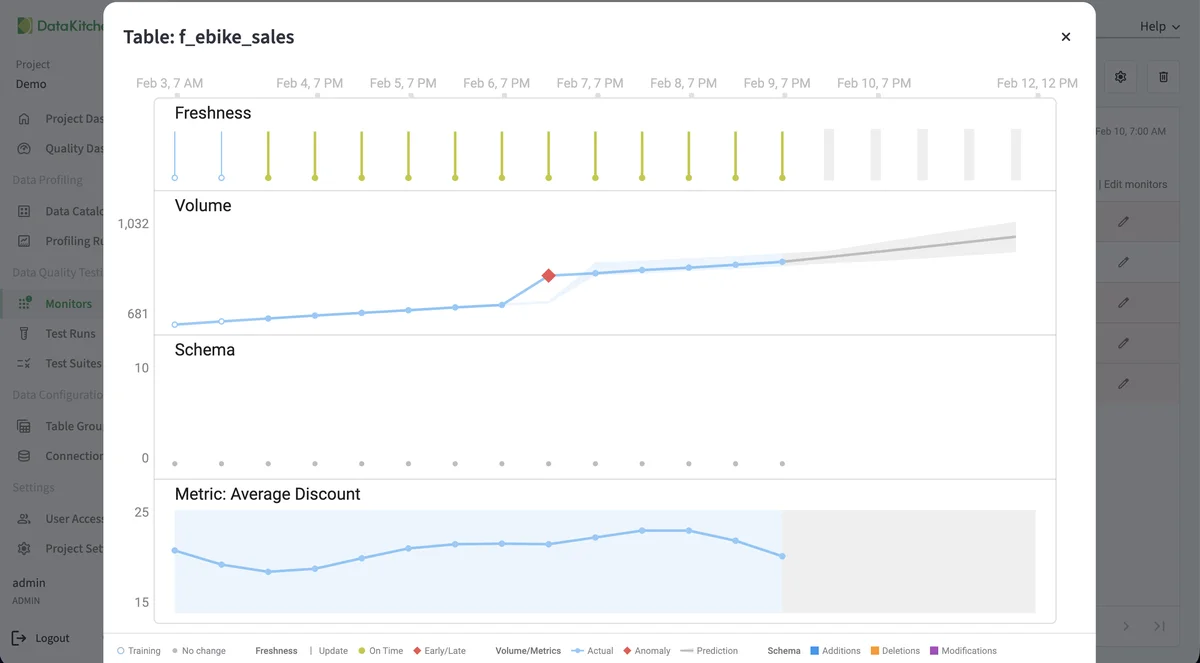
Anomaly detection and a catalog you’ll actually use. TestGen runs freshness, volume, schema, and data drift monitors out of the box. The data catalog gives you metadata, hygiene issues, PII risk, test results, and Critical Data Elements in one view. Shareable issue reports send the right ticket to the right Slack channel in one click.
Real support from the people who built it. DataKitchen is a profitable, bootstrapped company that has shipped DataOps software since 2013. Same team, same product line, same pricing. The engineers who wrote TestGen answer support tickets. No chatbot wall, no offshore tier-one triage, no acquisition shutdown email landing in your inbox.
Venture-backed, growth-mandated. Recce runs on venture capital. The pricing, the roadmap, and the support model are built around exit math, not your budget. The data observability category has taken on more than a billion dollars of venture investment, and we wrote about why that is not going to end well for buyers.
Pairs with open-source DataKitchen Observability. TestGen monitors your tables. DataKitchen Observability monitors every tool acting on your data, from Airflow and dbt to Fivetran, Snowflake, and the BI layer. Most modern data quality vendors stop at the warehouse.
Bottom line
Install the open-source TestGen and try it on your data. The auto-generated tests, profiling, and anomaly monitors cover what most teams need without writing a line of YAML. The matrix above lays out capabilities, license, and price.
Same engine in the open-source edition and the enterprise edition. No feature lock-out, no upgrade tax for the parts you actually need.
How DataKitchen handles each capability
- Auto-generated tests
- One-click test generation. Point TestGen at a database. It generates tests from 34 test types covering integrity, hygiene, and quality. No YAML. No SQL. No Python. TestGen product page
- Data profiling
- A profile run captures 55 column characteristics per column. Queries execute in-database, so the data never leaves your perimeter and the run is fast. TestGen docs
- Anomaly detection
- Automated alerts on freshness, volume, schema, and data drift. The model learns the shape of your data and flags breakage before downstream consumers see it. TestGen product page
- Freshness, volume, schema monitors
- Freshness, volume, and schema monitors run alongside the auto-generated tests with no extra configuration. TestGen docs
- Data quality scoring
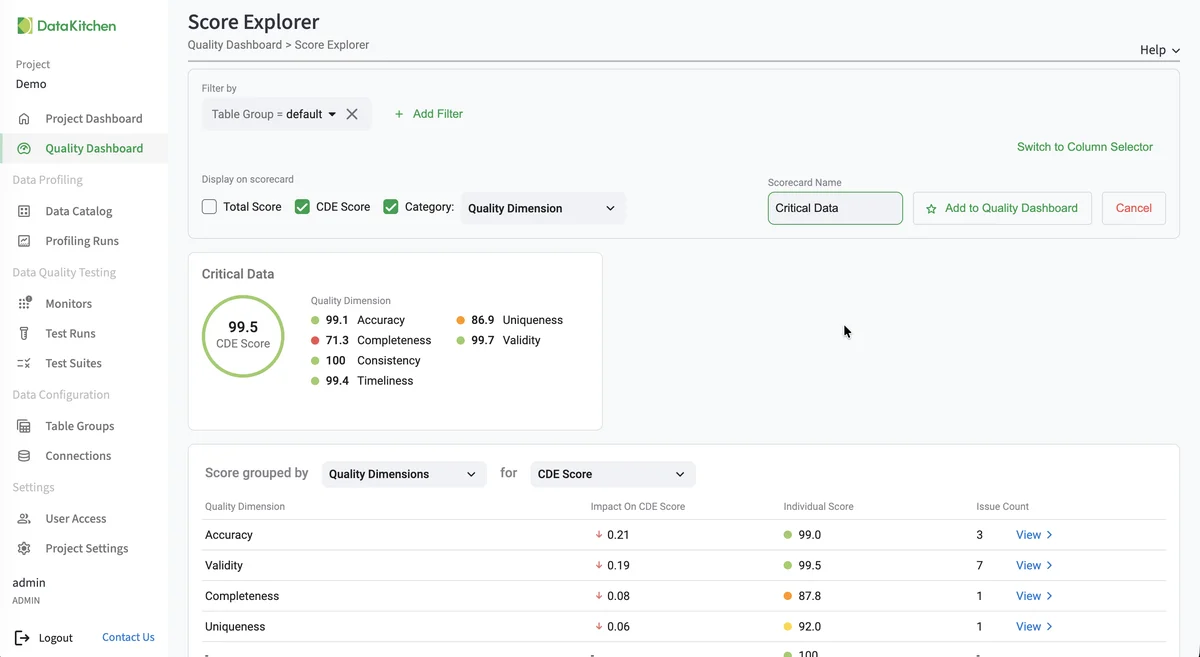
- Customizable scorecards with drill-down reports. Roll up by table, project, DAMA category, Critical Data Element, or business goal. Shareable issue reports send the right ticket to the right Slack channel in one click. TestGen product page
- Data contracts
- Partial today. ODCS v3.1.0 support is in development. Hygiene detectors and custom rules cover most contract use cases right now. TestGen FAQ
- Column-level lineage
- In development. Profile diffs and hygiene tests catch column-level breakage today. Full lineage trees come from DataKitchen Observability. DataKitchen Observability
- Process and pipeline observability
- TestGen monitors tables. DataKitchen Observability, free and open source, monitors every tool acting on your data. Airflow, dbt, Fivetran, Snowflake, the BI layer. Most modern DQ tools stop at the warehouse. DataKitchen Observability
- AI agent integration (MCP)
- Connect Claude, Cursor, or any MCP client and ask which tests failed, what a column looks like, or why a score dropped. Authenticates with OAuth 2.1 or an API token. TestGen MCP docs
- REST API for automation
- Trigger profiling and test runs from CI/CD, fetch results by job ID, and move test definitions between environments. Authenticates with OAuth 2.1 or an API token. TestGen API docs
- Deployment
- Self-host with Docker on Mac, Linux, or Windows. Pip install for Python users. Managed cloud for Enterprise customers. Install TestGen
Common questions
Quick answers about TestGen vs Recce
Why choose DataKitchen TestGen over Recce?
Three reasons. TestGen writes the tests for you, generating them from a profile of 55 column characteristics instead of asking you to author them, which is what actually caps coverage. It runs as SQL inside your own warehouse, so no rows cross the wire. And it is Apache 2.0 from $0 against $0-$3K a year for Recce, with no feature gates.
What is the difference between DataKitchen TestGen and Recce?
TestGen profiles your tables and generates the tests for you, then runs them as SQL inside your warehouse. Recce expects you to define the checks yourself. TestGen is Apache 2.0 and runs behind your firewall; Recce is Apache 2.0.
How much does Recce cost compared to TestGen?
Recce runs about $0-$3K a year for 10 users and 1,000 tables, on Open-core (free OSS + Recce Cloud tiers), with pricing available on request. Open-source TestGen is free with no feature gates, for one user, one connection, and one project. TestGen Enterprise is $12,000 to $36,000 a year at the same size.
Is Recce open source?
Recce does offer an open-source edition, but the commercial tier is where most teams end up at scale. The difference with TestGen is that its open source is the same engine the enterprise edition runs, so there is no feature-gated version quietly doing the real work.
Does Recce generate data quality tests automatically?
No. Recce expects you to define checks yourself, which is what caps coverage on a large estate. TestGen generates tests from profiling before anyone writes a rule, so coverage stops being the thing that blocks the project.
Can I run Recce behind my own firewall?
Recce deploys via Self-host, SaaS. TestGen runs entirely in your environment: tests execute as SQL inside your warehouse, and no rows leave your network. For regulated teams, that distinction is usually where a security review either ends or clears.
Why teams pick the open-source path
34 auto-generated test types
Point TestGen at a database. It writes tests covering integrity, hygiene, and quality on day one. No data expertise required.
Column-level profiling
55 characteristics per column. Surface the rows that quietly break dashboards.
In-database execution
Queries run inside your database, not over the wire. Fast, and your data stays put.
Hygiene detection
Automatically confirm how closely data structures and assumptions match actual column contents.
Anomaly alerts
Freshness, volume, schema, and data drift monitors flag breakage before it lands.
Data catalog
Metadata, hygiene issues, PII risk, test results, and Critical Data Elements in one view.
Quality scorecards
Drill from the dashboard to the row that broke. Configurable by table or business goal.
Built-in UI
A working dashboard for data engineers and data stewards. Secure, self-hosted, no extra glue code.
MCP server + REST API
AI-assisted flows through MCP for Claude, Cursor, and agents. REST API for CI/CD automation.
Pairs with Observability
Pair TestGen with the open-source DataKitchen Observability. Watch every tool, end to end.
What you actually get
Try TestGen yourself
Install the open-source edition in five minutes. No card. No call.
Want to talk first? Request an enterprise demo or read the docs.