Catch bad data the moment it lands
Your sources change without telling you. Schema shifts, vendors send half a file, a column that was always populated suddenly has nulls. TestGen Monitors watches every table on every refresh with ML anomaly detection. Freshness, volume, schema, and metrics. Open source. Free.
Key points
- Sources change without telling you: a schema shifts, a vendor sends half a file, a column that was always populated arrives full of nulls.
- TestGen Monitor watches every table with ML anomaly detection, so a new failure mode does not need a hand-written test first.
- Freshness, volume, schema, and metric monitors ship out of the box, and custom monitors cover the measures specific to your business.
- Open source with no per-table pricing, so watching every table is an engineering decision rather than a budget one.
Watch every table with ML anomaly detection
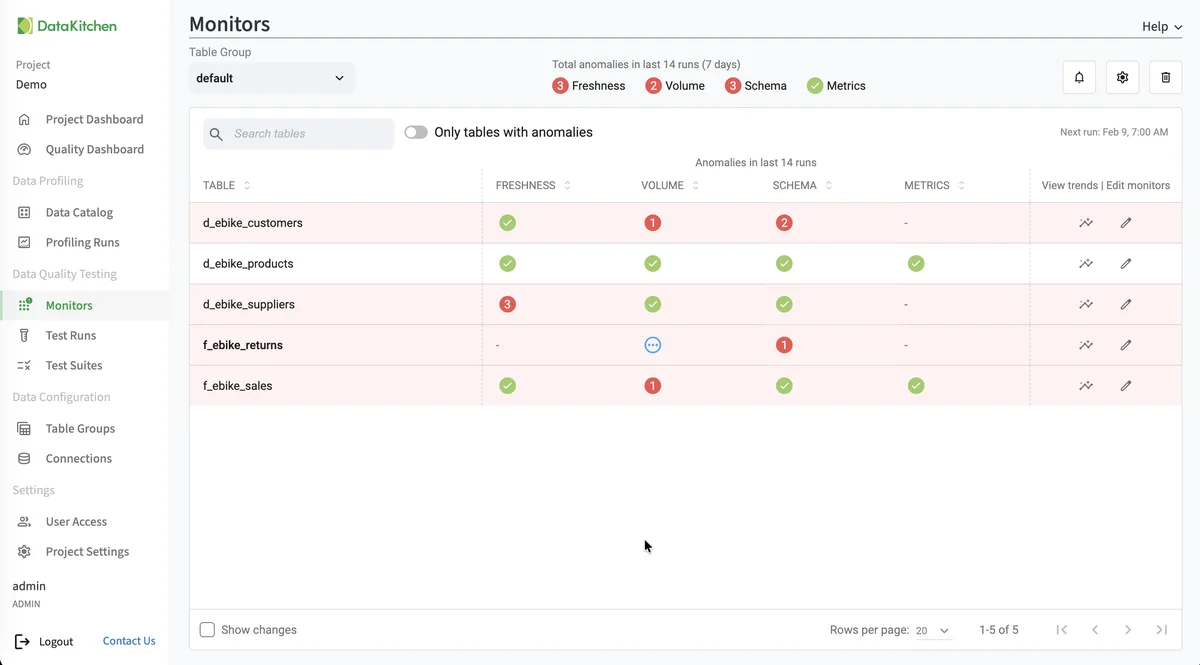
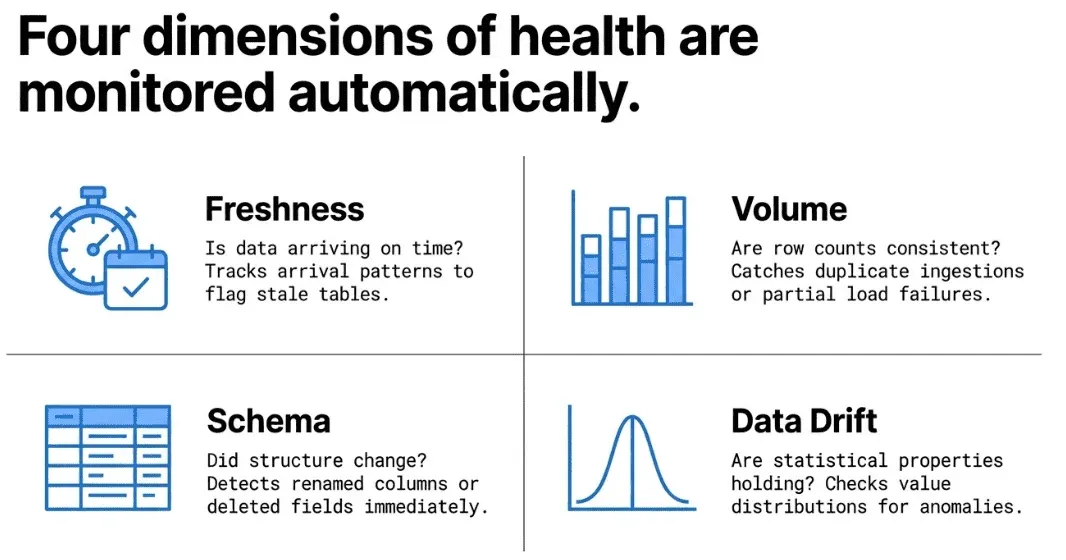
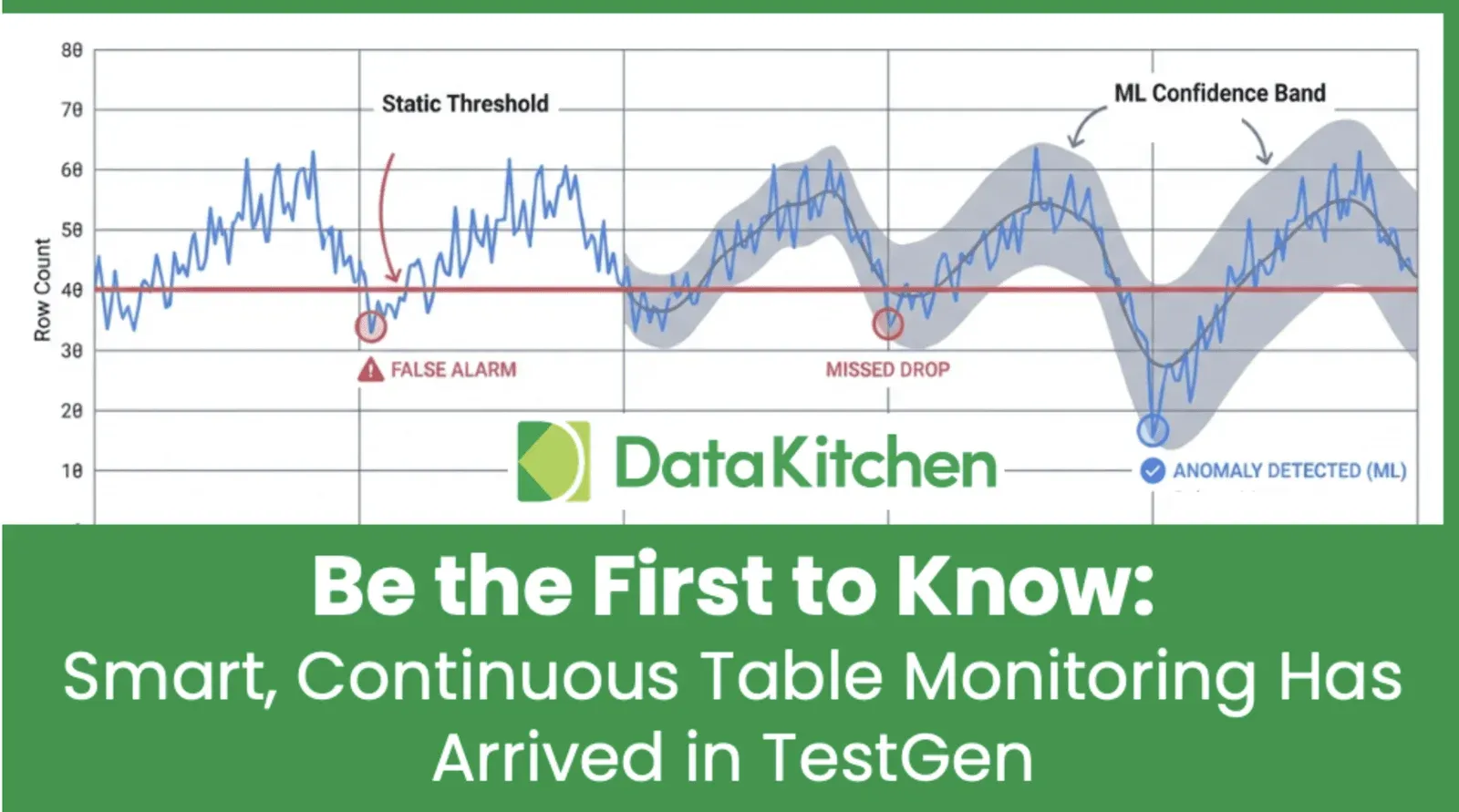
TestGen profiles every table and learns what normal looks like: row counts at this hour, value distributions for this column, the freshness pattern you've come to expect. On every refresh it compares against the baseline and flags anomalies before anyone has a chance to look at the data. The Monitors page rolls everything up by table over a 14-day window. Green means healthy. Red means somebody is going to file a ticket. The pattern is automatic. Nobody is hand-coding thresholds.
Freshness, volume, schema, and metrics out of the box
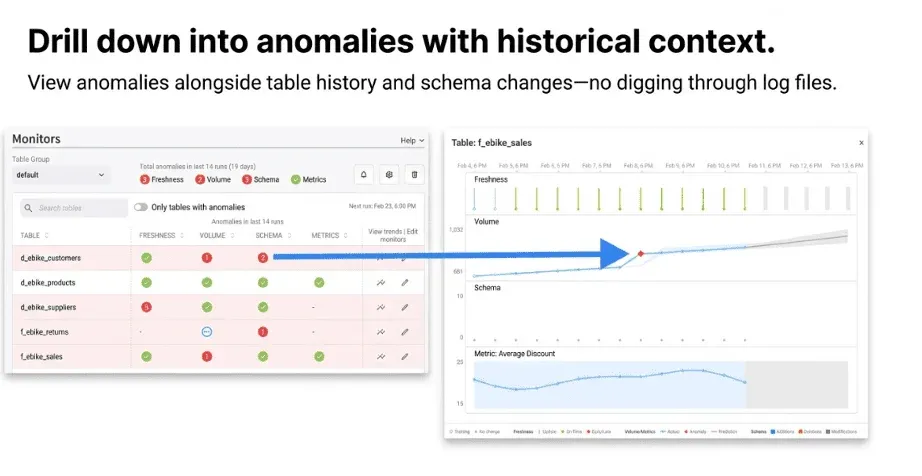
TestGen runs four baseline checks on every table. Freshness: did new data arrive on schedule? Volume: are the row counts in line with the last 14 days? Schema: did a column rename, drop, or change type? Metrics: did the average, the median, or the null rate drift outside the expected band? You don't write any of these. They're generated when TestGen profiles the table the first time, and they re-baseline as the data evolves. The four catch the most common bad-ingest scenarios: late files, partial loads, vendor-side schema changes, and silent corruption.
Build custom monitors for the metrics you actually care about
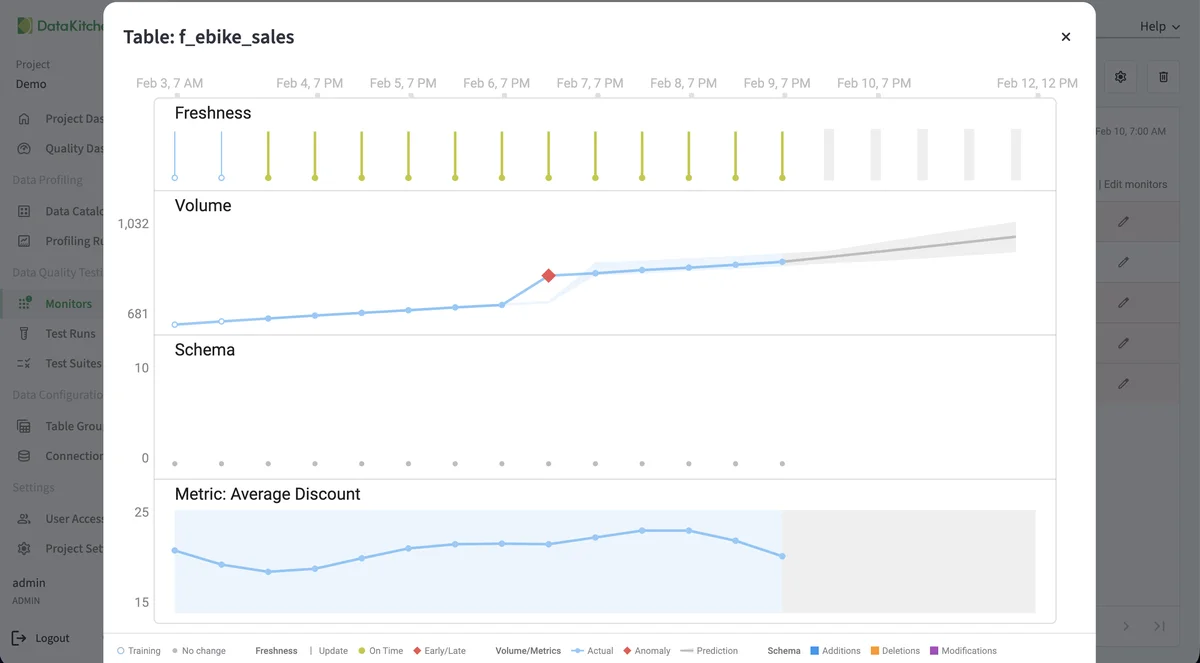
The four baseline checks cover most ingestion failures. The fifth covers the one your team actually cares about. Maybe it's the average sale price after the daily ETL. Maybe it's the count of distinct customer IDs in a CRM dump. Maybe it's whether the timestamp range covers the full business day. Write a custom monitor as a SQL expression. TestGen takes care of running it on every refresh and tracking the trend. You don't manage cron jobs or alerting infrastructure.
Catch errors before they become problems
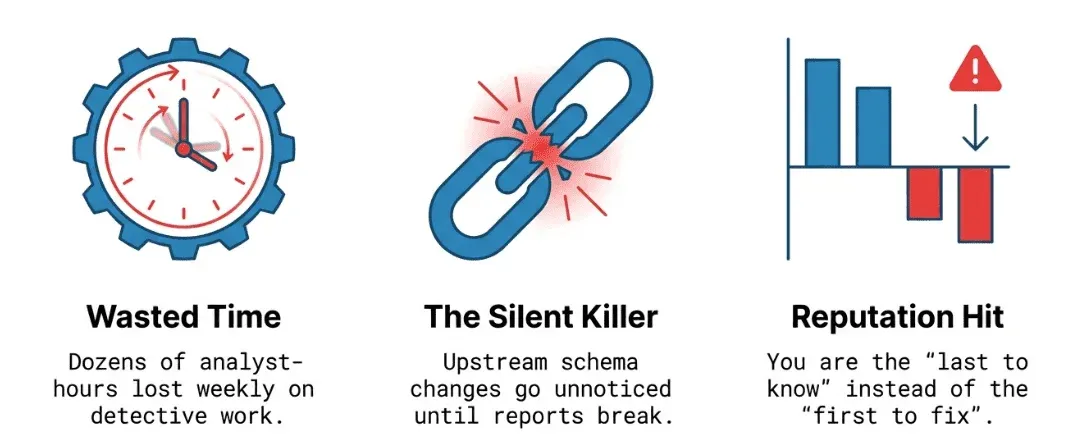
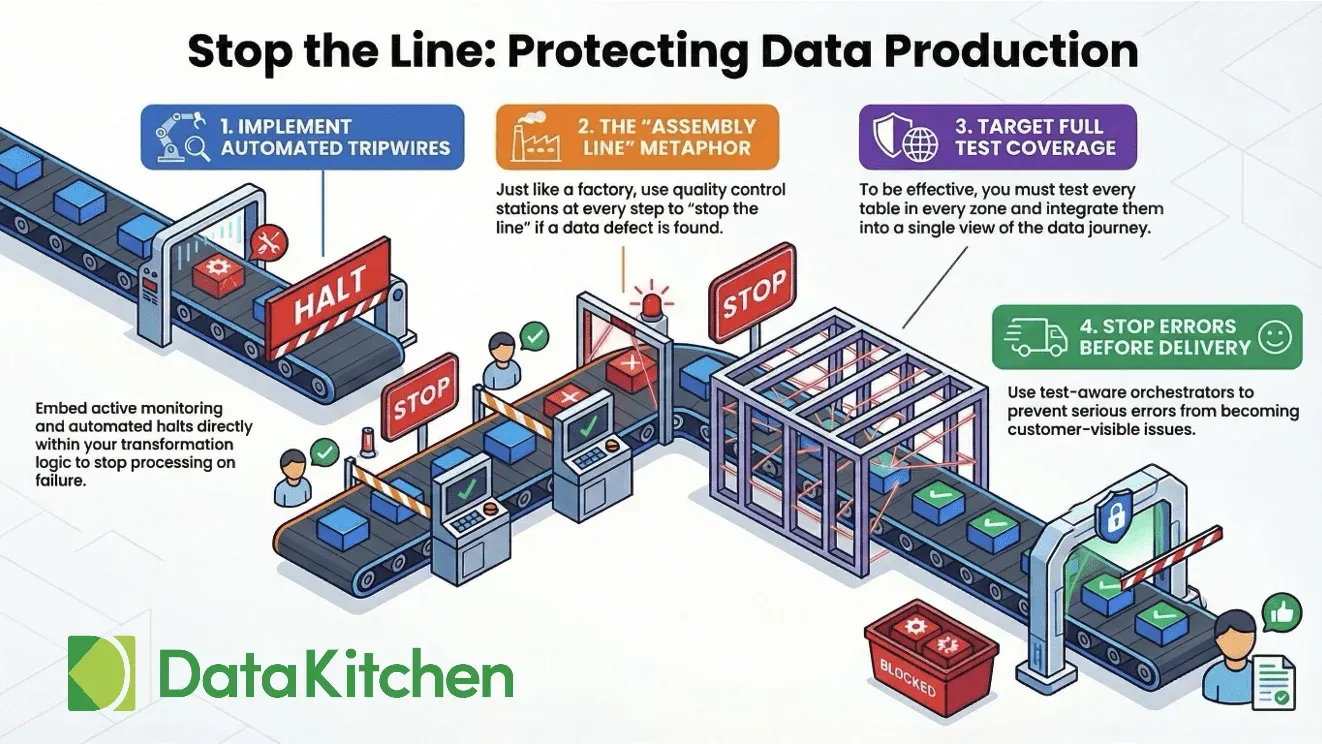
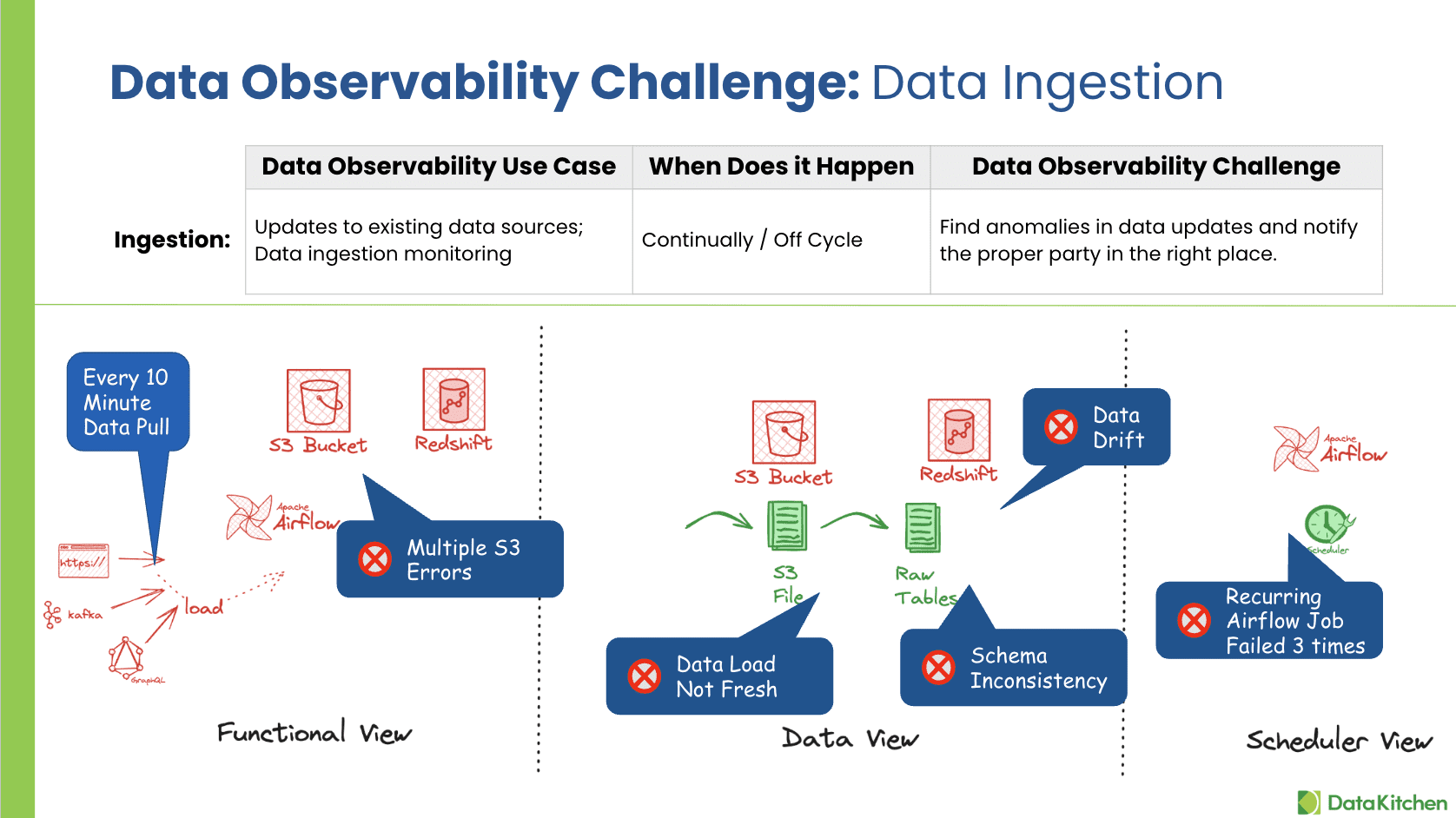
Your dashboard shows the wrong number at 9am on Monday and a VP is on the phone by 9:15. The cost of finding a data error at the source is about a dollar a record. The cost when the customer finds it is a hundred. TestGen runs at ingestion, before the data flows downstream. Tag a failing test as a tripwire and the next pipeline step doesn't run until you fix it. Your downstream tables stay on the last good data. The Monday-morning ticket doesn't happen.
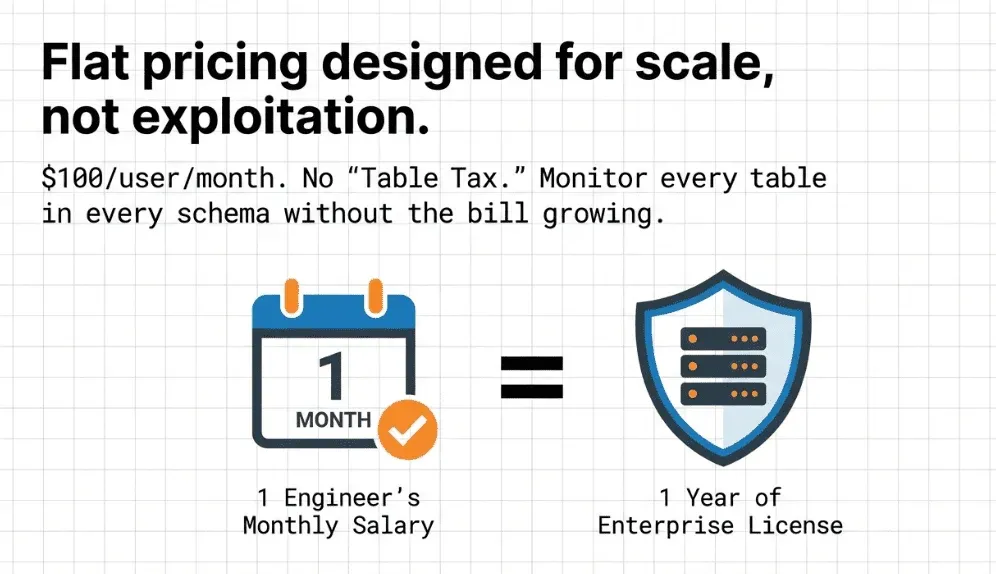
Open source. Low cost. No table tax
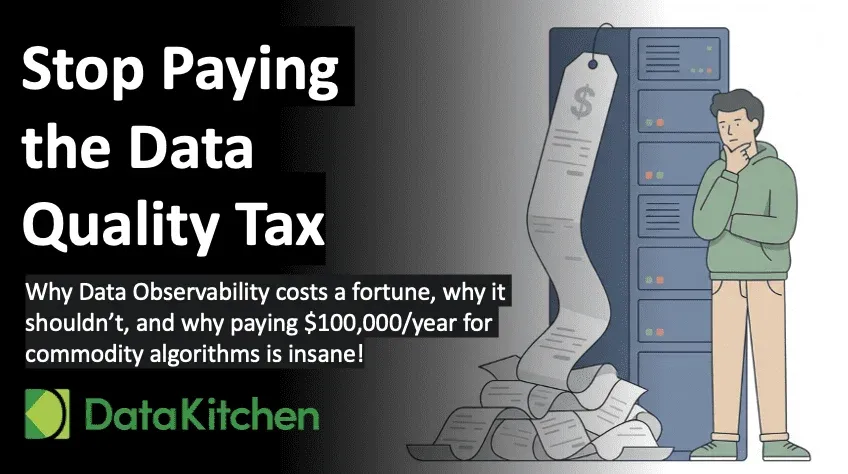
TestGen is open source and ships in a Docker container. Stand it up against PostgreSQL, Snowflake, Redshift, BigQuery, Databricks, Oracle, SAP HANA, or any of the other supported databases in 15 minutes. No per-row pricing. No table tax. No consultant required. The Enterprise edition adds collaboration features for larger teams, but the Monitors and anomaly-detection engine that ingestion teams rely on is in the free version. The source is on GitHub.
Answers
Questions this page answers
- How do you check vendor CSV, Excel, and Parquet files before they break your reports?Profile and test vendor files where they land, before the load. What DataOps TestGen reads directly (CSV, Parquet, JSON), and why Excel needs a CSV first.Read the answer →
- Why does data observability miss freshness failures and schema drift?Observability tools watch freshness and schema yet still miss late and reshaped data. Five reasons, from muted monitors to breaks before the warehouse.Read the answer →
- How do you reduce false-positive data alerts without missing real problems?Cut false-positive data alerts by fixing why they fire: seasonal baselines, warn-only starts for new tables, backfills, and rules for warn to block.Read the answer →
Stand up TestGen Monitors against your sources
Profile your ingestion tables, baseline the four health dimensions, and catch the next bad refresh before anyone files a ticket. Free, no vendor lock-in.
Frequently Asked Questions
Common questions about DataOps Software for Data Ingestion Teams
What is data ingestion?
Data ingestion is the movement of data from source systems into your platform, before any transformation for analytics. It is where schema changes, partial files and unexpected nulls arrive, usually without warning from the source, which makes it the cheapest place to catch a problem and the most expensive place to miss one.
What data quality problems do ingestion teams face?
Sources that change without telling you. Schema shifts, vendors sending half a file, a column that was always populated arriving null. The data is structurally valid, so nothing errors, and the problem surfaces days later in a report somebody trusted.
How do you catch a partial file at ingestion?
Test volume against the feed's own history rather than a fixed threshold. A file that should carry 40,000 rows and arrives with half looks perfect on every content check. Only a volume comparison against what normal looks like for that feed catches it before it propagates.
How do you detect schema drift from a source?
Monitor the schema itself, not just the values. A new column arriving silently, a renamed field, or a type change will pass row-level validation entirely. Schema monitoring reports the change as an event, which is the signal ingestion teams most often lack.
Can you hold external data suppliers accountable?
You can measure them precisely, which is most of it. Source-level metrics on error rate, timeliness, and volume tell you which supplier is responsible and by how much. That converts a vague complaint into a specific, dated claim, though enforcement still depends on your commercial leverage.
Where should ingestion tests run?
At the landing zone, before anything transforms the data, so a bad feed is caught while it is still attributable to its source. Testing later means the error is entangled with your own transformations and takes far longer to trace back.
How much of this can be automated?
The mechanical majority. Freshness, volume, and schema monitors generate from a profiling run, with baselines learned from each feed's history. What still needs a person is the business logic specific to your domain, which a profiler has no way to infer.