Data Contracts · in TestGen since November 2026
A data contract is a promise with consequences
Someone commits to delivering data in a specific shape, at a specific cadence, within specific bounds. TestGen puts a test behind every quality rule. Data contracts shipped in TestGen on November 12, 2026.
Key points
- A data contract is a promise with consequences: someone commits to a specific shape, at a specific cadence, within specific bounds.
- A contract nobody tests is a document. TestGen puts a test behind every quality rule in it.
- Data contract initiatives fail when the contract lives in a wiki and the enforcement lives nowhere.
- Handing the contract to the supplier moves the fix upstream, where it is cheapest to make.
“So much of what we do involves business questions that are fire drills. Executives don't trust our analytics. DataKitchen enabled us to deliver over 10,000 data quality validation tests that run every release. Now, they trust us.”
One view, every contract
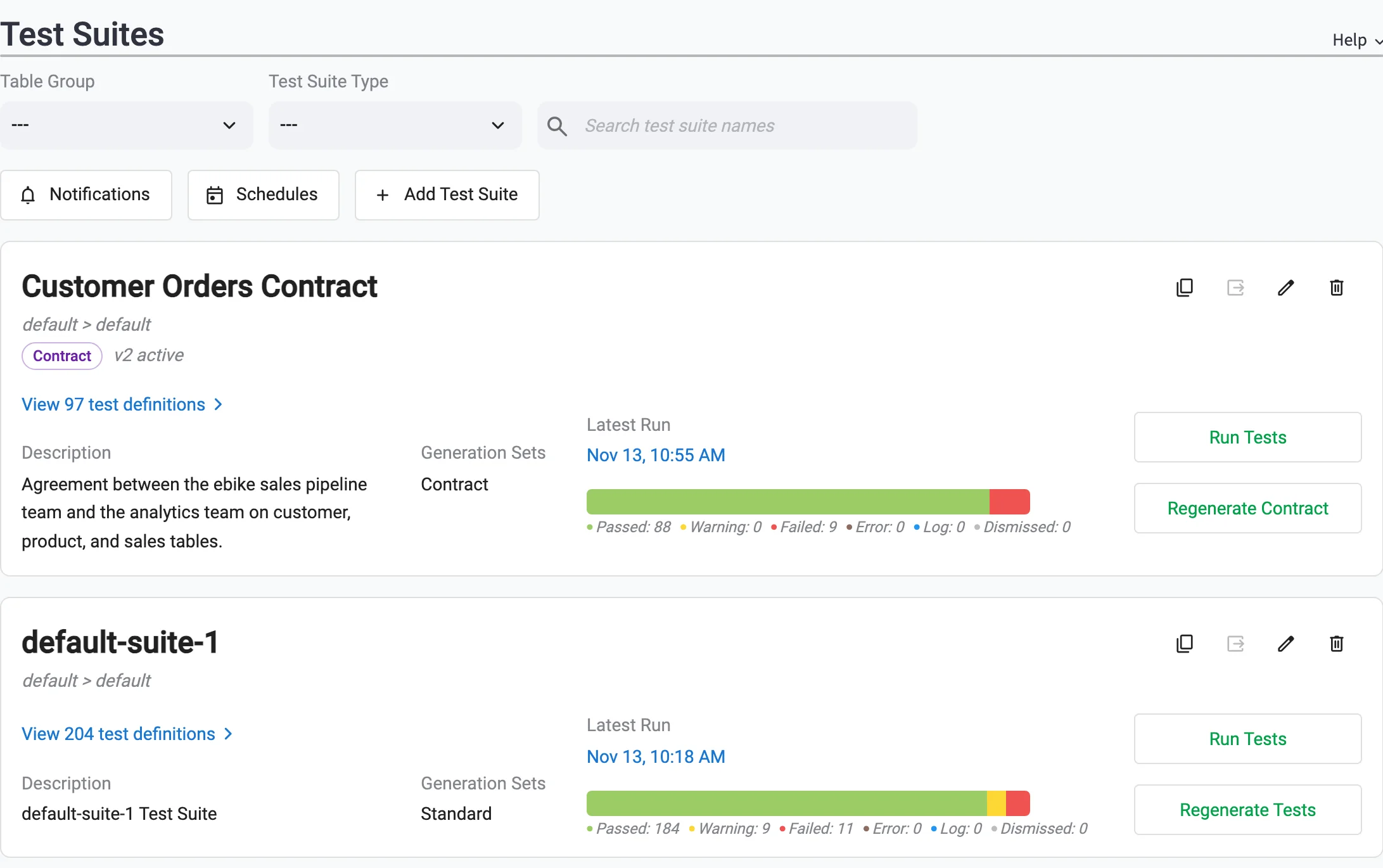
In TestGen since November 12, 2026. Every supplier, every output, every internal pipeline in one list. Test Suites shows each contract with a Contract badge, its active version, and the latest run's passed and failed tests. No dashboards to build. No dashboards to maintain.
Every quality rule, tested
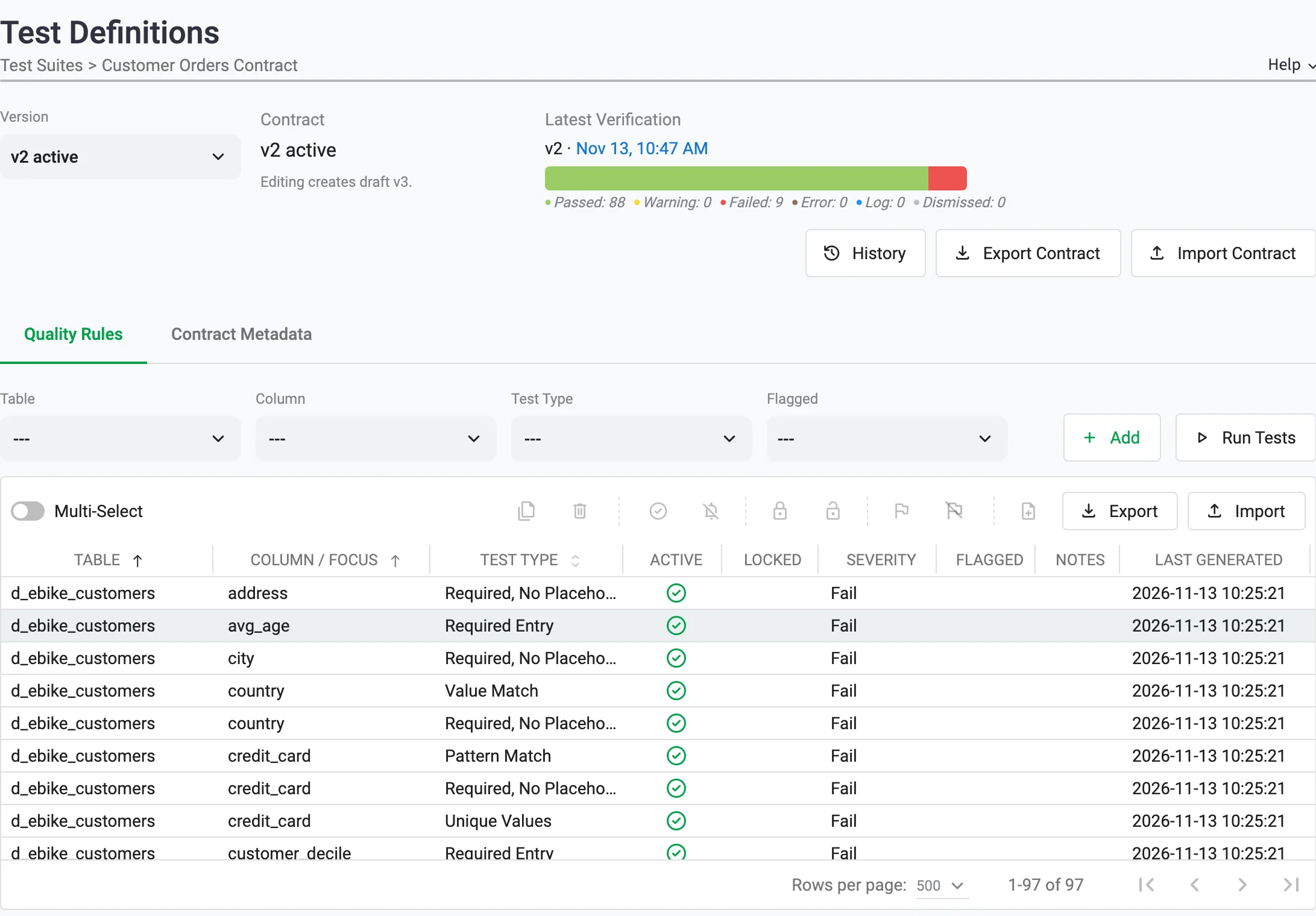
In TestGen since November 12, 2026. The contract page lists its quality rules. Null rules, value ranges, patterns, uniqueness, freshness, volume. Each declared table also gets a Schema Conformance test. When a rule fails, you see the table, the column, and the threshold it missed. Compare any two versions to see what changed.
Hand the contract to your supplier
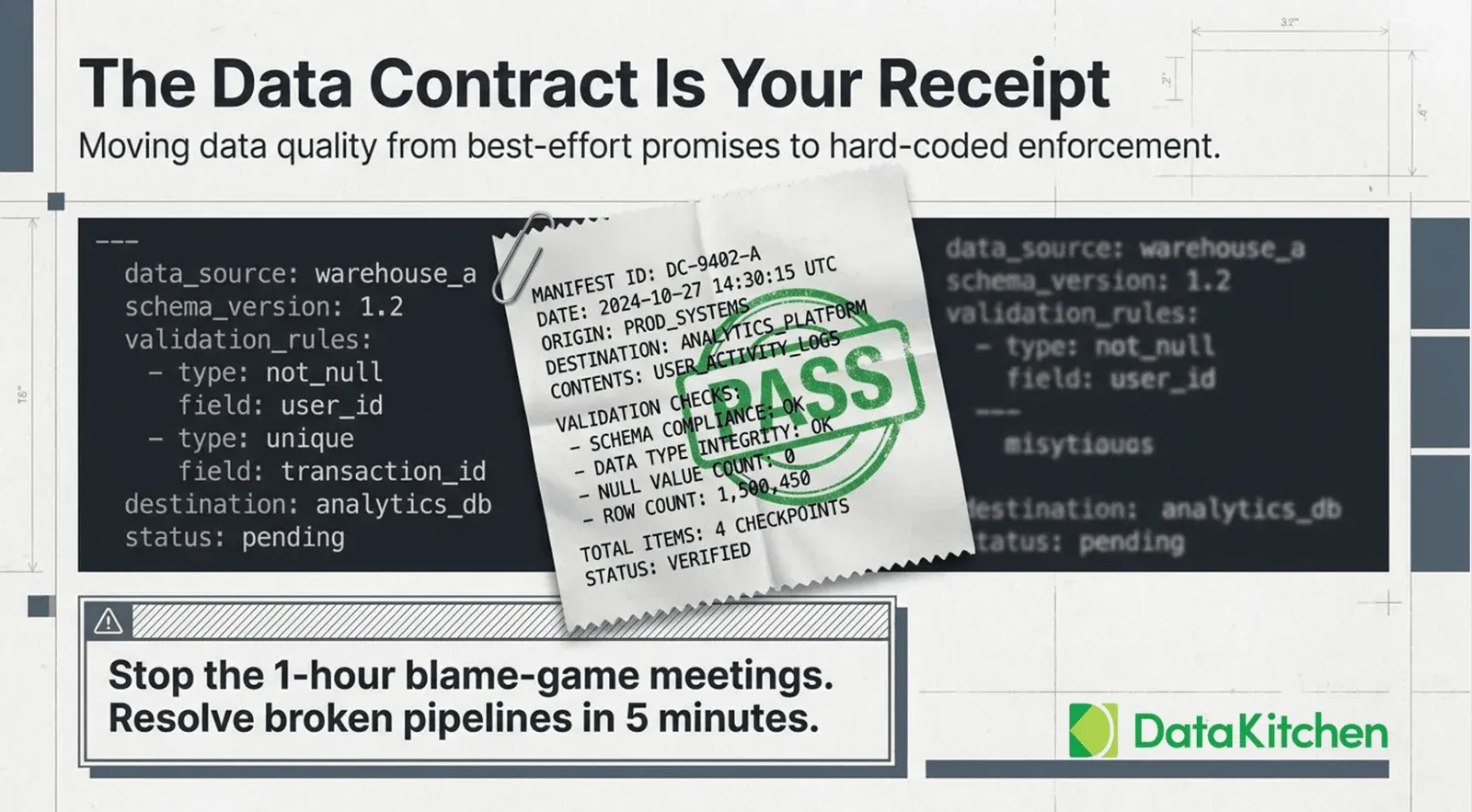
TestGen is open source. Free, no account, no seat count. Send your supplier the tool and the contract. They install it in 10 minutes, run it before they ship, and you never see a broken file. Stop playing goalie.
Answers
Questions this page answers
- What should a commercial data vendor file specification and acceptance agreement include? A reusable checklist for a pharma vendor file spec: grain, cadence, control totals, definitions, identifiers, corrections, change notice, and acceptance. Read the answer →
- How do you check vendor CSV, Excel, and Parquet files before they break your reports? Profile and test vendor files where they land, before the load. What DataOps TestGen reads directly (CSV, Parquet, JSON), and why Excel needs a CSV first. Read the answer →
- What is shift-left data quality testing? Shift-left data quality testing moves checks toward the source on the data production line. Shift down moves them into the deployment path. Why both pay. Read the answer →
Start with one contract
Pick the export you're most nervous about shipping, or the supplier who sends you the most garbage. Write one contract. Run it for a month.
Frequently Asked Questions
Common questions about Data Contracts
What is a data contract?
A data contract is an enforceable agreement about what a dataset contains: its schema, value constraints, freshness, and who is accountable when those break. The useful version has a test behind every clause, so the contract is evidence that ran last night rather than a document somebody wrote once.
How do you enforce a data contract?
By turning each clause into a test that runs on a schedule and reports pass or fail. Enforcement is the difference between a contract and a wish. Without the test, a breach is discovered by whoever consumes the data, which is exactly the situation the contract was meant to prevent.
Why do data contract initiatives fail?
Because teams treat them as legal negotiations rather than as receipts. Six weeks of meetings produce a PDF nobody checks. Starting with one dataset, encoding what you already promise informally, and shipping the passing test alongside the data teaches more than a program that tries to contract everything at once.
What should a data contract specify?
Which columns exist and their types, which fields are never null, acceptable value ranges, expected freshness, and expected volume. Each of those maps to a test. Anything you cannot express as a test is a preference rather than a contract term.
Do data contracts help with AI?
Yes, and it is the case that matters most. AI consumes data without a human reviewing it, so there is no step where somebody notices a column changed meaning. A contract is the checkpoint that catches a schema change or shifted value range before it reaches training or inference.
How do you start with data contracts?
Pick one dataset you already ship to somebody and write down what you implicitly promise about it. Turn each promise into a test. Publish the result with the data. One working receipt is more persuasive than a governance framework covering everything.