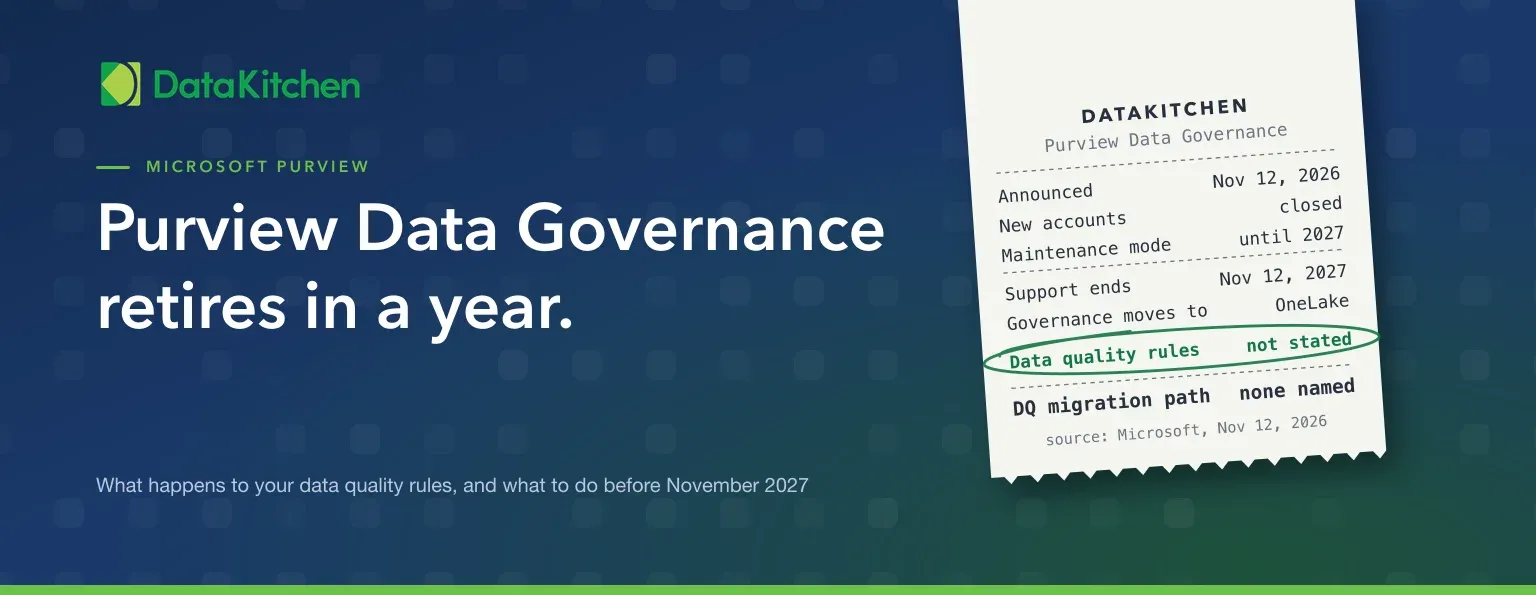
On November 12, 2026, Microsoft announced that Purview Data Governance will be retired, with support ending November 12, 2027. Governance moves to the OneLake catalog in Microsoft Fabric. Purview keeps its data security and compliance work.
The words “data quality” do not appear anywhere in the announcement.
If your team built data quality rules in Purview, that omission is the whole story. You have a year. Here is what is in scope, what Microsoft hasn’t said, and what to do with the time.
What Microsoft is retiring
The announcement says “Purview Data Governance will be retired a year from now.” Microsoft’s own documentation is more specific. The banner now on its data quality overview page says that Microsoft Purview Unified Catalog and the classic data governance capabilities, formerly Azure Purview, are being retired. The same banner says new data governance accounts can no longer be created, and that existing capabilities stay in maintenance mode through November 12, 2027.
Microsoft’s billing documentation defines its data governance solutions as Unified Catalog and the Purview Data Map. Read together, the notice reaches the catalog, the data map, and everything built on them.
What stays is the rest of Purview: classifying, labeling, and protecting sensitive data, preventing data loss, and compliance. Microsoft says those features are unaffected and that it will keep investing in them. “Microsoft Purview as a whole is not being retired,” the banner says.
Where your data quality rules live today
Purview’s data quality features sit inside Unified Catalog. Microsoft’s documentation describes no-code and low-code rules, some out of the box and some AI-generated, across six dimensions: completeness, consistency, conformity, accuracy, freshness, and uniqueness. Scores roll up from the rule to the data asset, the data product, and the governance domain. Scans run on a schedule on Apache Spark, with profiling, alerts, and an actions center, and the compute bills in Data Governance Processing Units (DGPUs).
That is the product being retired. A team that adopted it has rules, thresholds, score history, and alert routing inside a catalog whose support ends in a year.
What the announcement does not say
Four gaps, each worth an email to your Microsoft account team:
- Whether data quality moves at all. The announcement describes the OneLake catalog in terms of discovery, governance, security, lineage, policies, endorsements, and stewardship. It does not describe data quality rules or scans in Fabric. Neither does the data quality documentation.
- How rules and history migrate. Microsoft says detailed transition guidance is available, but nothing in the announcement or the data quality documentation names a migration path for rules, scores, or scan history.
- Which sources Fabric covers. Microsoft says the OneLake catalog can govern data across Fabric, Azure, and third-party sources “through shortcuts, mirroring, and supported connectors.” It does not list them. Purview scanned on-premises SQL Server and several clouds. If your estate does not live in OneLake, check source by source.
- What it costs afterward. Microsoft says governance in Fabric comes with Fabric capacity instead of separate meters. Whether that covers data quality compute, and what happens to DGPU billing between now and November 2027, is not stated.
Microsoft does acknowledge the gap. “Some organizations have needs that reach beyond what’s in Fabric today,” the announcement says, and it names Atlan, Alation, Collibra, and Informatica as partners.
What to do this year
Migrate once. Move your rules somewhere you own, not to the next catalog that owns them for you.
- Inventory now, while everything still runs. Export every rule, its threshold, the asset it covers, and its score history. Maintenance mode means the product works. It doesn’t mean it gets better, and a year goes fast.
- Map your sources. List every table your rules cover and mark which ones live in Fabric or OneLake and which do not. On-premises SQL Server, Azure SQL, Snowflake, and Databricks sources are the ones Microsoft has not named.
- Separate the catalog decision from the data quality decision. You may well move governance to the OneLake catalog. That does not mean your tests have to move with it. Catalogs change owners, products, and strategies. The test that checks your revenue table should not.
- Pick a format you own. A rule stored in a vendor’s catalog is a row in someone else’s database. A test written as SQL that runs in your own database moves with you.
- Talk to Microsoft early if you’re regulated. That’s Microsoft’s own advice for customers with contractual obligations or in highly regulated industries. It’s good advice.
Where TestGen fits
We build DataOps TestGen, so weigh this section accordingly.
TestGen is a data quality tool, not a catalog, and it does not replace Purview’s governance features: no sensitivity labels, no access policies. What it replaces is the data quality layer. It connects to SQL Server, Azure SQL Database, Azure Synapse Analytics, Microsoft OneLake, Databricks, Snowflake, and other databases. It profiles every column and generates tests from the profile: 34 of its 55 test types write themselves. The tests run as SQL inside your own database, so no rows leave it. Freshness, volume, and schema monitors run on every table without anyone writing a rule.
It does not depend on Purview or Fabric, so the next platform decision Microsoft makes does not reach it. The open-source edition is Apache 2.0 and free for one user, one database connection, and one project. TestGen Enterprise is $100 per user per month plus $100 per database connection per month. The side-by-side is on our TestGen vs Microsoft Purview comparison.
The pattern
Purview is not the first data quality product this year to get an end date. GX Cloud shut down on June 1, 2026 with about 30 days’ notice. Microsoft gave a year, which is far more generous. The lesson is the same. A vendor’s plan for its product is not your plan, whether the vendor is a venture-funded startup or Microsoft. We keep a running map of who owns whom in the 2026 data quality and data observability landscape.
The question to ask of any data quality tool, from any vendor: if it disappeared next year, what would you keep?
FAQ
What are the key points in this blog?
Microsoft will retire Purview Data Governance, with support ending November 12, 2027. The retirement covers Unified Catalog, where Purview’s data quality rules, scores, and scans live, but the announcement never mentions data quality and names no migration path for it. Teams should inventory their rules now, map which sources sit outside Fabric, and move to a data quality setup they own before the deadline.
When does Microsoft Purview Data Governance support end?
Support ends November 12, 2027. Microsoft announced the retirement on November 12, 2026, stopped new data governance account creation, and put existing capabilities in maintenance mode until the end date. Purview as a whole is not being retired: its data security and compliance features continue.
Is Purview data quality being retired?
It sits inside the retiring product. Microsoft’s data quality documentation places data quality in Unified Catalog, and the retirement notice covers Unified Catalog and the classic data governance capabilities. Microsoft has not said whether data quality rules, scores, or scan history move to Microsoft Fabric, and no migration tooling for them has been named.
Where does Purview data governance go after the retirement?
To the OneLake catalog in Microsoft Fabric. Microsoft says the OneLake catalog becomes its single foundation for governing data and reaches Azure and third-party sources through shortcuts, mirroring, and supported connectors. It also names Atlan, Alation, Collibra, and Informatica as partners for needs beyond what Fabric covers today.
What should a Purview data quality team do now?
Start with an inventory: export every rule, its threshold, and the scores it produced, and list which sources sit outside Fabric. Then decide where data quality should live long term, so you migrate once rather than twice. Regulated teams should follow Microsoft’s own advice and talk to their account team early.
Can TestGen replace Purview data quality on SQL Server and Azure?
For the data quality part, yes. DataOps TestGen runs its tests as SQL inside SQL Server, Azure SQL Database, Azure Synapse Analytics, Microsoft OneLake, Databricks, and Snowflake, and generates them from a profile of every column. It does not replace Purview’s catalog features, such as sensitivity labels and policies. It is Apache 2.0, with an Enterprise edition at $100 per user and $100 per connection per month.