Leading software companies perform millions of code releases per year. Typical data-analytics organizations perform less than 10. This gap explains why most data-analytics projects fail to deliver. Without the capability to move at lightning speed, data analytics can’t adapt to fast-paced markets and keep up with the endless stream of requests generated by business users. Despite soaring levels of investment, the percentage of organizations that describe themselves as “data-driven” has fallen since 2017.
Software teams have faced similar challenges and found answers. The methods that yielded tremendous improvements in software development productivity can deliver similar results for data organizations. In the data industry, the process of going from 10 releases per year to millions is called “DataOps.”
DataOps enables data organizations to accelerate the development of new analytics, deploy confidently with the push of a button, and reduce data errors to virtually zero. This represents an orders-of-magnitude decrease in analytics cycle time and improvement in quality. Sound impossible? It’s already happened in software companies, like Amazon, Facebook, Netflix and many others. If your data organization neglects to modernize its processes, it risks being left behind in an increasingly “on-demand economy.”
Accelerating Your DataOps Initiative
The goal of DataOps is to enable the analytics team to keep pace with user requests. Data analysts and business users can unlock enormous creativity when they work closely together. When it takes six months to release a 20-line SQL change, innovation is stymied; users get frustrated.
Applying DataOps requires a combination of new methods and automation that augment an enterprise’s existing toolchain. Some organizations build DataOps capabilities from scratch, but the fastest way to realize the benefits of DataOps is to adopt an off-the-shelf DataOps Platform. As the DataOps Platform is a relatively new product category, unlike anything else on the market, there is still a general lack of understanding about how it delivers such significant improvements in analytics productivity and quality.
DataOps Platform
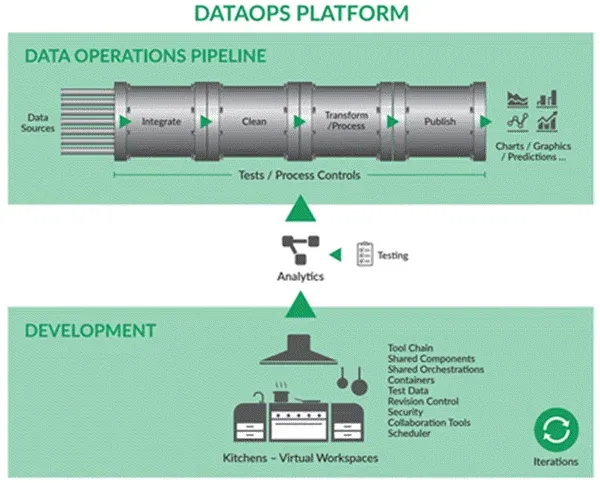
A DataOps Platform unifies the end-to-end workflow and processes related to data-analytics planning, development and operations into a single, common framework, improving overall collaboration. It incorporates your existing tools into automated orchestrations that drive analytics creation and the transformation of raw data to insights. The DataOps Platform accomplishes this goal by managing the creation, deployment and production execution of analytics. DataOps Platforms offer four fundamental capabilities:
-
Spins up safe and synchronized workspaces – Using virtualization, DataOps separates and harmonizes your production and development environments. Aligning the two technical environments avoids unexpected errors during deployment. Access control secures each workspace and domain. When it’s time to start a new project, data scientists spin up self-serve development sandboxes in minutes – this includes test data, validation tests, tools, a password vault, – in short, everything they need. No more waiting months for IT.
-
Automates deployment – New analytics pass extensive validation tests and seamlessly move from development to production engineering and then operations, with a few clicks. Verification tests replace your impact review board, minimizing the time and effort required to deploy.
-
Orchestrates, tests, and monitors the data pipeline – Data flows in from hundreds or thousands of sources and is integrated, cleaned, processed and published in analytics. As millions of data points flow through the pipeline, tests distributed throughout the data pipeline monitor work in progress and check data for anomalies. Virtually zero errors reach user analytics. When errors are found, DataOps takes appropriate action based on severity: warnings, alerts, or even suspension of a data source. Dashboards that summarize test results and activity provide unprecedented visibility into operations and development. The DataOps Platform provides quality and productivity metrics, showing the progress of your DataOps initiative.
-
Fosters Collaboration – DataOps automates workflows to coordinate tasks and improve teamwork. Workspace environments provide the structure to move analytics through the development workflow, from person to person, eventually reaching production. Sandboxes feature reusable analytics components saving time and enforcing standardization. Coupled with source control, workspaces branch and merge, providing centralized control of artifacts. With a DataOps Platform, everyone has a common view of the development and operations pipelines.
Focusing on Value Add
With an orchestrated data operations pipeline, quality controls and an automated development workflow, the DataOps Platform minimizes unplanned work. Task coordination between team members and groups leads to a more transparent and robust workflow. DataOps tests virtually eliminate data errors. The DataOps Platform enables data professionals to develop and deploy new analytics at lightning speed, delighting users and delivering insights that meaningfully impact the enterprise’s goals and initiatives.
To learn more about how a DataOps Platform can help your data organization develop analytics at lightning speed and eliminate errors, contact us at datakitchen.io.
FAQ
What are the key points in this blog?
A DataOps platform unifies the planning, development, and operations of data analytics in a single framework, wrapping the tools an organization already owns in automated orchestrations. It offers four capabilities: synchronized self-service workspaces, automated deployment, an orchestrated pipeline with tests distributed through it, and collaboration through shared workspaces and source control. The target is a release cadence closer to software teams and virtually zero data errors.
What is a DataOps platform?
A DataOps platform unifies the end-to-end workflow and processes of data analytics planning, development, and operations into a single common framework, improving collaboration across the team. It incorporates existing tools into automated orchestrations that drive analytics creation and the transformation of raw data into insight, and it manages the creation, deployment, and production execution of those analytics.
What are the four capabilities of a DataOps platform?
Spinning up safe, synchronized workspaces, so development and production environments are harmonized and a data scientist gets a sandbox with test data, validation tests, and tools in minutes. Automating deployment, so new analytics pass validation tests and move to production in a few clicks. Orchestrating, testing, and monitoring the pipeline. And fostering collaboration through shared workspaces, reusable components, and source control.
How does a DataOps platform reduce data errors?
By testing data in flight rather than inspecting it afterwards. Tests distributed throughout the pipeline monitor work in progress and check data for anomalies as millions of data points flow through, so virtually zero errors reach user analytics. When a test fails, the response matches the severity: a warning, an alert, or suspension of the offending data source.
Why do data teams release so much more slowly than software teams?
Manual process, not lack of effort. Typical data analytics organizations perform fewer than 10 releases a year where leading software companies perform millions, because each change waits on environment setup, an impact review board, and hand-checked verification. When it takes six months to release a 20-line SQL change, innovation stalls and business users get frustrated.
Do you have to build DataOps capabilities from scratch?
No. Some organizations build DataOps capabilities from scratch, but adopting an off-the-shelf DataOps platform is the faster route to the same benefits, and it augments the existing toolchain rather than replacing it. Either way the goal is the same: keep the analytics team in step with user requests instead of making users wait months for a change.