9 vendors Reviewed Apr 2026
Best traditional data quality tools
The big-name enterprise data quality suites scored against DataKitchen TestGen. Strong on profiling and matching. Weak on price, on cloud-native deployment, and on auto-generated tests.
Deep on profiling, deep on parsing, deep into your budget.
Traditional data quality vendors built their tooling for on-prem analytics. The features are real. So is the six-figure list price and the deployment burden. TestGen does the same auto-profiling and auto-test generation in a Docker container, priced per user and per database connection.
All 9 vendors at a glance
Sorted by closest to TestGen first. Click any row to read the full comparison.
| Vendor | Est. price | License | Auto tests | Profiling | Scoring | Pipeline obs | |
|---|---|---|---|---|---|---|---|
 DataKitchen TestGen OSS + Enterprise | $0 OSS / $12K-$36K Ent. | Apache 2.0 + Commercial | Yes | Yes | Yes | Via DK Obser… | Product page → |
 Ataccama ONE | $150K-$400K | Proprietary | Partial | Yes | Yes | Yes | Compare → |
 Informatica Data Quality / IDMC | $200K-$500K+ | Proprietary | Partial | Yes | Yes | Yes | Compare → |
 IBM InfoSphere QualityStage | $150K-$400K | Proprietary | No | Yes | Partial | Partial | Compare → |
 Oracle Enterprise Data Quality | $150K-$400K | Proprietary | No | Yes | Yes | Partial | Compare → |
 Precisely Data Integrity Suite | $120K-$300K | Proprietary | No | Yes | Yes | Partial | Compare → |
 Qlik Talend | $100K-$300K | Proprietary | No | Yes | Yes | Partial | Compare → |
 SAP Data Services | $150K-$400K | Proprietary | No | Yes | Partial | Partial | Compare → |
 SAP Information Steward | $100K-$300K | Proprietary | No | Yes | Yes | No | Compare → |
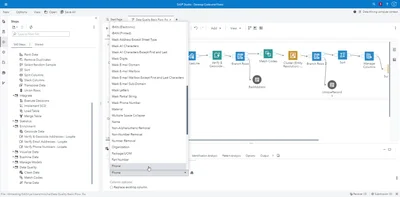 SAS Data Quality | $120K-$300K | Proprietary | No | Yes | Yes | Partial | Compare → |
How to read: Yes ships out of the box. Partial means limited or gated. No means absent. Prices are estimates at 10 users and 1,000 tables a year. Verify before purchase.
Try TestGen yourself
Install the open-source edition in five minutes. No card. No call.
Want to talk first? Request an enterprise demo or read the docs.
Frequently Asked Questions
Common questions about this category.
What are traditional data quality tools?
The established enterprise suites: Informatica Data Quality, SAP Data Services and Information Steward, Oracle Enterprise Data Quality, Ataccama ONE, Qlik Talend, IBM InfoSphere QualityStage, SAS Data Quality, and Precisely. They emphasize rules, cleansing, matching, and mastering rather than automated test generation.
How do traditional tools differ from modern data quality tools?
Traditional suites do cleansing, fuzzy matching, and survivorship, which modern observability vendors largely do not. Modern tools emphasize automated monitoring and anomaly detection, which the traditional suites largely do not. They solve adjacent problems and are often both present in one estate.
How much do traditional data quality platforms cost?
Typically $100,000 to $500,000 a year at 10 users and 1,000 tables, with Informatica at the high end. They are usually sold as custom enterprise agreements with consumption components, so the quoted figure and the eventual bill often differ.
Do traditional tools generate tests automatically?
Mostly no. Across this category, automated test generation is rare or partial, so rules are authored by hand. That is the practical constraint on coverage, and it is why teams with large estates end up testing only the tables somebody had time to configure.
Should I replace a traditional data quality platform?
Not necessarily, and often not entirely. If you rely on cleansing, matching, or mastering, no modern observability tool replaces that. What is frequently worth adding is automated test coverage across the estate, which the traditional suites do not provide.
What is the fastest way to compare these?
Run open-source TestGen against the same data your current platform covers and compare coverage and findings. It costs nothing, installs behind your firewall, and produces a concrete baseline, which is a stronger position than comparing feature lists.
Answers
Questions this page answers
- How do you evaluate a data quality tool on your own data in two weeks?A two-week trial plan for a data quality tool: pick your tables, plant failures you know the answer to, log setup and tuning hours, and score the results.Read the answer →
- How much does data quality and data observability software cost a small team in 2026?What a small data team pays for data quality and observability software in 2026, from $0 open source to six-figure enterprise contracts, with dated prices.Read the answer →
- What are the best open-source data profiling tools?Open-source data profiling tools compared: YData-Profiling, Deequ, DataCleaner, OpenRefine, GX Core, and DataOps TestGen, by depth and what each enforces.Read the answer →