The quote was an engineer’s yearly salary. The CFO said no.
For 10 users and 1,000 tables, TestGen Enterprise costs $15,600 a year. The rest of the field charges $60,000 to $400,000 for the same job.
A team signed with us last week. They’d spent two months evaluating one of the big-name observability tools and they liked it. Good demo, good UI, good sales engineer. Then the data lead took the quote to the CFO, who asked one question: which engineer are we letting go to pay for this?
Nobody had an answer, because the honest answer was “one of them.” The quote was a senior engineer’s salary. So the CFO said no, and the team came looking for something that didn’t require a layoff to afford.
One meeting, and it was over. Price is supposed to signal quality. Here it signals who the vendor’s investors are and how they bill.
Here’s the test. Take a team of 10 with three databases and 1,000 tables. Price that team on every tool in the category that will tell you a number. Then price it on TestGen Enterprise. TestGen comes to $15,600 a year. That’s about one month of one data engineer’s salary. The field runs from $60,000 to $400,000 for the same coverage, and the median lands near $150,000. That’s the engineer’s whole year, and in some cases two engineers.
That’s a 10x gap. If the expensive tools did 10x more, fine. They don’t. They do about the same thing as each other: 55 vendors, mostly converged on capability, running the same open source anomaly algorithms wrapped in a nicer basket. They watch row counts and freshness and call it quality. The real difference is at the bottom of the invoice.
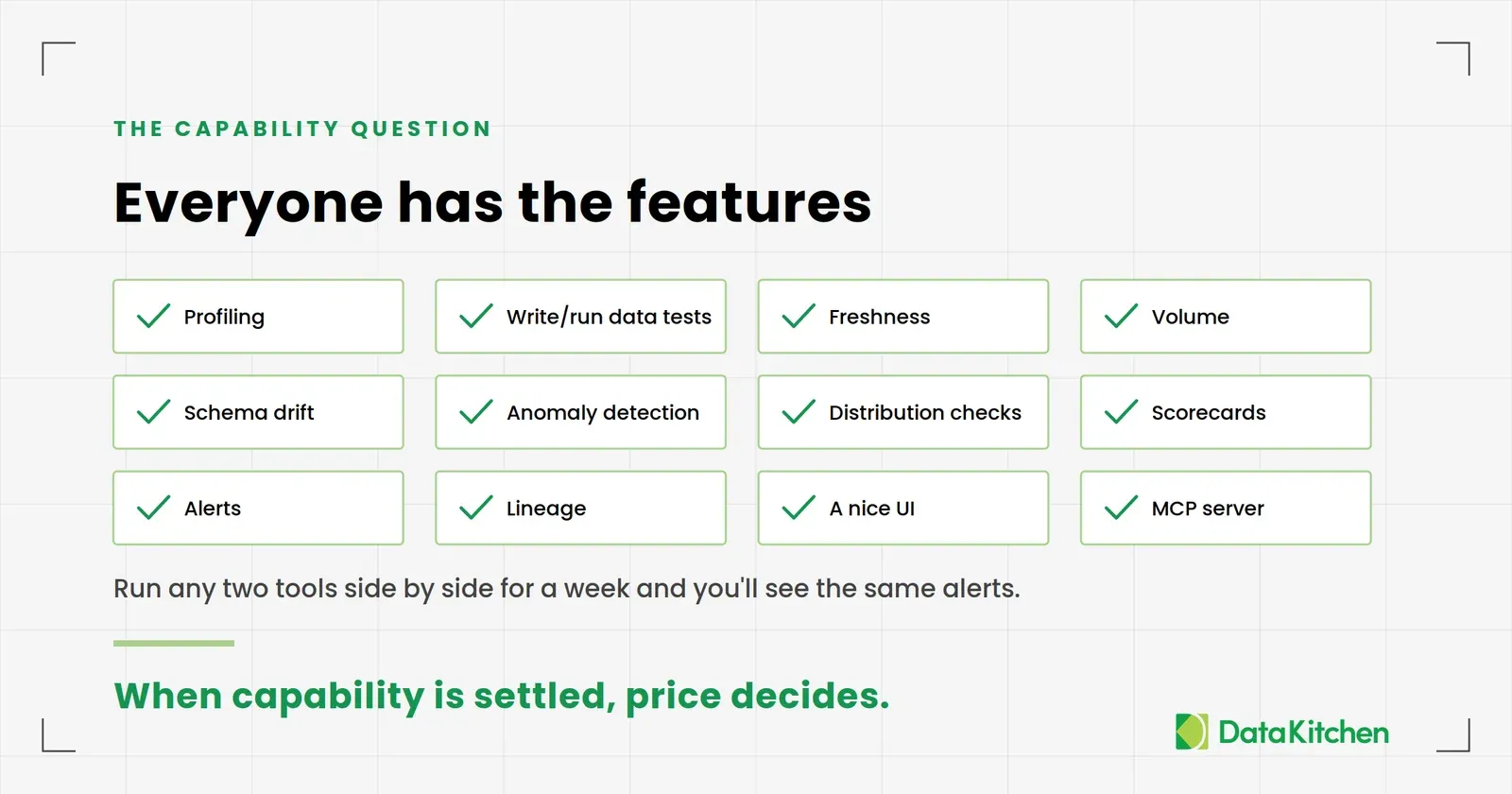
So here’s the claim, flatly. TestGen is the cheapest data quality and observability tool on the market. I won’t tell you it’s the best one. After 55 vendors the feature list stopped being the interesting question. Profiling, generated tests, freshness, volume, schema drift, anomaly detection, scorecards, an MCP server: everyone has them, and buyers know how to measure them. When capability is settled and the price spread is 10x, price decides.
You don’t get what you pay for. You get what the vendor needs you to pay.
The receipts
Same team, same data: 10 users, three database connections, 1,000 tables, one year. Vendor figures come from the DataKitchen comparison matrix, reviewed quarterly, cross-checked against DataTrail’s roundup of AWS Marketplace list prices and, where a vendor publishes nothing, the medians Vendr reports from contracts its buyers actually signed. Prices as of October 2026.
| Tool | Annual cost, 1,000 tables | How they bill | License |
|---|---|---|---|
| TestGen Enterprise | $15,600 | $100 per user and per connection per month; tables unlimited | Apache 2.0 core |
| Soda Team | ~$103,000 | $750/mo base for 20 tables, then $8 per table per month | Elastic License 2.0 |
| Bigeye | $80,000 to $180,000 | Per table; AWS list $45K/100 tables, $75K/300 | Proprietary |
| Sifflet | $70,000 to $160,000 | Per table; AWS list $48K/500 tables | Proprietary |
| Metaplane (Datadog) | $60,000 to $150,000 | Per table; Datadog lists $16/table/mo annual | Proprietary |
| DQLabs | $60,000 to $150,000 | Custom; AWS list ~$140K | Proprietary |
| Anomalo | $100,000 to $200,000 | Custom; Vendr median ~$115K | Proprietary |
| Monte Carlo | $120,000 to $250,000 | Credits; $0.18 Start, $0.28 Scale per credit | Proprietary |
| Acceldata | $150,000 to $350,000 | Units sized on TB processed, from $5K | Proprietary |
| Collibra DQ & Observability | $150,000 to $400,000 | Platform; Vendr median ~$197K | Proprietary |
| Informatica IDMC | $200,000 to $500,000+ | Platform, IPU consumption | Proprietary |
Most of the category won’t tell you the price at all. Bigeye, Anomalo, Sifflet, Acceldata, Validio, Datafold, Collibra, and Ataccama route you to a sales call. Four publish something: Soda at $750 a month, Metaplane through Datadog’s price list at $16 per monitored table, Monte Carlo’s per-credit rates on its order forms, and DQOps at $600 a month for one user and 200 tables. Run the 1,000-table scenario through any of them and you land above TestGen Enterprise, usually by a lot. Below that scenario the honest answer changes: a one-person team on DQOps or Metaplane’s free tier pays less than $15,600. Compare those to TestGen open source, which is also free, has no table cap, and writes the tests itself.
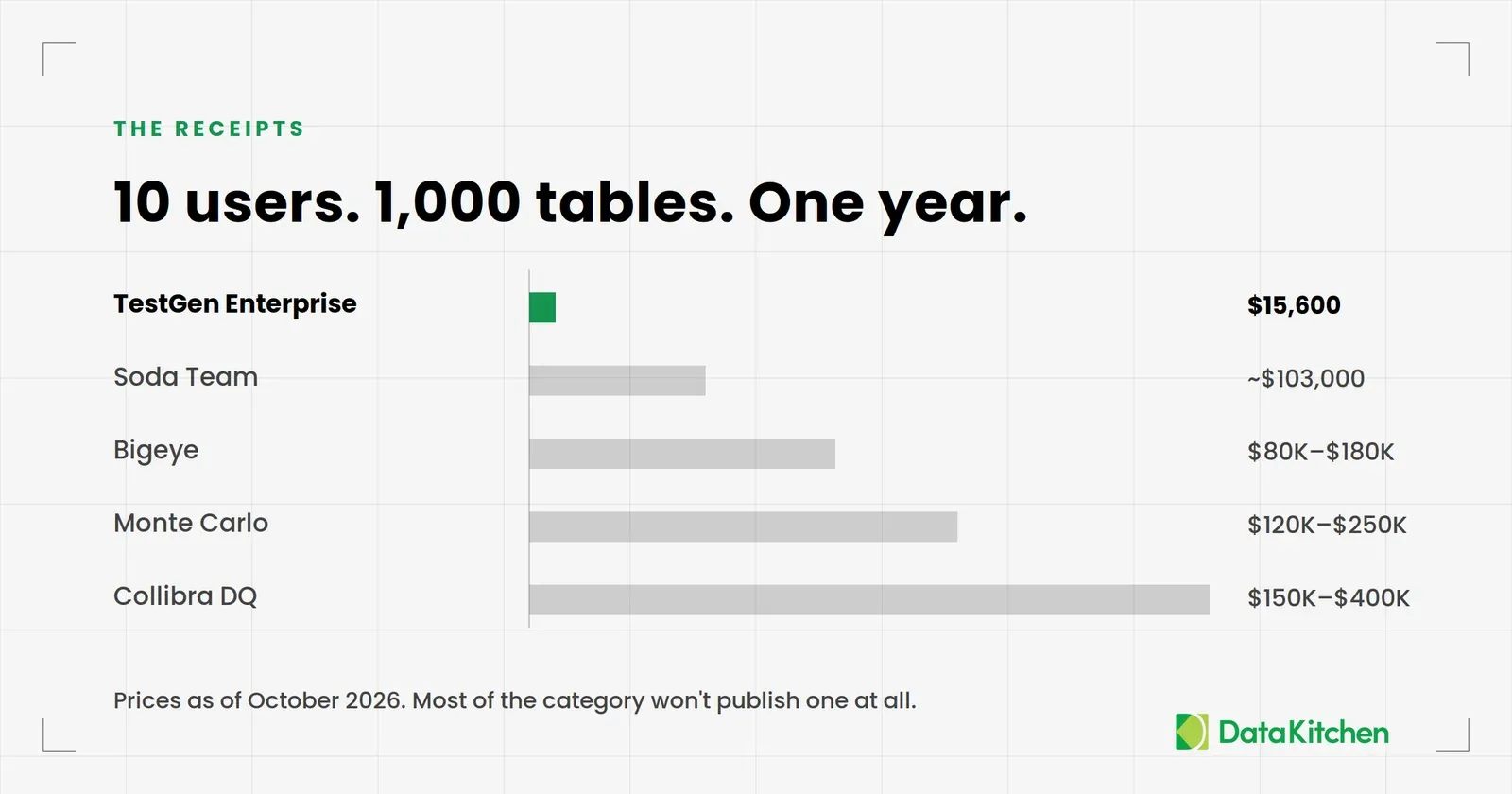
Soda is the number to stare at, because it’s the most transparent full-featured tool in the category and it still lands here. Soda publishes its price, so do the math yourself: $750 a month covers 20 tables, then $8 a month for each one after. At 1,000 tables that’s $8,590 a month. Six and a half times TestGen, and it climbs every time you add a table.
TestGen charges nothing for the 1,001st table. Or the 10,001st.
And $15,600 is the expensive option. TestGen open source is Apache 2.0 and costs nothing: profiling, generated tests, anomaly monitors, scorecards, every supported database, unlimited tables, unlimited runs. No “community edition” with the useful parts removed, no 30-day clock. One user, one connection, and you can run it against your whole warehouse tonight. Enterprise adds the team, SSO, role-based access, pharma tests, and people who answer the phone. Same engine underneath.
Why the gap exists
The anomaly detection inside every one of these tools is the same half page of Python. Prophet, ARIMA, z-scores, isolation forest. Open source libraries with university papers behind them. Load the model, feed it a time series, score the new point, check whether it’s inside the band. That’s the engine. It works, and it’s not proprietary. We wrote this up in Stop Paying the Data Quality Tax and nobody has written in to say we got the algorithms wrong.
So the price isn’t buying you better math. It’s buying three other things, and none of them is for you.
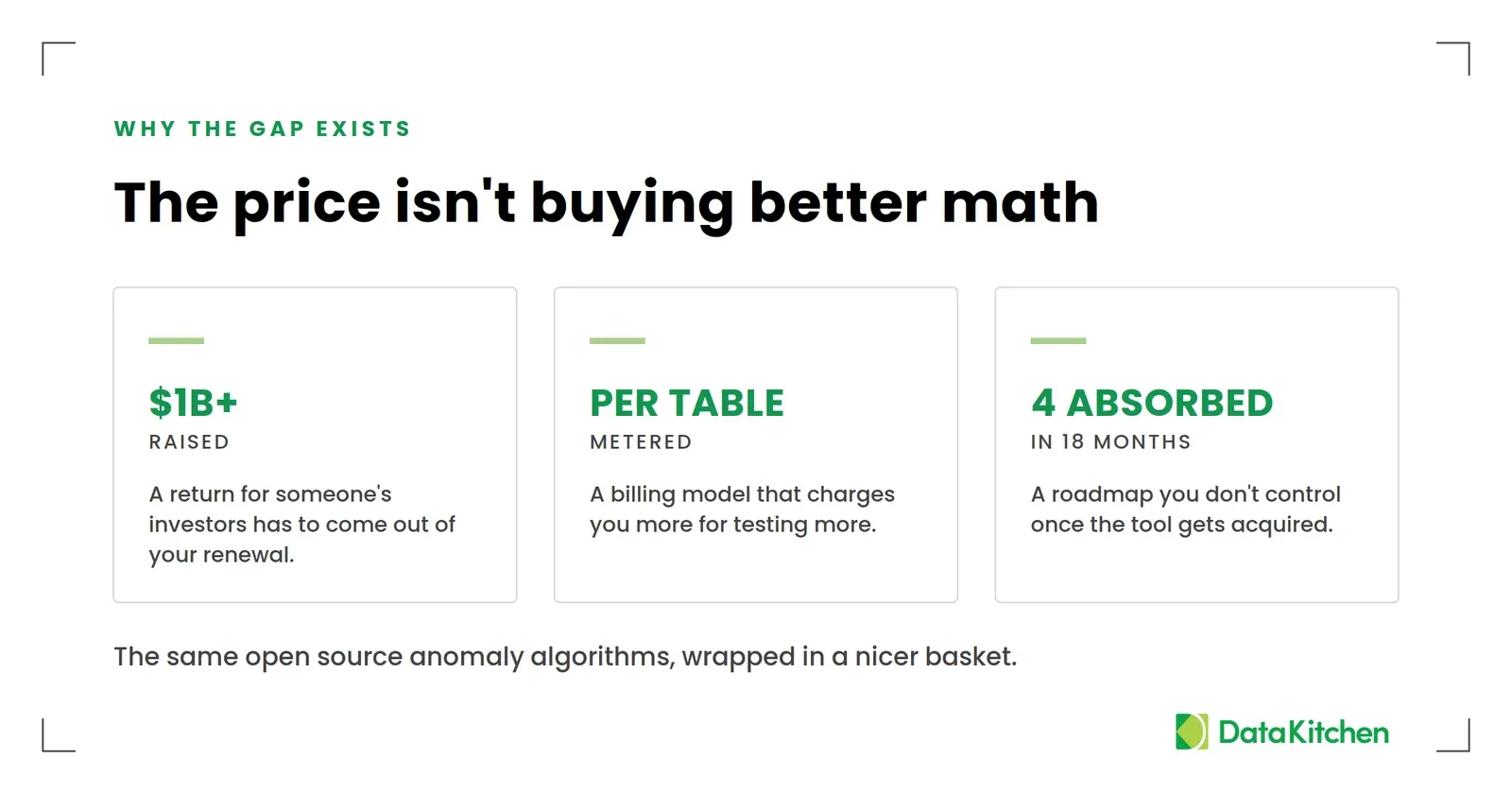
It’s buying a return for someone’s investors. Add up this category and you’re past a billion dollars. Monte Carlo alone raised $236 million, Acceldata about $106 million, Anomalo about $82 million, Bigeye about $71 million, and that’s before the governance platforms, where Collibra dwarfs them all.
That money has to come back out with a multiple on top, and it comes out of renewals. Monte Carlo is the one to watch: it raised the most, at the highest valuation, in a category where capability has converged and the warehouses give away the entry-level features. Three endings fit that math. A much bigger price per customer, an acquisition like the four we just watched, or a down round. None is good for a team that standardized on it three years ago, and the meter is how the first one arrives without a sales call.
It’s buying a billing model that punishes coverage. Per table, per credit, per terabyte: every one of these turns the right engineering decision, test everything, into the expensive one. You end up monitoring your 200 most important tables and hoping about the rest. The vendor calls that a reasonable starting point. It’s a revenue plan, and the next section is how it works.
And it’s buying a roadmap you don’t control. In the last 18 months Metaplane went to Datadog, Synq went to Coalesce, GX Cloud went to FICO and was shut down, and Elementary went to Boomi. Informatica is inside Salesforce. Every one of those tools is now a line item in a company whose main business is something else. You’re paying enterprise prices for a product that will be prioritized the way a feature gets prioritized.
Watch for “per credit”
Of those three, the billing model is the one you can inspect before you sign, so inspect it. You can count tables. A credit is whatever the vendor says it is this year. Monte Carlo publishes its rate per credit and how many credits a table monitor burns, 1.75 a day for your first thousand tables. But that rate lives on a docs page its order form says Monte Carlo can replace. Do the math at the Scale rate: 1,000 tables × 1.75 credits × 365 days × $0.28 is about $179,000 a year. Acceldata sizes its units on terabytes processed. Add a schema, turn on a monitor type, or let the warehouse grow, and the meter moves without anyone on your side touching the invoice. The trap isn’t the first-year price. It’s that the meter makes you hesitate to use the tool more, which is the opposite of why you bought it.
A meter is also a price increase waiting for a reason. Venture-backed companies live on net revenue retention, the number that says how much more existing customers paid this year than last. When new logos slow and the next round needs a better number, the fastest lever sits in your contract already: redefine the unit, raise the rate, move a feature into a higher tier. You don’t get a sales call about that. You get a renewal quote.
So ask for the definition in writing before you sign, and ask what it cost per table last year against this one. A per-user, per-connection price can’t do this to you, because you can count your users and your databases, and so can your CFO.
The one capability question left
Nobody here is hiding a secret capability. The feature list converged years ago and the measures are well understood: does it profile, does it generate tests, does it catch freshness and volume and schema drift, does it score, does it talk to your LLM. Run any two tools side by side for a week and you’ll see the same alerts. That’s why the rest of this piece is about price.
One line still separates them, though, and it’s the only capability question worth asking in a bake-off. When a value in a table is wrong, does the tool tell you, or does it only tell you the table showed up?
What follows is how to check that for any tool on your shortlist, TestGen included. It isn’t a claim that we’re better at the features above. We aren’t.
Freshness and volume monitors can’t. They know the table loaded on time with roughly the right number of rows. They don’t know the NDC codes in column 14 are now nine digits instead of eleven, or that a vendor file flipped the sign on returns. Snowflake now does freshness and volume monitoring for free inside the warehouse. Databricks does too. If that’s all a $150,000 tool does, the warehouse just made it worth $0.
TestGen starts where those stop. Point it at a schema and it profiles every column, then writes the tests from that profile. It picks from 82 test types across six quality dimensions and generates only the ones that fit what it found, and it also flags 32 kinds of hygiene problem straight out of the profile, before a single test runs. Then it keeps running them, and it adds anomaly monitoring on top for the drift that no fixed test would catch.
That’s the comparison that matters. Declared tests (dbt, Soda, GX) catch what someone thought to declare. Metadata monitors (Monte Carlo, Bigeye, the warehouses) catch what changed in the shape. TestGen catches what’s wrong in the values, and it generates the checks from the data itself, so coverage doesn’t depend on who had time to write YAML.
The expensive tools genuinely do more in one place: agent spend monitoring, LLM governance, and cataloging documents for GenAI. That’s where they went this year, and more on that below. If you need to know your data is right, you’re choosing between tools that do the same job, and then it’s a price question.
What you don’t need to pay for
A good chunk of that $150,000 is paying for features you already own somewhere else. Three of them show up on nearly every quote.
You don’t need an AI layer inside your data quality tool. Every vendor added a chatbot this year and priced it as a platform tier. You already have an LLM you like. TestGen ships an MCP server with more than 100 tools, so Claude, ChatGPT, Cursor, or whatever your team uses can ask it why a test failed, what changed since Tuesday, and which table is missing a check. The LLM is the front door; the quality tool is a room behind it. We laid that out in Stop Clicking, Start Asking. Paying a second time for a worse chat window inside each tool is how you end up with six AI assistants that don’t talk to each other.
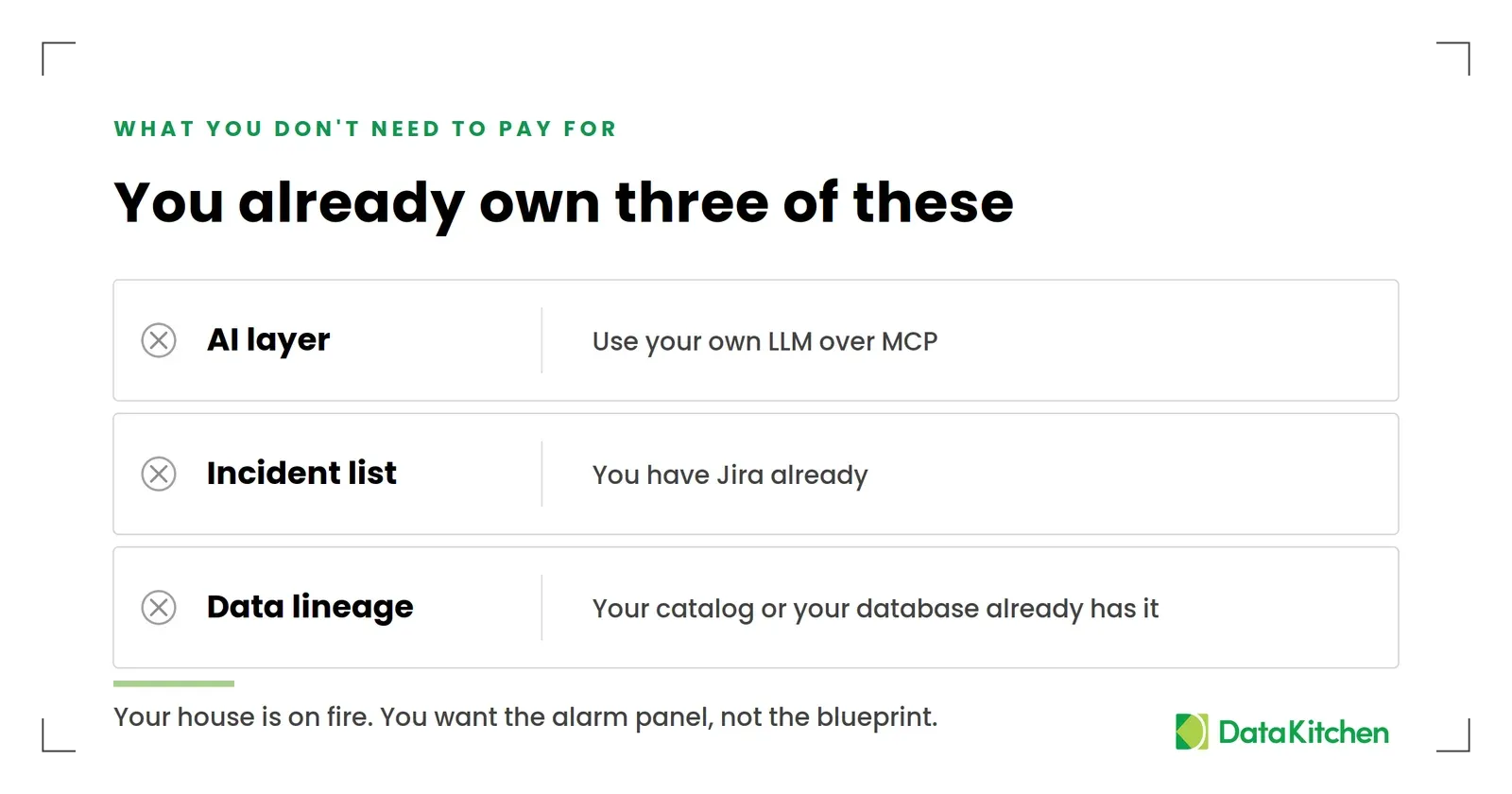
You don’t need an incident list. You have Jira. Or ServiceNow, Linear, PagerDuty, GitHub Issues, or one of the gazillion other ticketing systems your company pays for and your team already ignores. A data quality tool’s job is to find the problem and hand it off with the evidence: the failing rows, the test, the history. TestGen does that through its API and MCP server, and its notifications go to email, Slack, or Teams. It doesn’t need to become a third place your team has to check every morning, and you shouldn’t pay enterprise money for the privilege of a fourth.
You don’t need lineage in your data quality tool. Lineage is the blueprint of the house: which table feeds which view feeds which dashboard. Your catalog has it. dbt has it. Snowflake, Databricks, and Purview have it. Buying it again inside an observability tool is paying a fourth time for a map already in three drawers. None of those systems tells you what happened at runtime: did last night’s load run, did the test pass, did the dashboard refresh before the 8am meeting. That’s process observability, a different thing. We wrote up the distinction in “You Complete Me,” said Data Lineage to Data Journeys. We built a second open source tool for exactly that. DataKitchen Observability tracks process lineage as it happens: every run, every test, every tool that touched the data on its way to the dashboard. Apache 2.0 too. We think it matters more than data lineage, for the reason we laid out in Test Coverage Beats Data Lineage: lineage describes, tests detect. When a source starts sending order totals in cents instead of dollars, the graph draws an edge to all five downstream tables and shrugs. Nothing errored. Every job went green. The test on the one table that’s wrong is what tells you which of the five to go fix, and which four teams to stand down. Ask a firefighter which they want, the blueprint or the fire alarm control panel. They’ll take the panel. They’ll read the blueprint later, once the fire is out.
Strip those three out and what’s left is the thing you were trying to buy: tests that find bad values, and monitors that catch drift. That’s what the $15,600 pays for. Everything else was padding.
What you give up
You give up a booth at Gartner. You give up the good-looking sales rep who remembers your kids’ names. You give up the sales engineer flying out to run the POC for you. You give up the swag, and theirs is genuinely nice: the Patagonia vest, the socks, the water bottle your spouse now uses. You give up the comfort of an investor whose name your CFO has heard of.
You also give up AI agent monitoring, and this one is real. If you want to watch what your AI agents spend, govern which LLM reads which column at runtime, or catch a model drifting in production, TestGen won’t do it and DataKitchen Observability won’t either. Observability watches the tools and jobs in your data pipeline. An agent calling your warehouse 400 times an hour isn’t a pipeline run, and we don’t pretend to see it. Monte Carlo, Bigeye, and Collibra have all built in that direction this year, and if that’s your problem they’re ahead of us. Buy one of them, or buy an LLM observability tool, and keep TestGen for the data underneath. The two jobs don’t compete, and nothing stops you from paying $15,600 for the one and spending the rest of the budget where you actually need it.
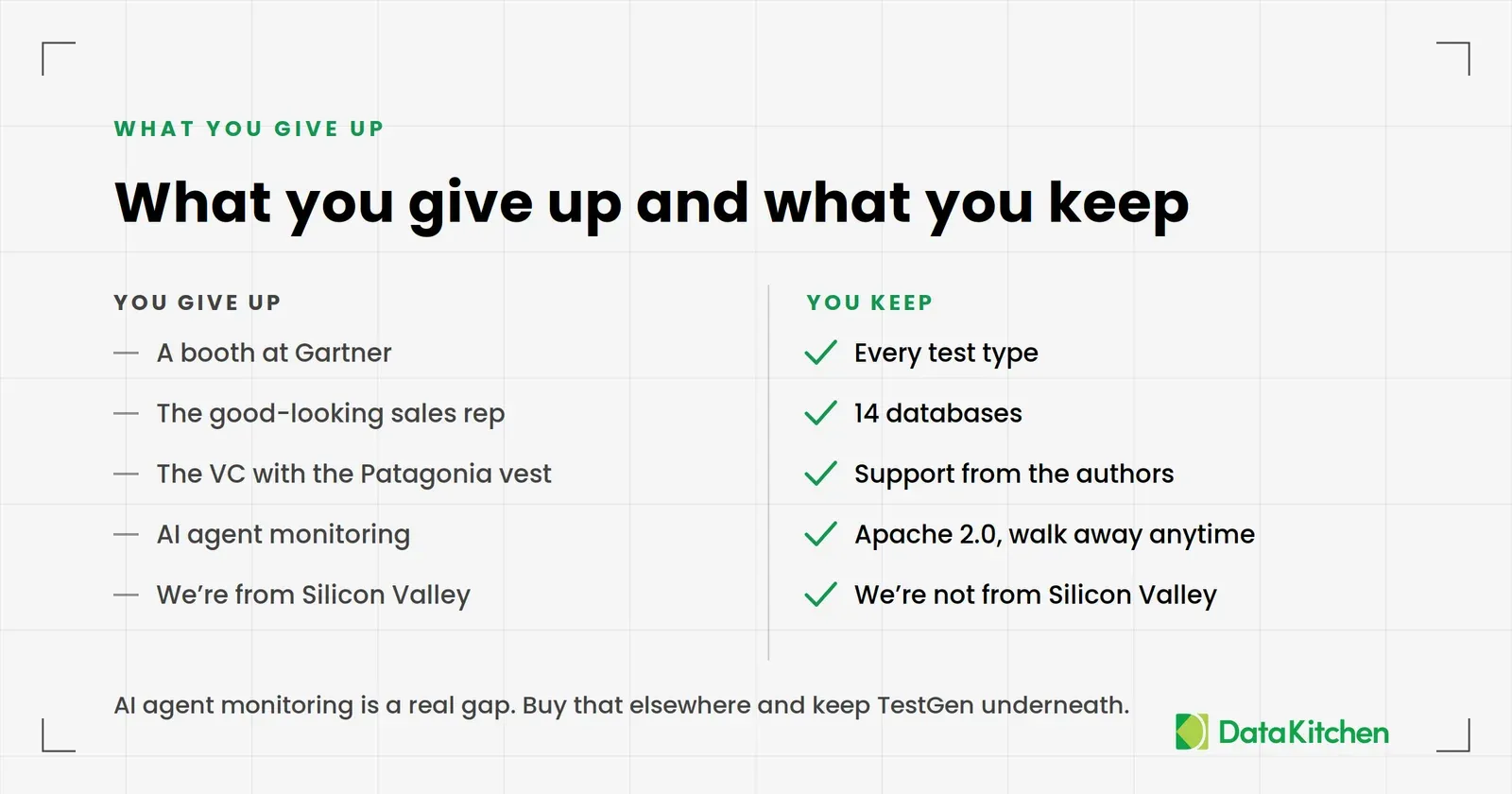
You don’t give up the tests. Every test type ships in the open source edition. You don’t give up the databases: TestGen connects to 14, including Snowflake, Databricks SQL, BigQuery, Redshift, Azure SQL and Synapse, SQL Server, Postgres, DuckDB, OneLake, Oracle, SAP HANA, and Salesforce Data 360, plus CSV, Parquet, and JSON on disk, S3, or Azure Blob, and Iceberg tables. Every one works in both editions. You don’t give up support, because Enterprise comes with the people who wrote the code. And you don’t give up the ability to walk away, because the core is Apache 2.0 and your tests and profiles live in a Postgres database you own.
That’s the whole pricing philosophy. A year of enterprise data quality should cost about one data engineer’s monthly salary. Not their annual salary, and not two of them. $15,600 for 10 people and three databases is that number, and it’s one a CFO signs without asking who’s getting fired.
Why not just build it with Claude?
You can. I’d even encourage it, and I say that as the person selling the alternative.
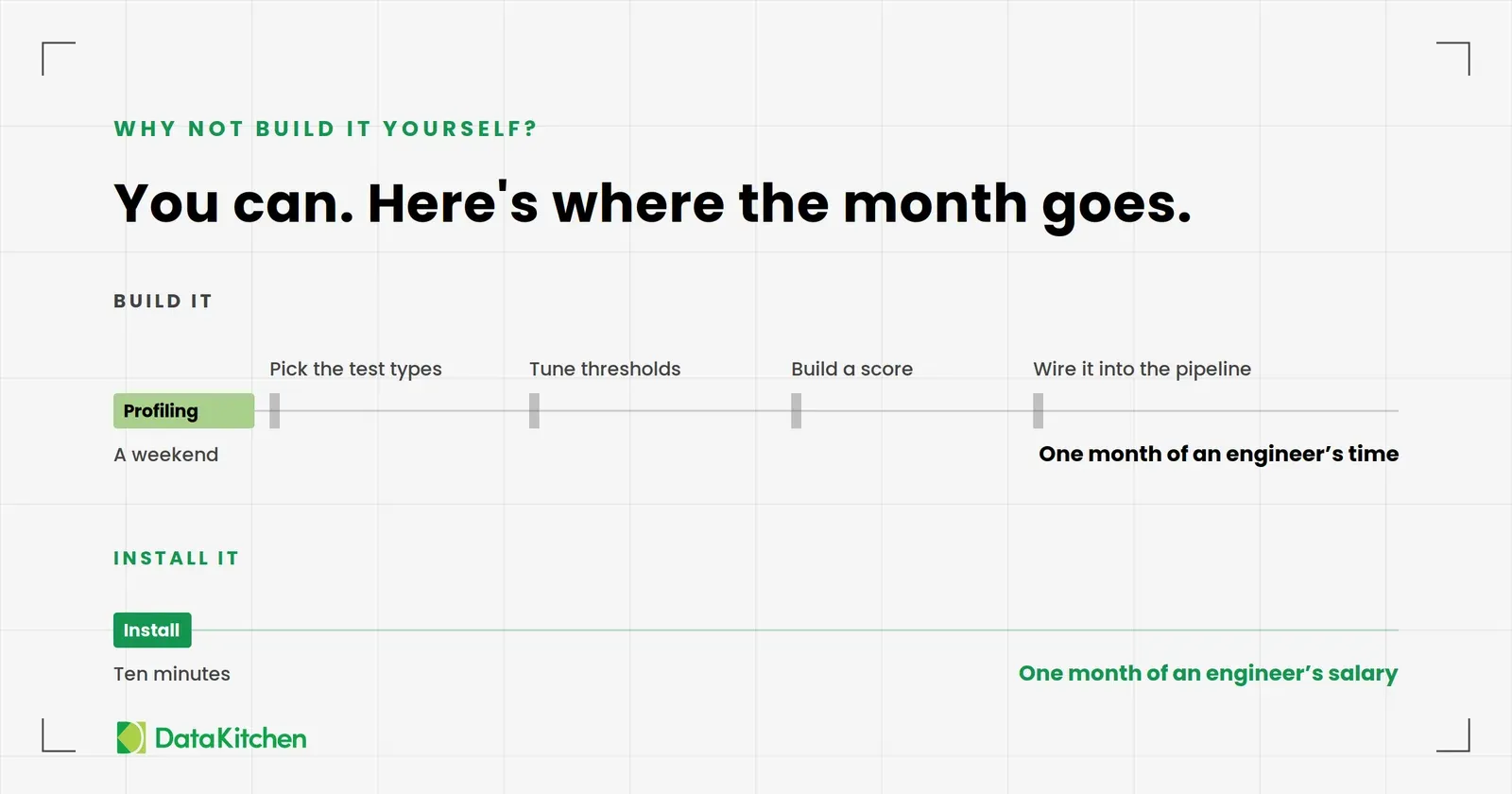
Point Claude at a schema and you’ll have profiling running in a weekend. The anomaly detection is the half page of Python from earlier. What takes the month is everything after: choosing which test types actually matter for your data, setting thresholds that don’t page you every Tuesday, building a score that means something when it moves, and wiring the results into your pipeline so a bad load stops instead of landing. Add the time you’ll spend learning enough about drift detection to tune it, and you’re at a month of an engineer’s time before you have something you’d trust in production.
We’ve argued for years that tests belong inside your pipeline rather than beside it, and that data engineers should spend more time writing tests, not less. None of that changed. If you build it yourself, you’ll understand your data better than any tool will tell you.
Here’s the problem we actually built TestGen for. Nobody has time to test at all. The tests don’t get written, which is why you find out the data was wrong when someone in finance asks why the number moved. A team that can’t find an afternoon to write tests is not going to find a month to build the thing that writes them.
So do the arithmetic one more time. Building it costs a month of an engineer’s time. TestGen Enterprise costs a month of an engineer’s salary. The open source edition costs nothing at all.
What $0 actually gets you
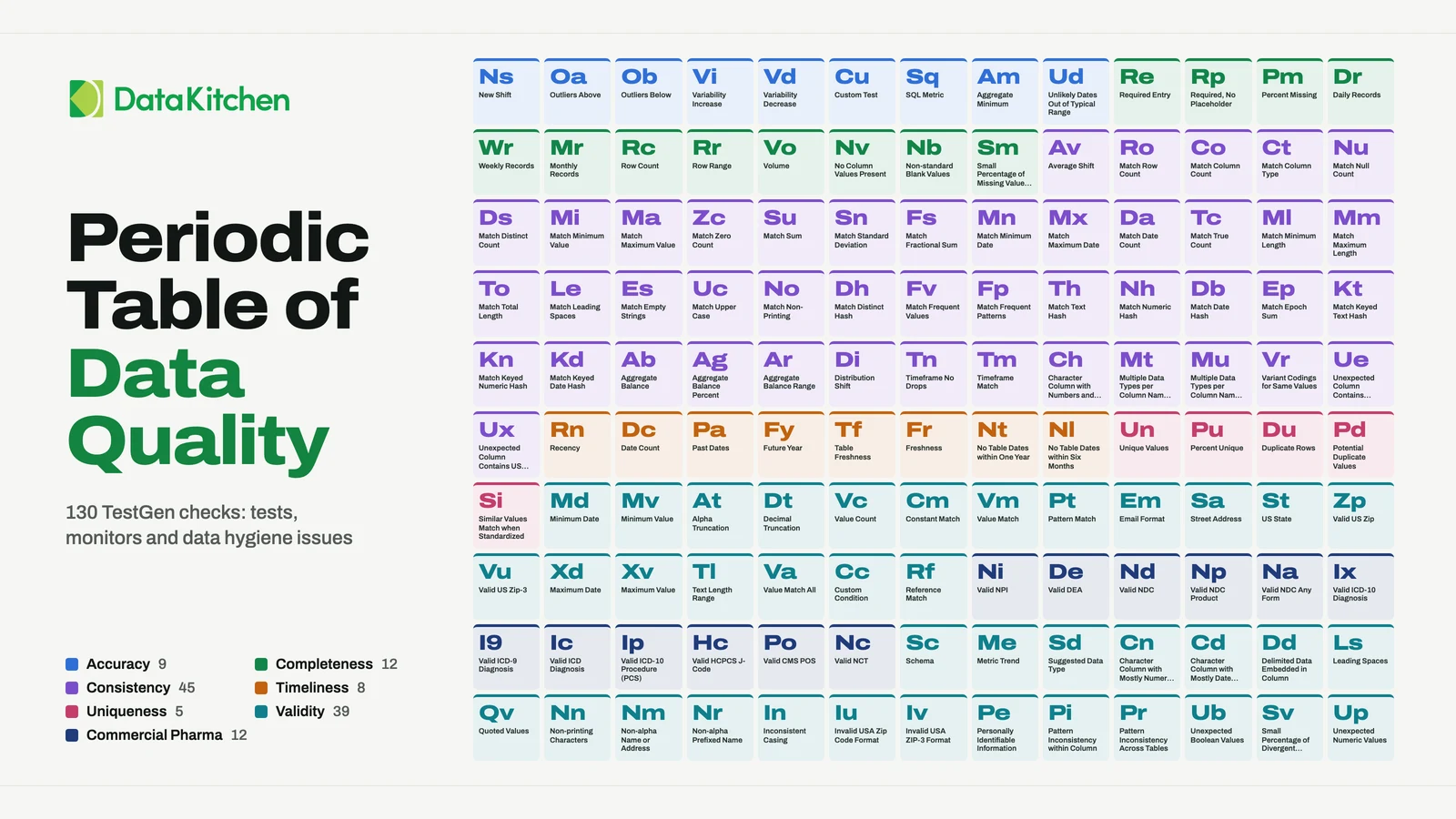
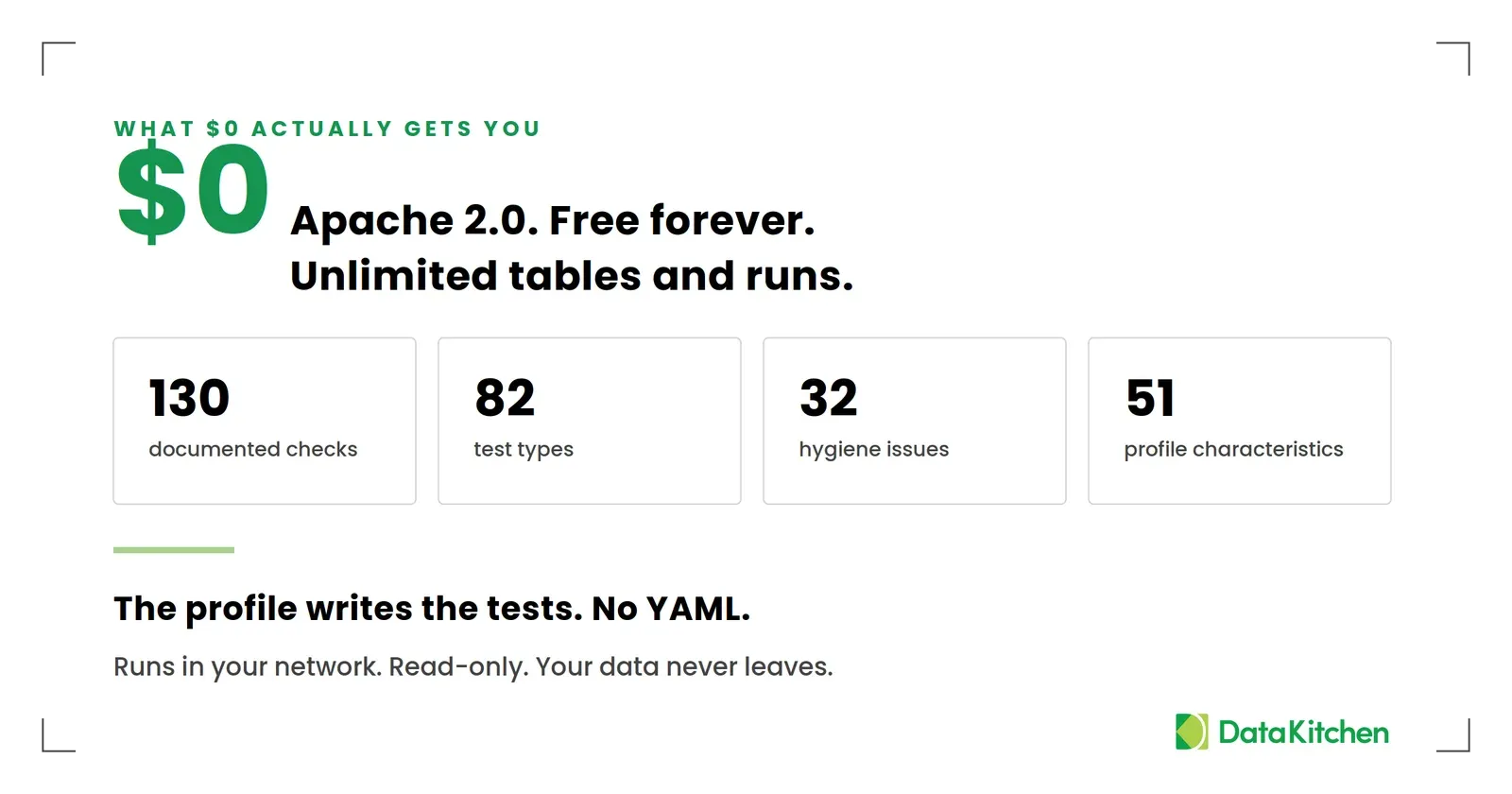
The open source edition isn’t a teaser. Apache 2.0, free forever, unlimited tables and runs, and 130 documented checks: 82 test types, four monitors, 32 hygiene issues. Only the 12 commercial pharma tests are held back for Enterprise.
You don’t pick those checks off a menu, which is the part people miss. TestGen profiles the table first, measuring 51 characteristics per column, then reads that profile and writes the suite with thresholds set from what it found. No YAML, no catalog to shop. The 130 are there for the tests a profile can’t guess.
That suite is also a data contract, free, shipping November 12. Sixty seconds for a working one, five minutes to 90% once your LLM reviews it through the MCP server, and business users fill the rest in the UI. Then hand it to your supplier with one rule: run this before you send the file. They install it in minutes and nobody signs anything.
Pair it with DataKitchen Observability, also Apache 2.0, and you see every tool acting on your data: Airflow, dbt, Fivetran, the warehouse, the BI layer. The company behind both has been profitable and independent since 2013. Nobody is going to buy us and fold TestGen into an integration platform.
It all runs in your network. Self-hosted, read-only connections, results stored in its own Postgres, your data never leaves. At the security review that means no vendor cloud to assess, no egress to explain, no DPA, and source your team can read.
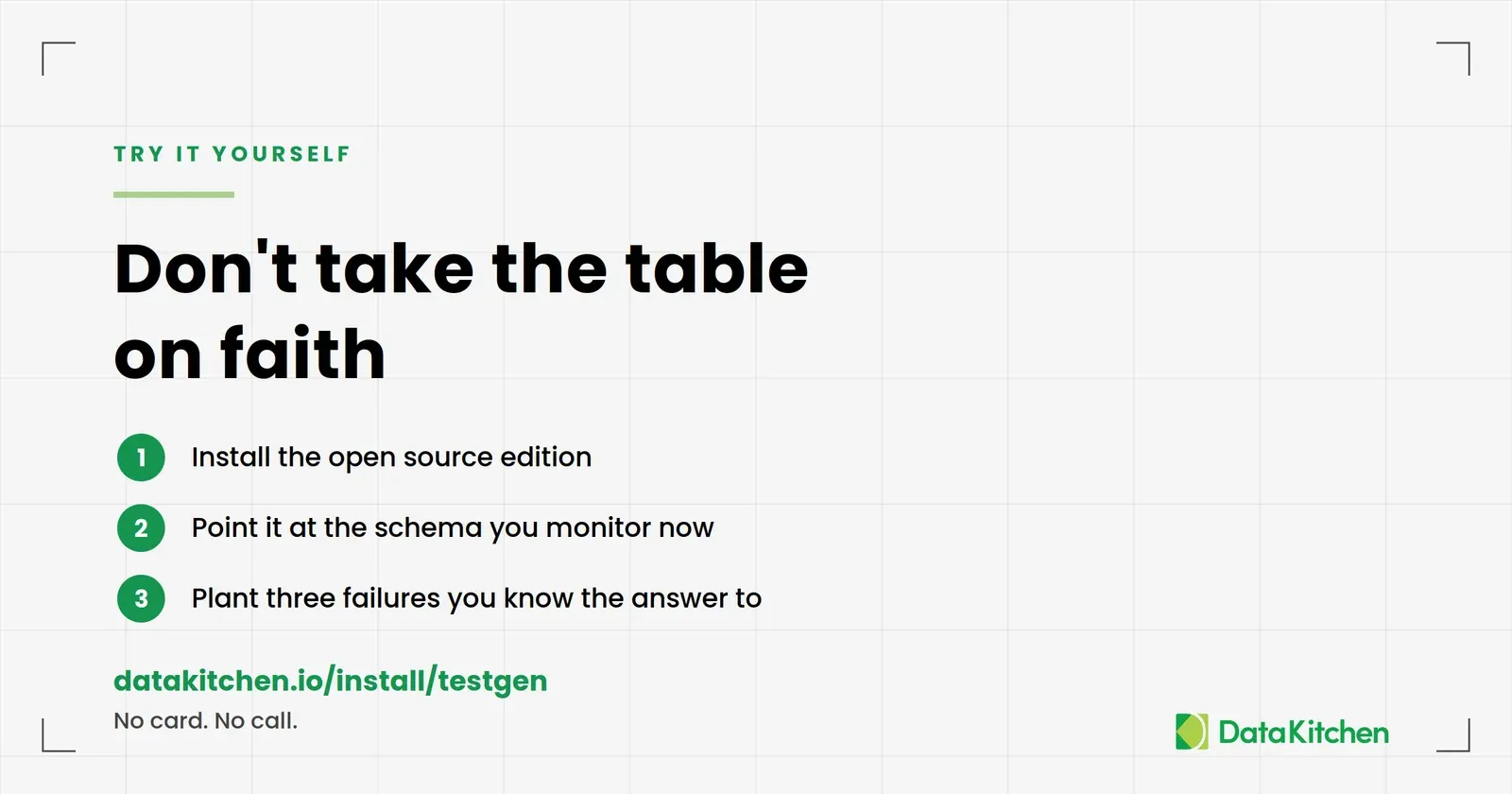
Don’t take the table above on faith. Run it like any vendor bake-off. Install the open source edition (Docker or pip, five to ten minutes), point it at the schema your current tool monitors, and plant three failures you know the answer to. Then see which tool finds them, how long setup took, and what each would bill you for the 1,001st table.
Install TestGen. No card, no call. If you want the enterprise edition priced for your team, the calculator above needs two numbers: users and database connections.
FAQ
What are the key points in this blog?
Data quality and data observability tools now do roughly the same job, but their prices differ by 10x. For 10 users, three databases and 1,000 tables, TestGen Enterprise costs $15,600 a year and the rest of the field runs $60,000 to $400,000. The gap pays for investor returns, per-table or per-credit billing, and acquisition risk, not better anomaly detection.
How much do data quality and data observability tools cost?
For 10 users, three database connections and 1,000 tables, expect $60,000 to $400,000 a year from most commercial vendors, with a median near $150,000. Soda Team comes to about $103,000, Monte Carlo $120,000 to $250,000, and Collibra $150,000 to $400,000. TestGen Enterprise costs $15,600 because it bills per user and per connection, with tables unlimited.
What is the cheapest data quality and data observability tool?
At the scale of 10 users and 1,000 tables, TestGen Enterprise is the cheapest commercial option at $15,600 a year. For one person, TestGen open source costs nothing, has no table cap, and generates its own tests from a profile. DQOps at $600 a month and Metaplane’s free tier also cost less than $15,600 for a single user with a small number of tables.
Why is per-table or per-credit pricing risky for data quality tools?
Metered pricing makes testing more tables more expensive, so teams monitor their 200 most important tables and hope about the rest. A credit’s definition can sit on a vendor page that changes without a new contract. At Monte Carlo’s published rates, 1,000 table monitors at 1.75 credits a day and $0.28 a credit cost about $179,000 a year. Ask for the unit definition in writing before you sign.
Do I need lineage, an incident list, or an AI assistant inside my data quality tool?
Usually not. Your catalog, dbt, Snowflake, Databricks or Purview already draws lineage, and Jira or ServiceNow already tracks incidents. Your team already has an LLM. TestGen ships an MCP server with more than 100 tools so that LLM can query test results, and it hands off failures through its API and notifications to email, Slack or Teams.
Should I build my own data quality tool with Claude?
You can, and profiling will run in a weekend. Choosing test types, tuning thresholds so they don’t page you every Tuesday, building a meaningful score, and wiring results into your pipeline take about a month of an engineer’s time. TestGen Enterprise costs about a month of one engineer’s salary, and the open source edition costs nothing.
What does TestGen not do?
TestGen does not monitor AI agents. It won’t watch what agents spend, govern which LLM reads which column at runtime, or catch model drift in production, and DataKitchen Observability doesn’t either. Monte Carlo, Bigeye and Collibra built in that direction in 2026. Buy one of them or an LLM observability tool, and keep TestGen for testing the data underneath.
Unlimited on every plan. Slide it all the way to ∞ and watch the price stay put.
Run every test as often as you like. Also unlimited, also $0.
- 10 users × $100 $1,000
- 3 connections × $100 $300
- 1,000 tables $0
- 1,000 tests run $0
$15,600 a year, or $1,300 a month
One user and one connection? Open Source TestGen covers that for free.
Talk to SalesComparisons
DataKitchen TestGen vs the field
Head-to-head against every major data quality and observability vendor.
No vendors match. .