Pull your data engineering team out of the past and into 10x
Your data engineers are stuck. They write SQL the way they did five years ago, ship pipelines that break at 2am, and the software team next door is shipping features in hours with Claude Code. We help your team adopt Claude Code on your Snowflake or Databricks stack, then build the context layer that lets your analysts query the data with AI tools and trust the answers.
Your data engineering team is stuck in the past while your analysts are getting impatient
Your data engineers are still writing the same hand-crafted SQL, debugging the same broken pipelines, and pushing back on every request because the backlog is already six months long. Your analysts are asking why they can't just talk to the warehouse in plain English like every demo on the internet.
You can't fix this by handing your team a new tool. Adding an AI agent to a messy pipeline doesn't speed anything up. It just generates broken code faster. And pointing an analyst's chatbot at your warehouse without a context layer gives them confident, wrong answers that erode trust faster than the old dashboards ever did.
We do the foundational work that lets both groups move forward: Claude Code adopted by your data engineers, and a context layer that lets your analysts query the data with AI and actually believe the results. We use your stack, Snowflake or Databricks, and our open source tools, TestGen and DataOps Observability.
Six things we install in your data engineering process so AI actually works
We work on your stack, Snowflake or Databricks, with our open source tools: TestGen for data quality testing and DataOps Observability for pipeline monitoring. These six tracks run in parallel. We work alongside your team and transfer everything to them by the end of the engagement.
Build the data trust foundation first
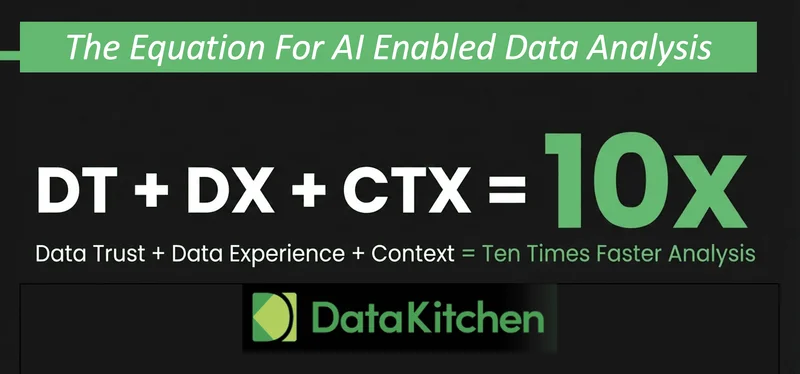
AI is an amplifier. Point it at untested data and it amplifies bad answers at speed. We install automated test coverage on your most error-prone and business-critical tables using TestGen, plus pipeline observability that watches freshness, volume, schema drift, and quality scores. Your AI stops giving the same confident answer whether the underlying data is fresh or three days stale.
Curate the ten tables that matter
Most warehouses have 150 tables. Half are deprecated. The AI doesn't know which is which, so it joins the wrong ones and returns confident, wrong answers. We help you build a curated semantic layer over the small set of tables that answer 80 percent of business questions, with names that say what the data is and join keys that are documented explicitly.
Engineer the six-category context layer
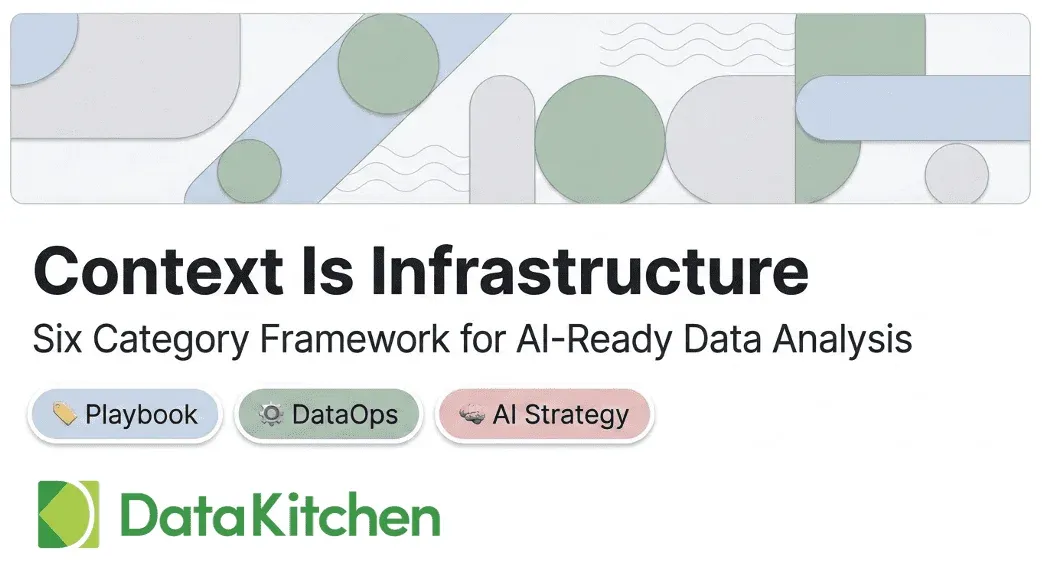
Documentation isn't context. We build the full six-category layer that sits between your data and your AI: schema and grain, business metrics and KPI definitions, validated example queries, live freshness and quality state, organizational and operational history, and policy and entitlements. The AI stops guessing what EQ_TRX means or which revenue source is authoritative.
Set up isolated environments for safe AI iteration
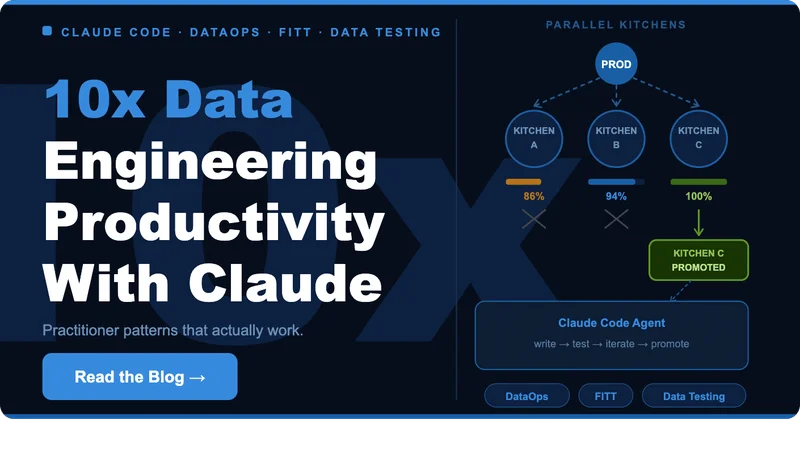
You can't let Claude Code iterate against production for 30 minutes hoping nothing gets dropped. We set up isolated environments using zero-copy clones in Snowflake or Databricks, each one bundled with its own Git branch and compute context. Your engineers can run three or four Claude sessions in parallel without any of them touching real data until work is explicitly promoted.
Refactor pipelines to FITT architecture
Pipelines that are easy for humans to reason about are also safe for autonomous agents to work on. We refactor your messiest, most error-prone pipeline stages into FITT units: same input gives same output, runs are idempotent, every transform is tested, and the architecture collapses to two stages instead of seven medallion layers. Claude can pick up a FITT chunk and iterate on it in isolation without breaking anything else.
Wire in the test feedback loop and parallel workflow
Claude can generate code and run code. It can't judge whether the output is correct. Tests do that. We wire your test suite into the agent loop so Claude knows when it's done and when it has regressed something upstream. Then we install the parallel-agent workflow: CLAUDE.md memory files, three terminals running three approaches at once, the engineer judges the winning diff. Four-hour tasks become 15-minute tasks.
Build, operate, transfer. We do the work alongside your team. You own it when we leave
Assess
Two-week assessment of your data trust, data experience, and context maturity. Concrete gap report, not a 60-slide deck.
Build
We build the foundation: tests, observability, isolated environments, FITT refactor, context layer. Working software, not documentation.
Operate
We run the system in production with your team for one to two quarters. Production workloads, real agent sessions, captured corrections feeding back into the context layer.
Transfer
Your team owns it. Open source tooling, documented patterns, no platform lock-in. We leave when you're running it without us.
Three blogs the engagement is built on
Talk to a Chef about our AI Enablement and data engineering consulting services
Stop generating untested code faster. Start shipping pipelines AI can maintain. We'll walk through what an engagement looks like for your team, your stack, and your data.
Frequently Asked Questions
Common questions about AI enablement for data teams.
What is AI enablement for a data engineering team?
AI enablement is getting a data engineering team productive with AI coding tools on their real stack rather than on demos. In practice that means Claude Code working against Snowflake or Databricks, isolated environments so an agent cannot break production, and the test coverage that tells the agent whether its change worked.
Why do AI coding tools underdeliver on data teams?
Because an agent needs somewhere safe to work and a way to know if it succeeded. Without isolated environments, every iteration touches production. Without tests, neither you nor the agent can tell whether the transform it rewrote is correct. The scaffolding is what turns fast code generation into shipped work.
What is a context layer and why does an analyst need one?
A context layer is the domain knowledge an AI cannot read from a schema: what your business means by an active customer, which columns are deprecated, how fiscal periods work, which joins are valid. Research on text-to-SQL consistently finds this is the missing input. Without it a model writes valid SQL that answers the wrong question.
Can analysts trust answers an AI gives about our data?
Only if the underlying data is verified, and that is the part teams skip. An LLM answers with identical confidence whether the tables are tested or badly broken. Trust comes from test coverage underneath the query, not from the model, which is why enablement work starts with data quality rather than with prompts.
Does this work on Snowflake and Databricks?
Yes, those are the two most common stacks for this work. The approach is the same either way: isolated environments with real data, automated test coverage so changes are verifiable, and a curated context layer so the AI is pointed at the tables that matter rather than guessing across hundreds.
How do you get started with AI enablement?
Start with one team and one stack rather than a program. Establish test coverage so agent output can be graded, set up an environment where an agent can iterate without touching production, then curate context for the ten tables that actually matter. Each step is useful on its own if the next one stalls.