Free Download
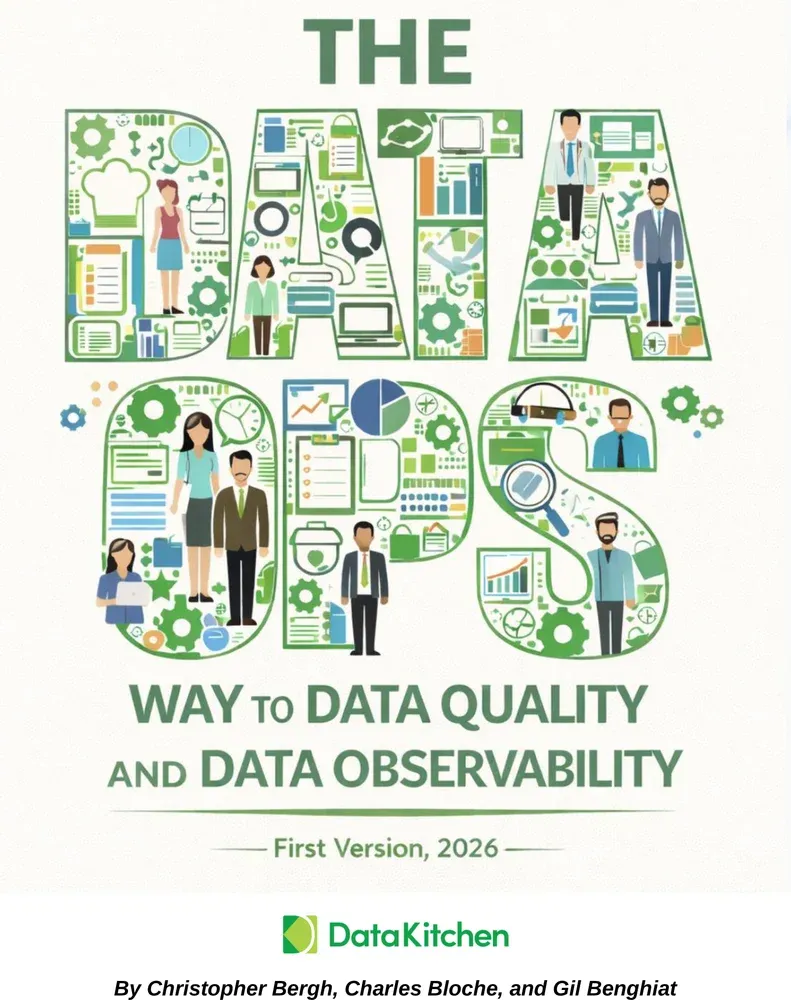
The DataOps Way to Data Quality and Data Observability
Updated September 2026
Most data quality advice tells you what to measure. This book tells you why your team keeps failing and what to actually do about it.
- Edition
- Updated September 2026
- Length
- 620 pages
- Price
- Free
About this book
The DataOps Way to Data Quality and Data Observability argues that data quality is not a technology problem but a cultural, organizational, and process one. It names the failure patterns that keep data teams stuck — warring tribes, the data shame game, the ostrich problem — and pairs them with the technical practices that give teams control: shift-left testing, systematic test coverage, continuous monitoring, and observability that catches failures before customers do. The September 2026 edition has 63 chapters in seven sections: why data quality matters, culture and organization, building your testing strategy, monitoring and observability, implementation and case studies, AI and data quality, and reference and tooling.
Key points
- The DataOps Way to Data Quality and Data Observability argues that data quality is a cultural, organizational, and process problem rather than a technology one.
- It names the patterns that keep data teams stuck, including warring tribes, the data shame game, and the ostrich problem.
- Each pattern is answered with a practice: shift-left testing, systematic test coverage, continuous monitoring, and observability that catches failures before customers do.
- The September 2026 edition adds a section on AI and data quality: context engineering, agents that fix data with control, and the seven deadly sins of AI-generated pipelines.
- 54 of its 63 chapters are published in full on datakitchen.io, linked from the table of contents on this page. The other nine were written for the book.
- Written by Chris Bergh, Chip Bloche, and Gil Benghiat. 620 pages, first published March 2026 and revised September 2026, free.
- The practices work on any stack. The two DataKitchen tools that match them, DataOps TestGen and DataOps Observability, are free and open source.
Download Your Free Copy
Complete the form below to get The DataOps Way to Data Quality and Data Observability.
What's inside
63 chapters, most of them published here first: the book's contribution is the selection and the order. Linked titles go straight to the full text, no form required.
Why Data Quality Matters
- Data Quality Testing is at the Core of Four Critical Data Team Processes
- The Mystery Box Full of Data Errors
- Data Quality vs Data Observability: The Pets and Cattle of Your Data Estate
- Stop Paying the Data Quality Tax
- How I Broke Our SLA and Delighted Our Customer
- The Economics of Data Quality: When to Test, How Much to Spend
- When Timing Goes Wrong: How Latency Issues Cascade
- We Got Roasted on Reddit for Asking Why Data Engineers Don’t Test
- We Just Eyeball Row Counts and Pray
- A Data Usability Crisis is Costing Your Company
Culture and Organization
- The Seven Deadly Sins of Data Quality
- The Data Errors Shame Game
- Is Your Team in Denial about Data Quality?
- The Ostrich Problem: When Your Data Team Stops Caring After Deployment
- The Data Quality Revolution Starts with You
- The Five Organizational Sins of Data Teams
- You’re Thinking About Data Products All Wrong
- Process Guardianship: The Most Valuable Work You Are Probably Not Doing
- How Data Quality Leaders Can Gain Influence and Avoid the Tragedy of the Commons
- How Do I Get My Data Team More Efficient?
Building Your Testing Strategy
- Shift-Left, Shift-Down: How to Take Control of Data Quality
- Scaling Data Reliability: The Definitive Guide to Test Coverage
- Data Quality Test Coverage in a Medallion Data Architecture
- The Race for Data Quality in a Medallion Architecture
- Building Data Quality Into dbt: A Complete Guide
- Data Contracts: Shifting the Burden of Quality to the Source
- Building and Scaling a Data Quality Practice: The First Year
- Impact Dimensions Cure A Data Quality Blind Spot
- Your Best Data Quality Rules Live in Someone Else’s Head
- The Blueprint or the Fire Alarm Panel: Why Data Test Coverage Beats Data Lineage
- The Data Contract Is Your Receipt
- The Four Points in Your Medallion Architecture Where Data Testing Really Matters
- Testing Every Layer of the Medallion Architecture, Now with OneLake at the Center
Monitoring and Observability
Implementation and Case Studies
- Data Testing Anti-Patterns: Why Your Tests Are Failing You
- Three Data Quality Disasters and How They Were Averted
- When Not to Test: Setting Reasonable Bounds on Data Quality Effort
- I Wrote Data Quality Tests for 3 Million NYC Taxi Rides in Five Minutes
- Data Quality’s Most Wanted: The 2026 Case Files
- Why Testing Commercial Pharma Data Is Harder Than Anyone Tells You
- IQVIA, specialty pharmacy, and your own files: the commercial data most likely to be wrong
- The Illusion of Clean Data: The Pharma Identifiers Generic Tools Never Check
AI and Data Quality
- Sure, Go Ahead And Feed That Data To The LLM … What Could Possibly Go Wrong?
- The Equation For AI Success: DT + DX + CTX = 10x
- DataOps + FITT + Data Testing = 10x Data Engineering Productivity with AI
- Context As Infrastructure: The Six-Category Framework for AI-Ready Data Analysis
- Stop Burning Tokens: Data Observability and Quality as Your AI’s System of Record
- Put Your AI At The Center Of Your Data Quality And Observability Decision-Making Process
- Agents to Fix Data Quality Automatically With Control: A Design Pattern
- The Seven Deadly Sins of AI-Generated Data Pipelines
Reference and Tooling
- A Practical Guide to Selecting Data Quality Tools
- The Data Quality and Observability Tools Landscape
- The 2026 Data Quality and Data Observability Commercial Software Landscape
- The 2026 Open Source Data Profiling Software Landscape
- The Consultant’s Growth Playbook: Accelerating Client Acquisition with DataKitchen Open Source TestGen
- $1 Billion in Data Observability VC Investment: This Is Not Going to End Well
- There are a lot of freaking data quality and data observability vendors
- There Is No Microsoft Data Quality Tool in 2026. There Are Nineteen.
- Where to Actually Start with DataOps in 2026
Why we wrote it
Data quality is not a technology problem. It never has been. The data industry has spent years chasing the next tool, platform, or vendor promise, yet data errors still dominate the daily work of data engineers. Teams keep blaming each other when pipelines break, and business stakeholders quietly distrust the numbers they see.
After working with data teams across many industries, we’re convinced the real barriers to data quality are cultural, organizational, and process-related. Teams get stuck in reactive habits: scrambling to fix errors after they happen, pointing fingers across silos, and treating data quality as someone else’s problem. Our third book, The DataOps Way to Data Quality and Data Observability, aims to identify these patterns and offer a better way honestly.
That better way is DataOps. It applies Agile, DevOps, and lean manufacturing ideas to data and analytics work. DataOps isn’t a product you can buy; it’s a set of habits and disciplines that, when followed consistently, turn data quality from a constant crisis into a managed, measurable, and ever-improving part of your data environment. The book covers organizational failure patterns like warring tribes, the data shame game, and the ostrich problem, alongside technical practices that give teams real control: shift-left testing, systematic test coverage, continuous monitoring, and data observability that catches failures before they reach customers.
The main reason data teams struggle with data quality isn’t a lack of technology; it’s a lack of knowledge, vocabulary, and process frameworks to use that technology well. That’s why we wrote this book. We want every data team, regardless of budget or organizational maturity, to have a clear, honest guide for doing this work well.
We also built two free, open-source tools: DataOps TestGen for data quality testing and profiling, and DataOps Observability for pipeline monitoring. The book gives you the vocabulary, the frameworks, and the organizational playbook. The tools give you the means to act on them the same day. Used together, they close the gap between understanding the problem and actually fixing it. This book and these tools share the same belief: better data quality is achievable for every organization and worth pursuing. We hope you find not just ideas that resonate, but practical steps you can start using today.
What changed in the September 2026 edition
The book grew from 44 chapters to 63, regrouped into seven sections. The new section, AI and Data Quality, covers what happens when you feed untested data to a model, the equation for AI success, context as infrastructure, agents that fix data quality with control, and the seven deadly sins of AI-generated data pipelines.
Nine chapters were written for the book and appear nowhere else: the economics of data quality, a complete guide to testing in dbt, data contracts, building a data quality practice in its first year, alert fatigue, testing anti-patterns, three averted disasters, when not to test, and a guide to selecting tools. They are listed above without links. Chapters from the first edition that overlapped with newer material moved to a Read More list at the back of the book.
Download the free 620-page book here:
Frequently Asked Questions
Common questions about The DataOps Way to Data Quality and Data Observability
What is The DataOps Way to Data Quality about?
It argues that data quality is not a technology problem but a cultural, organizational, and process one. Across 620 pages it names the patterns that keep data teams stuck, then pairs them with practices that give a team control: shift-left testing, systematic test coverage, continuous monitoring, and observability that catches failures before customers do.
Who should read it?
Data engineers and analytics leaders who keep fixing the same errors. The book assumes no budget and no existing data quality program, so it works for a team of one as well as a department. The chapters on team culture and dashboards are written for whoever has to explain quality to the rest of the business.
Is The DataOps Way to Data Quality free?
Yes. The full 620-page PDF costs nothing: fill in the form on this page and we send you a copy. 54 of the book's 63 chapters are also readable on this site with no form at all, and the table of contents above links to each of them.
Who wrote The DataOps Way to Data Quality?
Chris Bergh, Chip Bloche, and Gil Benghiat. Chris and Gil are two of DataKitchen's three co-founders. Chip Bloche leads data engineering at DataKitchen and is the principal architect of DataOps TestGen, which is where the chapters on test coverage and data profiling come from. The cover byline reads Charles Bloche.
What failure patterns does the book name?
Warring tribes, the data shame game, and the ostrich problem, among others. The book treats these as the real reasons data quality work stalls, and answers each with a practice rather than a purchase. The later sections cover testing strategy, monitoring and observability, implementation and case studies, AI and data quality, and the tooling landscape.
What changed in the September 2026 edition?
It grew from 44 chapters to 63, regrouped into seven sections. A new section covers AI and data quality: the equation for AI success, context as infrastructure, agents that fix data quality with control, and the seven deadly sins of AI-generated data pipelines. Nine chapters were written for the book and appear nowhere else, including a complete guide to data quality in dbt, data contracts, alert fatigue, and when not to test. Chapters that overlapped moved to a Read More list at the back.
Do I need DataKitchen software to use the book?
No. The book covers practices, and they work with whatever stack you already run. DataKitchen does publish two free open-source tools that match those practices: DataOps TestGen for data quality testing and profiling, and DataOps Observability for pipeline monitoring. Both install without talking to a salesperson.
Free Books
Read These Next
Same team, same price: the full PDF, no charge. Each one covers ground this book doesn't.