The Corona COVID-19 virus has completely changed the landscape for business in 2020. Strategic plans that were approved a few short months ago are being scrapped. With a recession at hand, it’s time to hit the reset button on your plans.
Business thought leaders were writing about a potential downturn last spring. No one can predict the timing or duration of a recession, but business cycles are inevitable. Let’s take a moment and review what researchers and management consultants have written about preparing for tough times and laying the groundwork to emerge even stronger during the inevitable recovery.
Recession Strategy for Superior Performance
In a March 2010 article in Harvard Business Review, researchers conducted a study of the performance of 4,700 public companies in the periods three years before, during, and after the recessions of 1980, 1990, and 2000. Here’s what they found:
- There are Losers and Winners – 17% of the companies studied went bankrupt, were acquired or went private. Most companies still struggled even three years after the recession. 9% thrived and outperformed competitors by at least 10% top-line and bottom-line growth.
- Prevention-focused companies struggled – Firms that focused only on cost-cutting had a 21% chance of emerging stronger after the recession.
- Promotion-focused companies lost – Companies that only invested in growth had a 26% chance of beating rivals. 85% of growth leaders entering a recession declined and did not regain momentum.
- Pragmatic companies did better – Companies that responded to the recession with a general mix of cost-cutting and investment in new opportunities had a better chance of surviving than the prevention- and promotion-focused companies.
- Progressive companies led the pack – Certain companies within the pragmatic group had a 37% chance of emerging strong. These companies focused on cost-cutting that impacted operational efficiency and invested confidently in marketing, R&D, and new assets. These companies reexamined every aspect of their business models: supply chains, organization, structure, and workflows. They improved efficiency, freeing up cash for new investment that stimulated post-recession growth.
Few business leaders have a master plan already figured out when entering a recession. Further, executives must walk a delicate balance between financial and brand management. Large companies operate in an environment that includes shareholder and employee activism, community stakeholders, and a wider societal conversation about social impact and income equality. These factors can create a political backlash or affect employee morale and force managers to consider the public impact of their decisions.
Navigating the Road Ahead Using Analytics
As data professionals, we know that data-driven decision making is now more critical than ever. Data analytics can serve as a company’s most valuable tool when evaluating proposals for cost-cutting or investment. Analytics could mean the difference between finding the right mix of strategic moves and falling behind. About a year ago, an article written by management consultant McKinsey & Company encouraged companies to plan for a future recession by turning to digital tools and advanced analytics to manage offensive and defensive strategies. Management consulting firm Bain & Company offered similar recession-planning advice. They recommended looking to digital tools and next-generation data analytics to find and pursue customer-focused opportunities that capitalize on the upcoming recession and subsequent growth cycles.
Preparing the Data Organization
As a leader of a data organization, you must prepare for this critical phase. It’s time to get your own house in order. You’ll need to respond to requests quicker than ever and accomplish a lot more with the same or fewer resources. Here’s how you can do that:
- Forget about Waterfall Projects – This is not the time to plan out projects that take months or years to deliver value. We call this the “trap of deferred value.” Your team will have to react quickly and responsively during this difficult time. You’ll need an Agile Development strategy to set and quickly adjust priorities.
- Automate Your Data Operations and Analytics Development Pipelines – Automated orchestration will boost your team’s productivity and minimize data errors. In a recent report, IT research firm Gartner wrote that data teams are spending an average of 56% of their time manually executing and maintaining the data operations pipeline – see figure below. This is a travesty. Your data analysts and scientists are your most precious resource. You need them focused on creating new analytics that will guide the enterprise through turbulent times. Automation of the data operations pipeline and the analytics development pipeline (as in DevOps continuous deployment) will keep them away from non-value added tasks and focused on their highest priority projects.
- Eliminate data errors – There is nothing more counter-productive than having data errors creep into otherwise working analytics. Automated orchestration will enable you to implement quality tests at each step in your data pipeline; both the data operations pipeline and the analytics development/deployment pipeline. The team can’t operate at lightning speed if errors constantly create unplanned work. Automated testing works 24×7 and catches errors before your users do. Trust us, with automated testing in place, you will sleep better than ever.
- When times get tough, tempers are going to get short. Your C-level colleagues are not going to wait weeks or months for new analytics. You need to cut the cycle time from the germination of an idea to the delivery of robust, working analytics to hours or days. This means automating a lot of tasks that you currently perform manually. For example, companies are having great success spinning up virtual environments to get data analysts started quickly on new projects. These environments reflect the production technical environment so there are no surprises as analytics transition to production.
There are several other tips for streamlining analytics development – see our blogs on analytics in the on-demand economy and the 7 Steps of DataOps.
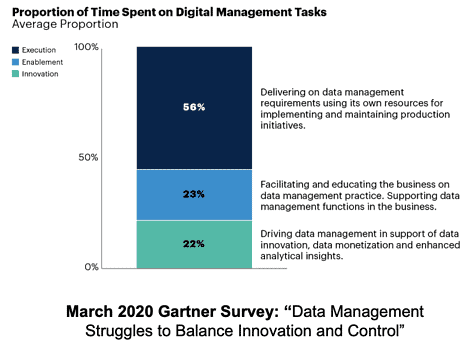
Figure 1: Data professionals spend only 22% of their time creating the analytics and models that drive innovation and monetize data. Most of their time is spent on tasks that could be automated.
DataKitchen Platform
We rolled these capabilities and many more into our DataOps Platform. Yes, you can build these functionalities in-house, but if you haven’t done so already, you are behind. The fastest way to get your data organization ready for the upcoming recession is to leverage a DataOps Platform that is already implemented and proven. Our DataOps customers have reduced error rates to virtually zero per year, slashed cycle time, and have greatly improved the ability of their data team to support users. One of our customers improved the productivity of their data analysts and data engineers by an order of magnitude. See the Celgene case study for more information.
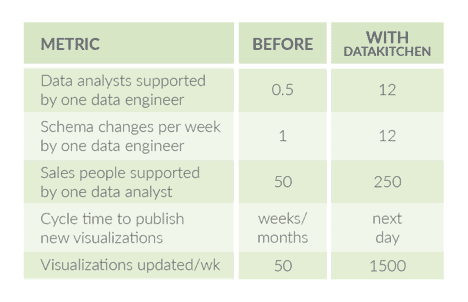
Figure 2: Productivity of data engineers and data analysts before and after implementing the DataKitchen DataOps Platform.
The DataKitchen Platform enables your data organization to:
- Deploy faster than the speed of business
- Orchestrate with the tools you love
- Reduce errors to virtually zero
- Collaborate across teams
- Foster Innovation with controlled environments
- Showcase your team’s performance
Differentiation Through Data
Research shows that a difficult economic environment can separate the leaders from the laggards. Data analytics and digital automation promise to be among the key ingredients that successful companies use to find opportunities to improve efficiency, productivity and growth. Data organizations need to prepare themselves for this remarkable moment in history by restructuring their own workflow processes to rapidly deliver high-quality analytics that address the enterprise’s strategic goals.
For more information about DataOps and the DataKitchen Platform, see our blog, “What Is DataOps: Ten Most Common Questions.”