Webinar: Data Quality, DataOps, and Large Language Models

AI is changing the world — in this webinar we show how Large Language Model drive the need for DataOps, Data Quality, and Data Observability

Written by Chris Bergh on November 6, 2025

DataOpsData QualityDataOps TestGenOn-Demand WebinarOpen Source
Webinar: Data Quality, DataOps, and Large Language Models

Key points

  • LLMs make the existing mess in a data team worse in two specific ways: Analysis-Palooza, where far more people analyze data through a model, and the Vibe Coding Extravaganza, where far more people write code that wants to go to production.
  • Model error and data error compound. An 80% accurate model on 80% accurate data leaves you a 64% answer, and the model's half of that is improving asymptotically — so the data half is the one you can still move.
  • The surface area changes, not just the volume. Users hand a whole table extract to a model, so every table and every column gets read. A data scientist could be told to patch it; an ordinary business user will not.
  • When the insight is poor, people blame the data and the data team, so coverage has to grow — and it can't be manual or dashboard-driven. One health insurer had a thousand data quality dashboards and still had serious data quality problems, because nobody looked at them.
  • Vibe-coded SQL is fast, impressive, and imperfect: benchmark accuracy around 50 to 60%, worse for database-specific SQL. More context — profiling, catalog, lineage, test results — helps, but it is not a miracle cure.
  • The answer for that code is shift down: run it in a development environment that mirrors production, laced with data quality tests and tool monitoring, so a change that breaks a report or a predictive model shows up before production does.

Struggling to bring order to the data and AI chaos?

The reality for many data teams is often an unproductive mix of broken pipelines, reactive problem-solving, and “good enough” data that leads to poor decisions. With the introduction of Large Language Models (LLMs), the situation has become even more complicated, increasing the number of data use cases, generating “vibe” data engineering projects, and intensifying the confusion. However, there is hope.

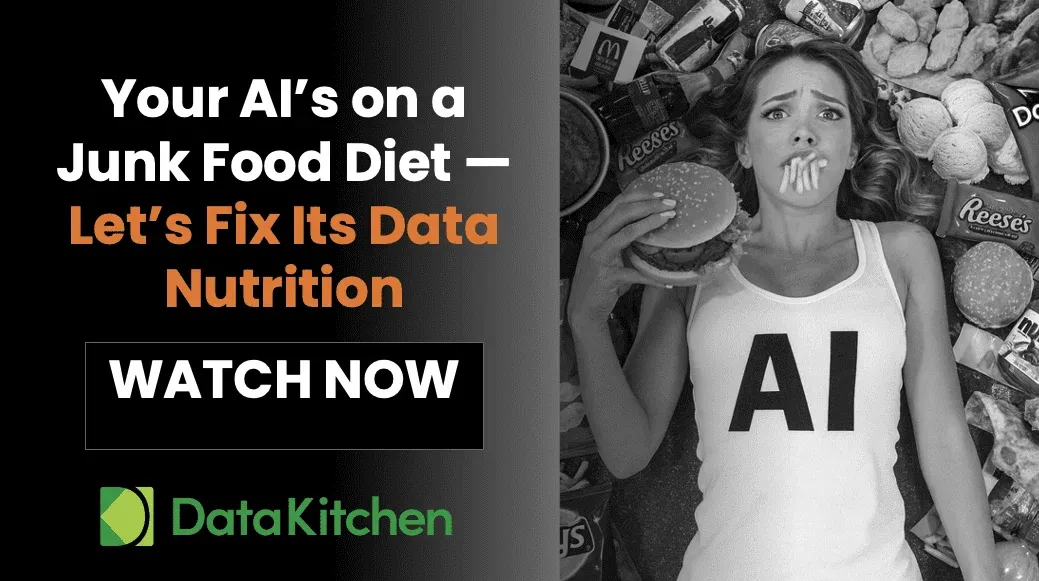
In this session, we will demonstrate how the proven principles of DataOps — including agile iteration, lean efficiency, and DevOps-style automation — can help restore sanity to your data stack and improve the quality of your LLM code and insights. Join us for a candid, humorous, and practical discussion on how to provide your AI with a healthy data diet, even on a limited budget.

Watch the webinar

Fill out the form and the recording, slides, and transcript open on the next page.

Install Open Source TestGen Free, no vendor lock-in Request a Demo See TestGen Enterprise in action
Chris Bergh

Chris Bergh

CEO and Head Chef at DataKitchen. He is a leader of the DataOps movement and is the co-author of the DataOps Cookbook and the DataOps Manifesto.

LinkedIn →

Don't want to give us your email address? Go directly to the webinar recording here.