What is shift-down data quality testing?

Shift-down data quality testing moves tests into the deployment path, where new code and configuration travel from development to production. Before a change merges, you run the changed pipeline on data pulled from production and compare its outputs with the current version's. A change that moves a number it shouldn't fails the build instead of reaching a dashboard.

Key points

  • Shift down means moving data quality testing into the deployment path, so a code or configuration change that alters a number fails before it reaches production.
  • Shift left tests the data flowing through production; shift down tests the code flowing into production. Shift left protects the data you already have, and shift down protects the data your next deployment is about to produce.
  • DataKitchen's Guide to DataOps Tests puts it in one line: production is yesterday's code against today's data, and development testing is today's code against yesterday's data.
  • Shift-down testing starts with regression and impact tests run on the full pipeline with test data pulled from production, not with unit tests, which miss a renamed column that breaks a report three layers downstream.
  • DataKitchen estimated in September 2025 that about 80% of data teams rely on hope-based testing in development, with no automated validation before changes reach production.

Somebody renames a column in silver to fix a misspelling. The unit test on that model passes. The reviewer reads the diff, sees a cleaner name, and approves it. It deploys. A process in gold still reads the old name, so it breaks, and so does every report built on gold. That’s DataKitchen’s example in its Guide to DataOps Tests, and nobody who looked at the change did anything wrong.

Shift-down testing catches that change before it deploys.

Data flows left to right, code flows down

DataKitchen’s Flip the Script post draws a data operation as two lines that cross. Data moves left to right through the production pipeline. Code and configuration move top to bottom, from development into production. Shift left puts tests earlier on the first line. Shift down puts them on the second, before a change merges.
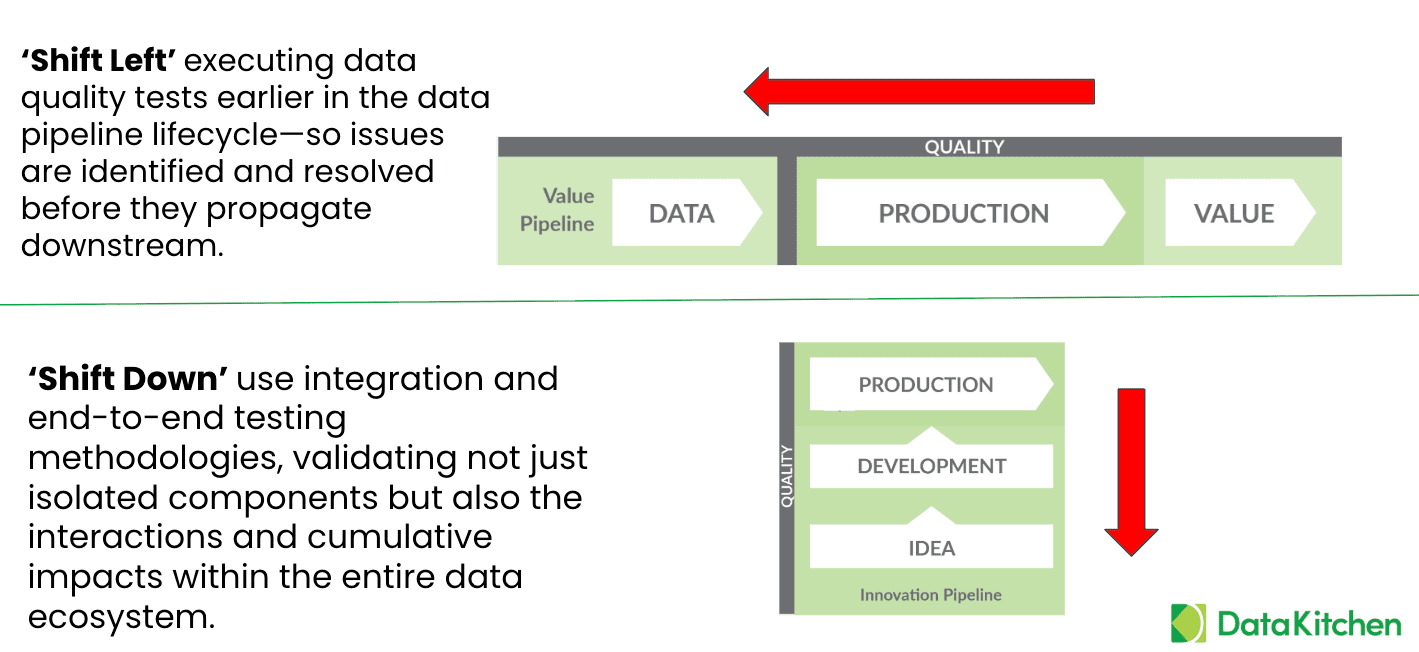
A DataKitchen slide in two halves. Top: Shift Left, executing data quality tests earlier in the data pipeline lifecycle so issues are identified and resolved before they propagate downstream, beside a horizontal Value Pipeline of Data, Production, and Value with a red arrow pointing left. Bottom: Shift Down, using integration and end-to-end testing to validate the interactions and cumulative impacts across the whole data system, beside a vertical Innovation Pipeline of Idea, Development, and Production with a red arrow pointing down.
The two directions from DataKitchen's Flip the Script post. Shift left runs along the value pipeline; shift down runs along the innovation pipeline, from idea to production.
Shift leftShift down
What it testsThe dataThe code and configuration
When the test runsEvery production runEvery change, before it deploys
What it catchesBad source data and broken tools mid-runA change that moves a number it shouldn’t
Test dataToday’s production dataData pulled from production into dev or QA

The Guide’s caption puts the second column in one line: production is yesterday’s code against today’s data, and development testing is today’s code against yesterday’s data.

Regression and impact tests come first

Run the same bronze, silver, and gold pipeline you run in production, with the changed code, in a development or QA environment loaded with a slice of production data. That’s the regression test. Then compare row counts, null rates, and the metrics your dashboards show, current version against changed version. That’s the impact test. Post the before-and-after on the pull request, and the reviewer judges what the change did to the numbers instead of guessing from the code.

The Guide says to build regression first and add unit tests later. Unit tests check one model at a time, and the renamed column breaks something three layers away.

The test environment has to look like production

A test is only as honest as the place it runs. DataKitchen’s post on environments names the usual gap: development runs on stale, three-month-old data while production runs on live data, or development sits in the cloud while production sits on-prem. Both make a green build mean less. The rule there is that development should be a clone of production, to the extent possible.

Cheap cloud copies make that practical now. It’s also why DataKitchen designs pipelines the FITT way (functional, idempotent, tested, two-stage): a pipeline you can rerun from immutable raw data is a pipeline you can stand up again in QA without a weekend of setup.

A green health check can still be wrong

A suite that checks whether data looks healthy will pass on data that’s missing. In DataKitchen’s October 2026 migration test, 55 health tests passed on a copy that had lost 483 orders. TestGen’s 345 Table Comparison tests failed 61 times on the same data and found the gap. A release has the same blind spot. “No nulls, keys unique” passes on a version that quietly drops a region, and only a comparison against the current version notices.

Most teams deploy on hope

The Flip the Script post estimated in September 2025 that about 80% of data teams rely on hope-based testing in development: a quick manual look, then deploy and wait. Large companies replace hope with meetings instead. DataKitchen’s 2018 post on impact review boards describes a room of senior experts who can take weeks or months to approve 20 lines of SQL. Shift down turns what those experts know into tests that run on every change, so the change ships the day the tests pass.
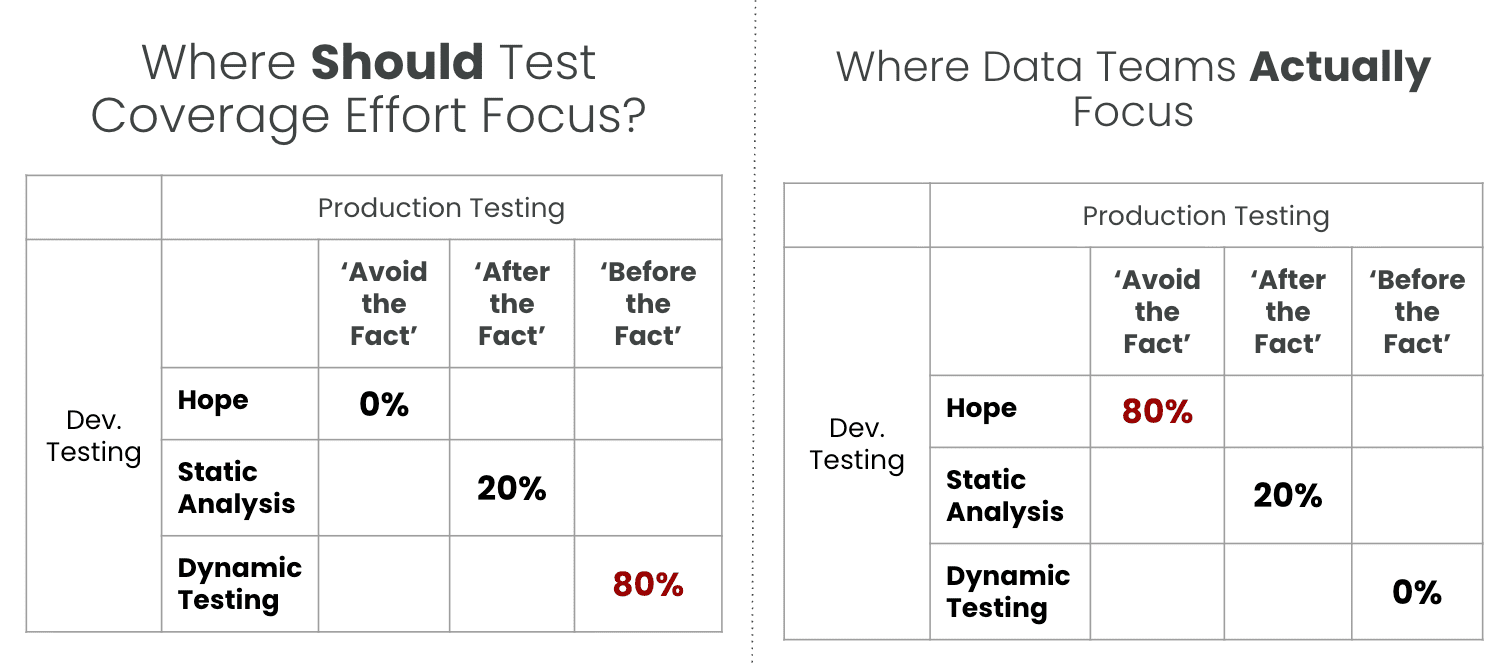
Two grids comparing development testing (hope, static analysis, dynamic testing) with production testing (avoid the fact, after the fact, before the fact). Where test coverage effort should focus: 0% hope, 20% static analysis, 80% dynamic testing. Where data teams actually focus: 80% hope, 20% static analysis, 0% dynamic testing.
DataKitchen's September 2025 estimate from Flip the Script: the split teams should aim for on the left, and the one most teams run on the right.

The economics follow the 1:10:100 rule from George Labovitz and Yu Sang Chang. The Guide applies it to code: a regression costs up to 100 times more once it reaches a customer than it does in development.
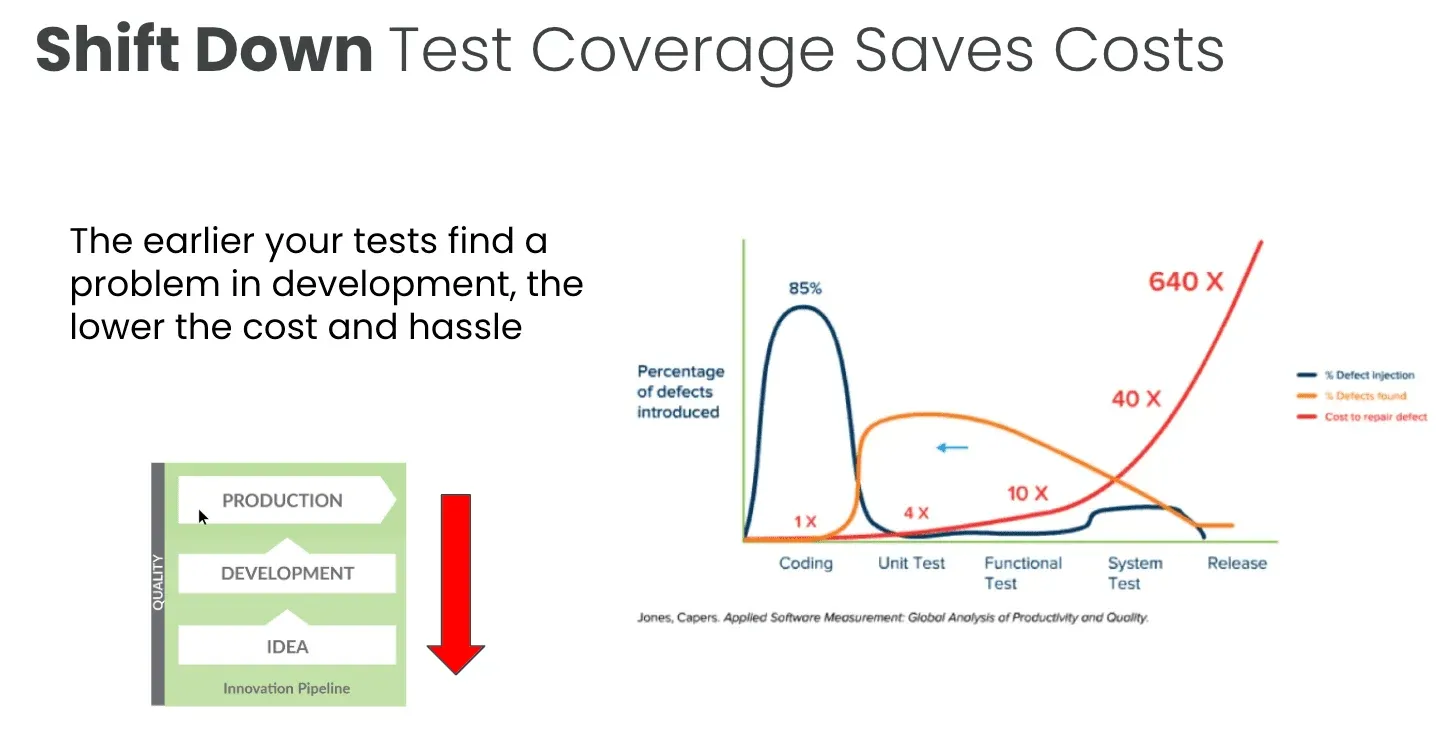
A DataKitchen slide titled Shift Down Test Coverage Saves Costs, with the text: the earlier your tests find a problem in development, the lower the cost and hassle. A chart from Capers Jones's Applied Software Measurement plots, across coding, unit test, functional test, system test, and release, the share of defects introduced (85% in coding), the share found, and the cost to repair a defect, rising from 1x in coding to 4x, 10x, 40x, and 640x.
The software version of the same curve, from Capers Jones's Applied Software Measurement as used in Flip the Script: 85% of defects go in during coding, and repair cost climbs from 1x there to 640x by release.

To wire the tests into GitHub Actions, GitLab CI, or Azure DevOps, see running data tests in CI/CD. For what to compare before a release, see testing data before a BI release. The open-source DataOps TestGen generates the routine regression checks from a profile of each table, and DataKitchen sells it, so weigh that.

Frequently asked questions

Short answers to the follow-up questions people ask next.

What is the difference between shift left and shift down?

Shift left moves data quality tests toward the source along the production pipeline, where data flows. Shift down moves tests into the deployment path, where new code and configuration flow from development to production. Shift left catches bad source data and broken tools mid-run. Shift down catches a code change that silently moves a number. DataKitchen's Flip the Script post argues a team needs both.

What tests does shift-down testing include?

Regression tests and impact tests first. A regression test runs the full changed pipeline on test data pulled from production and checks that what worked before still works. An impact test compares row counts, null rates, and key metrics between the current and the changed version. DataKitchen's Guide to DataOps Tests says to build regression testing first and add unit tests later.

Why aren't unit tests enough for shift-down testing?

Because most release failures happen between components. DataKitchen's Guide to DataOps Tests gives the example: rename a column in silver to fix a misspelling, and a process in gold that reads it breaks, along with every report on gold. The unit test on the changed model still passes, and so does a manual review of the diff, because neither one looks three layers downstream.

Where does the test data for shift-down testing come from?

From production. Use a filtered slice of production tables or a zero-copy clone, loaded into a development or QA copy of the same pipeline. Synthetic data rarely carries the duplicates, odd categories, and late records that break real reports. Where privacy rules apply, mask or sample the production data in a way that keeps its statistical shape.

Do I need a separate test suite for shift-down testing?

Mostly no. The data tests that guard production (row counts by layer, uniqueness, referential integrity, aggregate balance) also run against the changed pipeline in development or CI/CD. A team that already tests production data has most of its shift-down suite. What it adds is the before-and-after comparison against the current version.

Try it on your own data

DataOps TestGen is free and open source. Profile a table and generate its tests this afternoon.