Welcome, dear readers, to the hallowed halls of Data Buck-Passing University, where the motto is “Per Alios Culpa Transfertur ” (Blame is Transferred to Others). In the world of data and analytics, one skill stands timeless and universal: the art of blaming someone else when things go sideways. Let’s embark on this ironic journey through the curriculum of advanced finger-pointing, where blame is not just for breakfast anymore. It’s a full-course meal.
Introduction to Advanced Finger-Pointing
In this foundational course, students will learn the subtle nuances of directing attention away from themselves with the grace of a ballet dancer avoiding a puddle. This course covers the basics, from the “I believe that was their responsibility” to the advanced “As per my last email…” techniques. With some practice, you’ll perfect that innocent shrug and bewildered look that says, “Me? Could never be!”
Blame, It ‘s Not Just for Breakfast Anymore
Who said blame had to be confined to the early morning scrum meetings? In this module, we expand your palate, allowing you to savor the flavors of blame throughout the day. From the morning email blitz to the late-night Slack message bombardment, discover the joy of sprinkling a little blame in every interaction. It’s the seasoning that makes the data world go round.
10 Ways to Find the Fall Guy
Why take responsibility when you can embark on the exhilarating hunt for the fall guy? This course teaches you ten innovative strategies to identify the perfect scapegoat for every occasion. From interns to the cloud service provider, nobody is safe. By the end, you can pin an ETL failure on the office plant with convincing evidence.
Olympic CYA Techniques
In the grand tradition of the Olympics, this course introduces you to the competitive world of Covering Your Analytics (CYA). Here, you’ll learn to draft emails, document decisions, and log meetings with the precision of an athlete, all in the noble pursuit of ensuring that when the data hits the fan, your tracks are not just covered; they’re practically invisible.
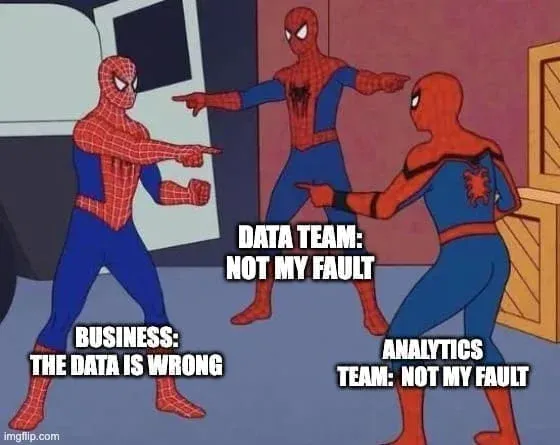
The Spiderman Finger-Pointing Meme: A Case Study
This module dives deep into the cultural phenomenon of the Spiderman finger-pointing meme, exploring its relevance to data teams worldwide. Through a comprehensive analysis, learn how to implement this timeless meme into your daily work life, ensuring that when accountability is called for, you’re ready with a meme that says, “Why not them?”
When In Doubt, Blame The Data Provider
Does the report contain errors? It must be those guys who supplied us with the data; they are constantly screwing up. They are always the real reason. Learn five easy ways to say ‘Garbage In, Garbage Out’ in calm, soothing business terms. Or ten ways to say, ‘It’s a Data Governance type problem.‘
Just Put it into Production, and I Can Blame Someone Else
Ah, the crowning jewel of our curriculum. This advanced seminar encourages the reckless push of untested code into Production with the safety net of a well-crafted blame strategy. Why bother with regression testing and impact checking when you can deploy and deflect? After all, someone else is in charge of the deployment pipeline, ripe for the blaming.
Why is Data Buck Passing University For You?
By the end of your studies at Data Buck-Passing University, you’ll have mastered the art of deflection and gained a PhD in Not My Fault-ology. Remember, in the fast-changing world of data and analytics, it’s not about the mistakes made but about how creatively and convincingly you can attribute those mistakes to someone else.
So, embrace the chaos, enroll today, and enter a brighter future where accountability is just a word in the dictionary between “absurdity” and “accolade.” Welcome to the art of blame—a skill that will serve you in data meetings, team collaborations, and, unfortunately, life itself.
FAQ
What are the key points in this blog?
This is a satire of blame culture in data teams, written as the course catalogue of Data Buck-Passing University. The curriculum runs from Introduction to Advanced Finger-Pointing through Olympic CYA Techniques to the crowning seminar on pushing untested code into production so that somebody else owns the failure.
What is data buck-passing?
Data buck-passing is deflecting responsibility when data goes wrong, directing attention elsewhere rather than owning the problem. The classic moves include claiming it was someone else’s responsibility, citing a previous email, and identifying a scapegoat, from an intern to the cloud service provider to the office plant.
Why do data teams blame the data provider?
Because it is the easiest available explanation and it is often partly true. Errors in a report can always be attributed to whoever supplied the data, expressed politely as garbage in, garbage out, or reframed as a data governance problem. Both phrasings end the conversation without anybody investigating what actually happened.
What does pushing untested code to production have to do with blame?
It is the advanced technique. Deploying without regression testing or impact checking transfers the failure to whoever owns the deployment pipeline. Skipping verification is not merely careless; inside a blame culture it is a rational way to ensure that when something breaks, the fault belongs to somebody further down the chain.
What is the serious point behind the satire?
That blame-shifting is a widespread and corrosive response to data failure, and that it substitutes for accountability rather than fixing anything. When a culture rewards creative attribution of mistakes over addressing them, the same problems recur, because nobody is ever responsible for the conditions that produced them.