Venture-funded open source has a timer, and Elementary’s just went off. On October 19, 2026, Boomi acquired Elementary Data, an open-source data observability company, and Elementary’s own post says: “The product continues, the open-source project continues, your service runs uninterrupted.”
The timer was set the day Elementary took venture money, and it has been running ever since. Full disclosure: DataKitchen makes TestGen, an open-source data quality tool, so we have a stake in this question.
The timer starts with the first check
When an open-source project takes venture capital, the investors need an exit. A fund has a life span, and the money has to go back to the people who put it in. So the exit has to come within the life of the fund. Elementary raised its seed money in 2022 and sold in October 2026. The clock can run short.
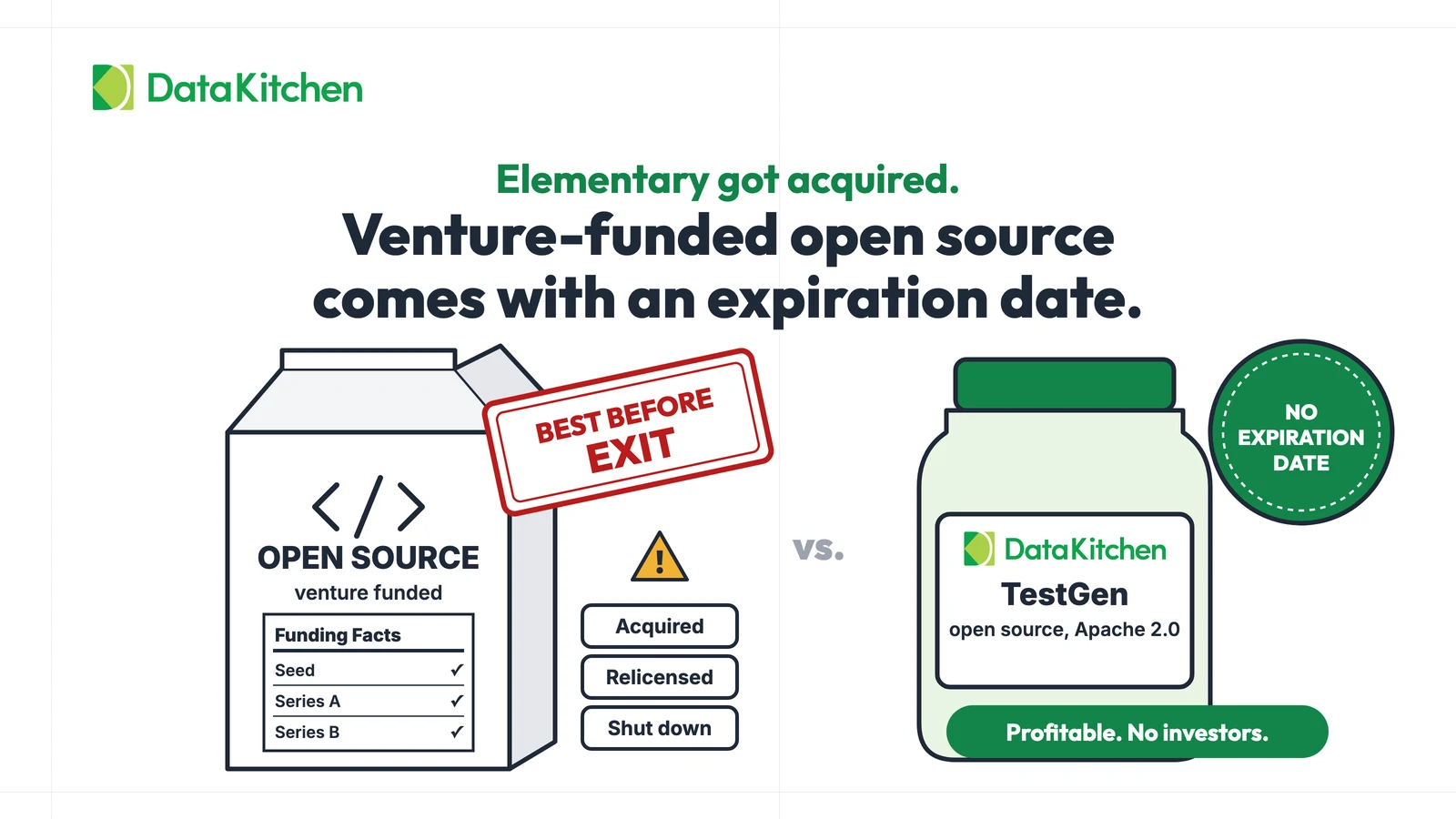
The exit comes in one of three forms. The company gets acquired. It changes its license. Or it shuts down. Each one changes what you can rely on.
The open-source license on past releases doesn’t protect you from any of them. That code stays yours. But the roadmap, the maintainers, and every future version belong to whoever owns the company. You built on a project, and the project’s next five years just became somebody else’s decision.
My view, and I’ll label it as mine: if you’re choosing an open-source data quality tool, the funding structure tells you more about its future than the feature list does.
Most of these timers ended in a sale
Elementary. It began in 2022 as an open-source, dbt-native observability project. It raised about $8.5 million in seed money from Cowboy Ventures, Y Combinator, and TLV Partners. Boomi cites 1,500+ data teams and about a million downloads a month, and it bought the company on October 19, 2026.
Great Expectations. The company raised $64.5 million, most recently a $40 million Series B in 2022. On May 6, 2026, it announced that FICO is acquiring GX Cloud, and “GX Cloud will no longer be publicly available beginning June 1.” GX Cloud shut down on June 1. The open-source GX Core went to Fivetran, “the new steward,” which “intends to support ongoing project maintenance.” The company split in two. The commercial half went one way and the community half went another.
HashiCorp. This is a related ending, not the venture-fund timer itself. HashiCorp was venture-backed, and it went public on Nasdaq on December 9, 2021, so its venture investors got their exit first. Then, on August 10, 2023, it moved Terraform and Vault from the open-source MPL 2.0 license to the Business Source License. The community forked Terraform as OpenTofu, which the Linux Foundation accepted on September 20, 2023. IBM closed its purchase of HashiCorp on February 27, 2025, for about $6.4 billion. The pressure doesn’t end when the funds cash out. Once the owner is public shareholders, and then an acquirer, the open-source license still changes.
The rest of the category. Our March 2026 post counted 26 vendors in data observability and data quality that took more than $1.02 billion of venture money. The endings keep coming. Metaplane went to Datadog. Databand went to IBM. Synq went to Coalesce. Kensu closed.
Add it up and most of these venture timers ended in an acquisition: Elementary, GX Cloud to FICO, Metaplane, Databand, and Synq. Kensu closed. The same structure sits underneath all of them. HashiCorp is the other case: the license changed after the venture investors had already exited.
The timer isn’t the founders’ fault
I’m not saying the people at Elementary did anything wrong. Elementary’s CEO, Maayan Salom, said that joining Boomi, “with 30,000+ customers and 800+ partners, lets us make trusted data the default.” I’d take that at face value.
Intent isn’t ownership. Once a company is acquired, the owner’s plan wins, and the owner has a platform to sell. A project that was built to serve a community now sits inside a product that serves a strategy. Maybe the two line up for a long while. You still don’t get a vote.
Data observability is a commodity: open-source time-series anomaly detection algorithms, such as Prophet and ARIMA, applied to the outputs of a few SQL queries. That makes it easy to fold into someone else’s platform, and there’s little proprietary technology standing between the community and the new roadmap.
Great Expectations fits the same pattern. A new steward saying it intends to support maintenance is a good-faith statement. It’s also a statement about intent, from a company that now owns the thing.
Founders take venture money because it buys speed, and it works. The cost shows up later and gets paid by the people who adopted the project. That’s you.
Ask who is waiting for the exit
Before you build tests and monitors on an open-source data quality tool, ask three questions.
Who funds it? How much money has gone in? Do the investors expect an exit?
If the answer is a venture fund, there’s a date on the clock. You may not know what it is. You just have to know there is one.
Then prefer a vendor that is profitable and has no investors. The risk doesn’t drop to zero. A company like that can still be sold, change its license, or lose its people. But no investor is forcing a sale on a schedule, so a sale is a choice, not a deadline. The company makes money by keeping customers happy. That’s a boring reason to choose a tool. Boring is what you want under a pipeline that runs at 2am.
Our answer, and how to check it
DataKitchen raised $0 and is profitable. TestGen is open source under Apache 2.0, and no investor is waiting on us to sell. We could still be sold or change course someday. That would be our choice, not a fund’s deadline.
You can’t verify our finances from the outside, and I won’t pretend you can. So ask us the same questions you’d ask anyone else. Who funds you? Do you have investors? Do you make money? We’ll answer.
Then start small. Point TestGen at the one table you don’t trust and see what it finds. It’s open source, and the company behind it has no exit to chase: datakitchen.io/install/testgen.