Your supplier changed a column type last Tuesday. You found out Thursday, from a dashboard, in front of your boss. There was a spec. Nobody ran it.
That’s the whole case for data contracts. A contract is a promise with tests attached. If the tests don’t run, you have a PDF.
This is the fourth post in our 2026 series on the tools. The first three covered open source data quality and observability, commercial data quality and observability, and open source data profiling. This one covers the tools that read, write, and enforce data contracts, with GitHub stats, pricing where anyone publishes it, and a hard filter on what counts.
A disclosure, since you’d ask: we make TestGen. It’s in both tables, scored on the same criteria as everyone else, and its ODCS support ships on November 12, 2026, after this post goes up. What we’d say in its favor, and where it falls short, is in its own section near the end.
Part 1: The 2026 data contract tools
Why now
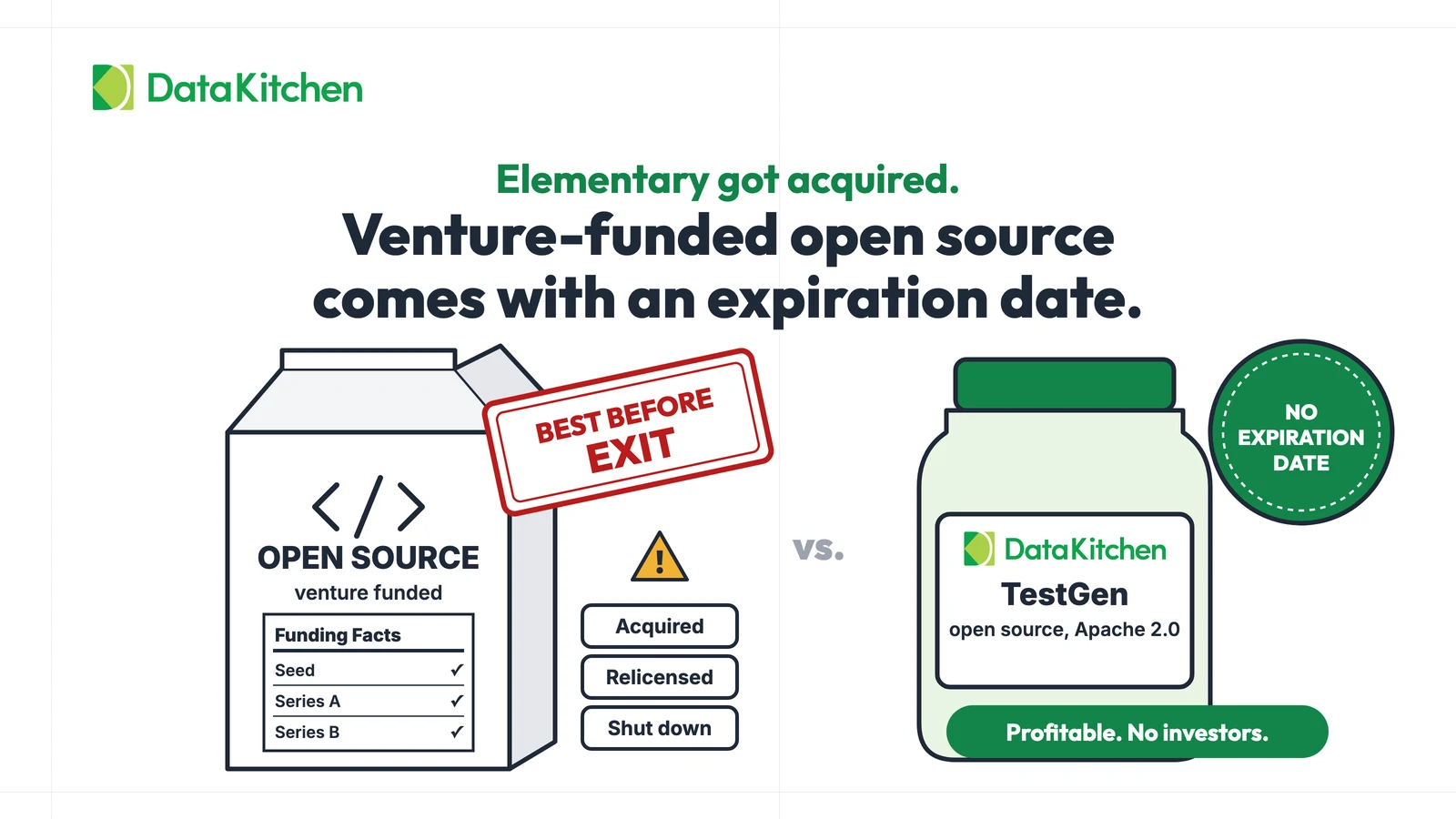
The format war is over. The Open Data Contract Standard (ODCS), maintained by Bitol under the Linux Foundation AI & Data, shipped v3.1.0 in December 2025. The competing Data Contract Specification deprecated itself in favor of ODCS the same month. Bitol counts 114 adopting organizations, up from nine in 14 months. If a tool invents its own contract format in 2026, you can’t hand that contract to anyone who doesn’t use the tool. That’s a problem, since the supplier who sends you garbage every Friday is the person you most need to hand it to.
How we judged the tools
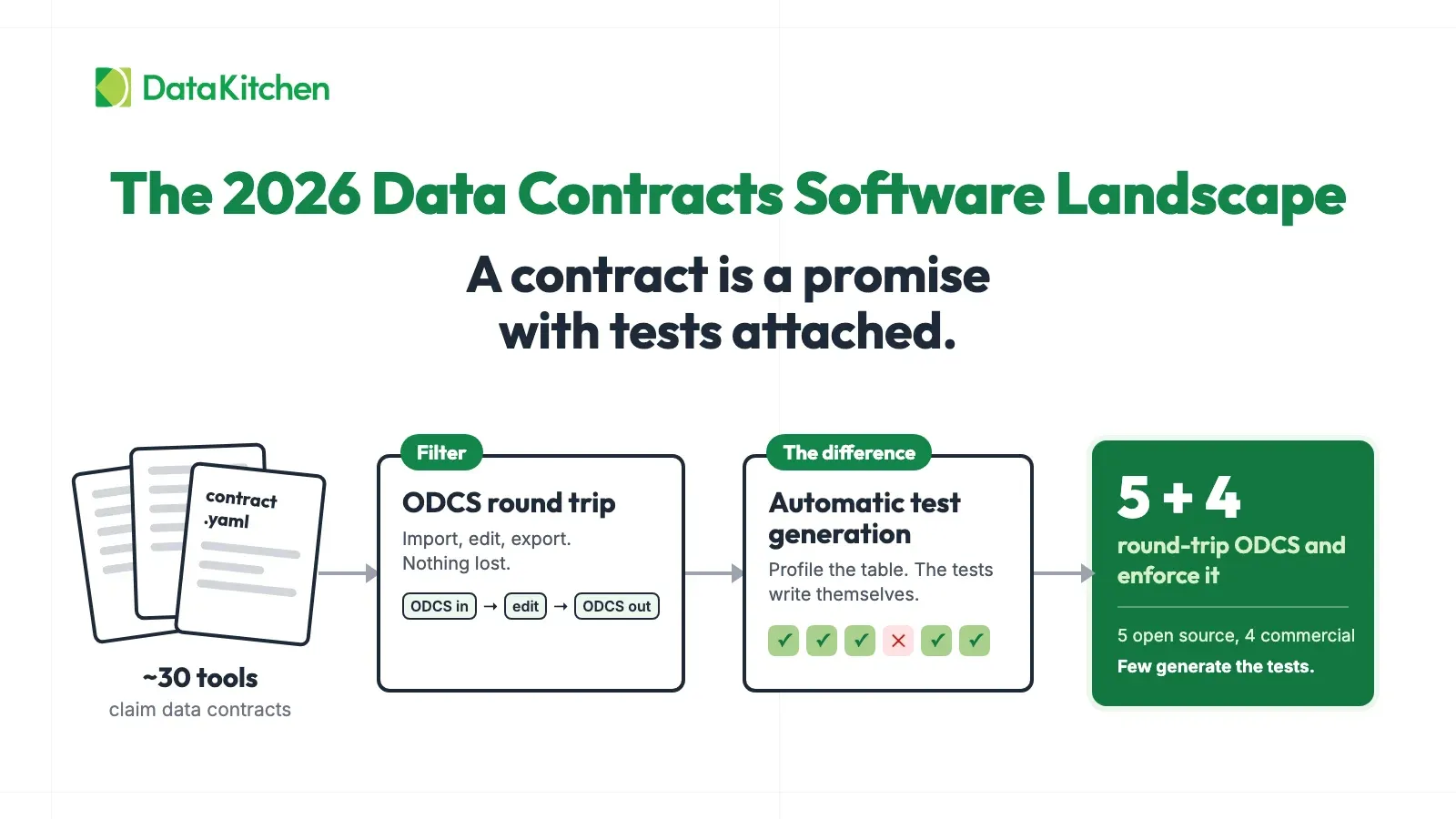
We started with roughly 30 tools, most of them from Bitol’s own vendor list, and applied two filters. First, can you put an ODCS file in, edit it, and get a faithful ODCS file back? Second, does the tool run tests against your data and fail when a term is broken? A tool that fails either test is a catalog or a text editor, whatever it calls itself.
For the survivors we scored five things. Does the ODCS round trip lose fields? Do tests run on real data? Can you point it at an existing table and get back a complete ODCS contract, schema plus a runnable test suite covering types, nulls, ranges, patterns, uniqueness, freshness, and volume, with no hand-written YAML? Can someone without a terminal use it? And does it have an MCP server, so an agent can read and act on the contract? For open source tools we also pulled GitHub stars, forks, license, release cadence, last commit, and how many humans actually commit, as of 26 October 2026.
Open source data contract tools
Five projects pass both filters. Two are built around ODCS with a company behind them, though ours adds ODCS support on November 12. Two treat contracts as one feature of a bigger platform. One is a single engineer in Singapore.
| Tool | ODCS round-trip | Enforces with tests | Tables to contract with tests, automatically | Business UI | MCP | License | Health (26 Oct 2026) |
|---|---|---|---|---|---|---|---|
| DataKitchen TestGen | Yes, from November 12, 2026 (not yet released when this was published) | Yes. Tests run in your database on every refresh | Yes, with ODCS output from November 12, 2026. One profiling run produces the schema and the tests: 55 characteristics per column, 32 hygiene detectors, 34 generated test types. LLM-written custom tests through MCP | Yes | Yes, 100+ tools in the open source edition | Apache 2.0 | 223 stars across the installer and TestGen repos, 57 GitHub releases, 39 PyPI releases, commits weekly |
| Data Contract CLI + Data Contract Editor (Entropy Data) | Lossless. The YAML file is the record | Yes. 18+ platforms including Kafka and S3, CI gate | Schema only. Import reads the DDL for types and required flags; declared attributes become checks. No ranges, patterns, freshness, or volume unless you write them. No profiler | Yes (Editor) | No. Agent skills published instead | MIT | CLI 1,101 stars, 308 forks, 98 PyPI releases, 7 recent human authors. Editor 125 stars, 3 authors |
| OpenMetadata | Lossy, and documented. Drops servers, pricing, support, tags, custom properties; doesn’t keep the original file | Yes. ODCS quality rules become test cases | Yes, lossy on export. Profiler plus a subset of Collate’s AutoPilot proposes tests, then ODCS export | Yes | Yes | Apache 2.0 | 15,586 stars, 25 recent human authors, 51 PyPI releases in 180 days |
| Databricks DQX (Databricks Labs) | Reads ODCS, doesn’t rewrite it | Yes, Databricks only | Partial. Generates rules from a profile and from natural language, but consumes contracts rather than writing them | No | Via Databricks | Databricks License (not OSI) | 476 stars, 162 forks, 15 recent human authors |
| vowl (GovTech Singapore) | Native | Yes, server-side SQL via Ibis | Schema only | No | No | MIT | 22 stars, one author, shipping monthly |
Below that line sit the solo projects: DataVow, ContractGate, odcs-java-sdk, FLUID Forge, datacontract-x, SemaPact, dc43. Each has one author and under 20 stars. Three of them haven’t had a commit since summer. We looked. You don’t need to.
Two things to notice in the table. Only one open source tool turns an existing table into a complete ODCS contract with tests and hands the file back intact: TestGen, once its ODCS support ships on November 12. OpenMetadata gets there but loses fields on export. DQX generates rules from a profile and from plain English, then stops, because it reads contracts and never writes them, and it only runs on Databricks under a non-OSI license. And the Entropy Data stack, the purest ODCS implementation on the list, has no profiler at all. It tests what you declare. It can’t tell you what you forgot to declare.
Commercial data contract tools
Four vendors pass both filters. Soda is here too, because you’ll ask, with the caveat that it fails the round-trip test. Three publish prices. Two want a sales call.
| Vendor | ODCS round-trip | Enforces with tests | Tables to contract with tests, automatically | Business UI | MCP | Pricing |
|---|---|---|---|---|---|---|
| DataKitchen TestGen Enterprise | Yes, from November 12, 2026 (not yet released when this was published) | Yes, same engine as open source | Yes, same engine as open source, ODCS output from November 12, 2026 | Yes, multi-user with roles | Yes | Flat, per user and connection, not per table or per row. Published |
| Entropy Data (ex Data Contract Manager, founders on the Bitol TSC) | Lossless; ODCS is the storage format, ODPS 1.0 native | Via the CLI in your environment. No profiler of its own | Schema only. Import gives types and required flags; a coding agent authors contracts, but nothing scans a table and proposes rules | Yes (Studio) | Yes, remote; agents run governed SQL on output ports | Published: Team EUR 20k/yr, Business EUR 75k, Enterprise EUR 200k. Extra Studio users EUR 99/month, read-only free |
| Collibra Platform + Data Quality & Observability | File-faithful. Stores each manifest version verbatim, but maps only camelCase fields to the catalog | Yes, through Collibra DQ. Agents deploy checks from the contract and regenerate them on change | Yes, across two SKUs. Manifest from the knowledge graph, ML-generated rules from Collibra DQ | Yes | Yes, read and write | Not published. Estimates run about double Atlan, whose own floor is $100k/yr. DQ is a separate SKU |
| Collate (managed OpenMetadata) | Same lossy mapping as OpenMetadata | Yes | Yes, lossy on export. Profiler plus Quality Agent, then ODCS export | Yes | Yes, 26 tools | Free managed tier. Enterprise: contact sales |
| Soda | No. Own single-dataset checks format; ODCS is treated as a documentation layer and translated in one direction | Yes, strong. Missing, invalid, duplicate, aggregate, failed-rows, and metric checks across the major warehouses | Schema only, via the contract generation plugin, and not in ODCS | Enterprise only. Collaborative contracts and the no-code UI are gated to the Enterprise plan | Yes. create, publish, and verify contract tools for Soda Cloud customers | Published: free to 3 datasets, Team $8 per dataset per month, Enterprise custom. Soda Core is Elastic License 2.0, not open source |
What didn’t make the cut
Most of the field fails on round-trip, not on enforcement. DataHub ingests ODCS one way and never exports it; a contract lands as a logical dataset, not a contract. Soda sits in the commercial table on strength of enforcement alone; its format is its own and Soda Core is no longer open source. Atlan uses its own YAML. Gable enforces schema agreements on application code at pull-request time, which is useful and a different product. Great Expectations never had a contract format and now lives under Fivetran. IBM, Databricks Ontos, Actian, Witboost, and DQC.ai are on Bitol’s list, but we couldn’t verify round-trip or enforcement from their public docs. Confluent Schema Registry and dbt model contracts enforce for real and speak no ODCS.
Part 2: Our data contract evaluation criteria
Building a data contract is hard. Keeping it updated is harder. Running it often enough that it actually tells you whether your data is right is the hardest of all. Most teams barely have time to test their data, let alone publish a contract to a standard and republish it every time a column changes. A contract nobody updates goes stale, a contract nobody runs proves nothing, and either one is worse than none: it looks like protection while the data drifts underneath it.
So the columns in both tables measure one thing, which is how much of that upkeep the tool does for you. Here’s why each column matters, and what separates a contract that protects you from one that decorates a wiki.
The round trip
If you can’t get your ODCS file back out, you don’t own your contracts. The tool does. OpenMetadata is honest about this: import a long ODCS file and you get a short contract back, with servers, pricing, support terms, and custom properties gone. Collibra keeps the file but only maps the fields it recognizes. DataHub keeps nothing. Ask any vendor one question: if I import this file, edit one threshold in your UI, and export, what’s different? If they can’t answer, the contract lives in their database, and so does your bargaining power with your supplier.
A UI the business can use
A contract is an agreement between a producer and a consumer. Half the time one of those people is a data steward or the person who owns the P&L for the report. Neither will open a YAML file. If the only way to read or change a contract is a text editor and a git commit, the business side will nod in the kickoff meeting and never look again. You want the contract on a screen where a steward can see every term, which ones passed last night, and which one failed, with the table, column, and the threshold it missed.
Tables to contract, with tests, automatically
A contract with four tests is a schema check. A real contract on a 40-column table needs something closer to 150 terms: types, nulls, ranges, patterns, uniqueness, referential checks, freshness, volume. Nobody writes 150 tests by hand. Nobody maintains them by hand either, which is why most contract programs quietly decay into a schema check within six months.
This is the part of the market that’s thin. Most ODCS tools generate tests from what you declared in the contract. That’s deterministic and useful, and it only covers what you already knew to write down. Your supplier’s file has four different spellings of null in the comment column. You didn’t declare that because you didn’t know. A profiler finds it. The tools that generate tests from profiling, from the declared schema, and from a sentence you type to an LLM are the ones that produce enough coverage to matter. In open source that’s TestGen and OpenMetadata, though OpenMetadata’s export is lossy. In commercial it’s Collibra across two SKUs, Collate with the same lossy export, and TestGen Enterprise.
Profiling plus automatic test generation
You need both, connected. Profiling is how the tool learns what normal looks like before you ask it to defend normal. Profiling and semantic metadata give you the context. Test generation turns that context into coverage, and an MCP server wired to the same profiling context is how an LLM adds the tests a rule engine can’t think of. A profiler that writes a report gives you context and zero tests. A generator with no profile can only restate the schema you declared.
OpenMetadata and Collate pair a profiler with test proposals. Collibra pairs ML-generated rules with its catalog. DQX profiles and generates rules on Databricks. TestGen profiles every column and generates the suite from the result.
Entropy Data, the most faithful ODCS implementation on the list, doesn’t profile. It will enforce every term you write. It won’t tell you what to write.
MCP, because the next consumer is an agent
In 2026 the thing reading your data is increasingly a model, and a model doesn’t notice when a column changes meaning. An MCP server on your contract tool lets an agent check a contract before it queries, create a term when it finds a gap, and read last night’s results. Every catalog now ships one. The differences are whether the agent can write as well as read (Collibra and Soda can, most catalogs can’t), and whether it can run a governed query through the contract (Entropy Data can).
Where data contracts earn their keep
Four places. Put the first contract wherever it hurts most.
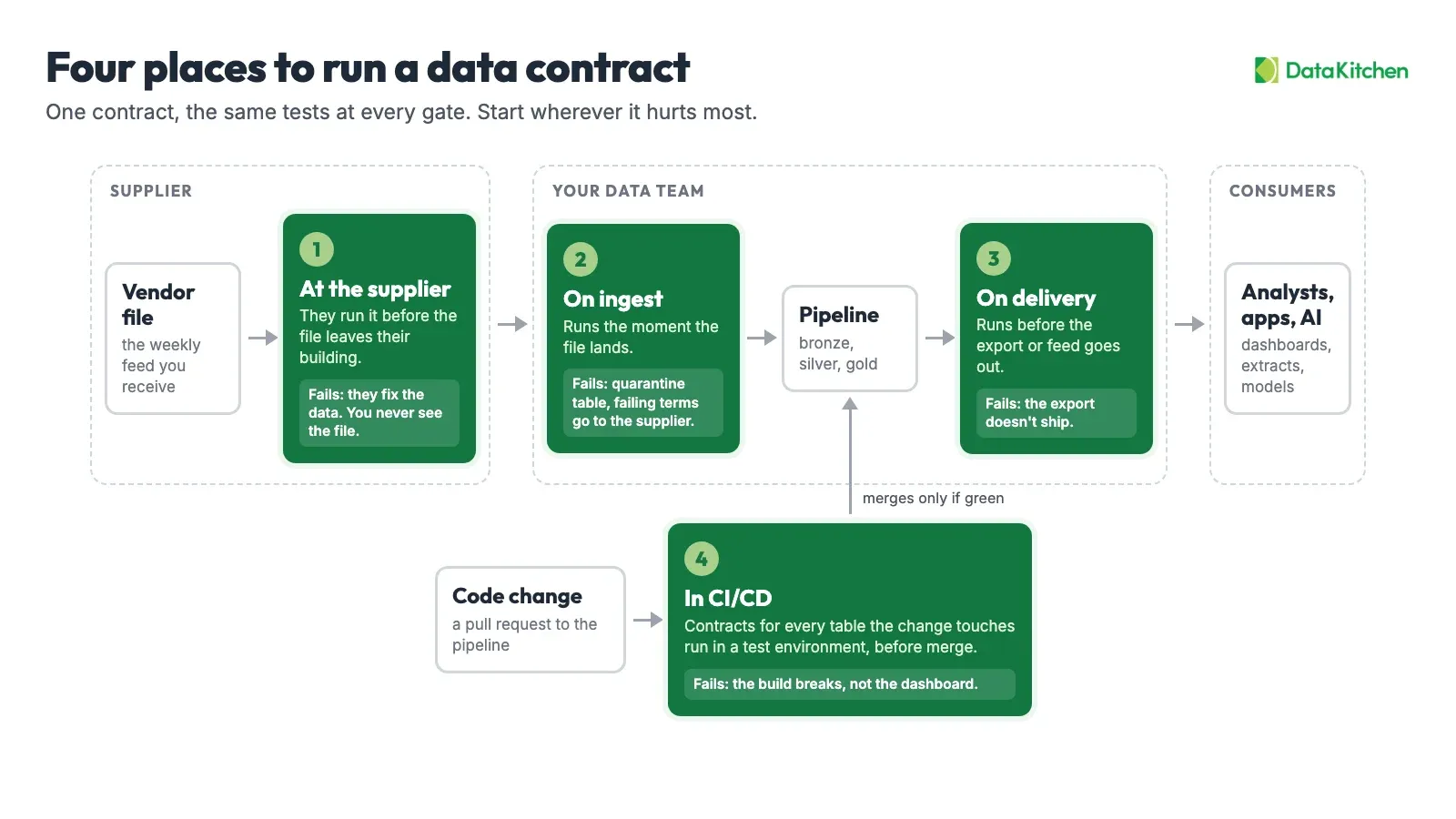 Figure 1: One contract, four gates. The same ODCS file and the same tests run at each one.
At the supplier: before the file leaves their building
You receive a file from a vendor every week. Some weeks it has an extra column. Some weeks it’s 40% shorter and nobody mentions it. Write the contract for that file and send it to the supplier along with a free tool that runs it. They run it before they ship. If it fails, they fix the data, not you, and you never see the broken file. This is why the tool has to be open source with no seat count: you can’t ask a supplier to buy a license to prove their own file is right. Our consulting team deals with suppliers who send garbage on a schedule. A contract they can run themselves is the most useful thing we’ve handed them.
On ingest: the moment it lands
Not every supplier will run your contract. Some won’t answer the email. So the same contract runs again on your side, the moment the file lands and before anything downstream touches it. Today you find out about a bad file when the load fails, or worse, when it doesn’t and the numbers are quietly wrong. With the contract at ingest, the file fails in a quarantine table, the supplier gets the failing terms with the table, the column, and the threshold, and your pipeline never sees it. Same contract, same tests, second line of defense.
On delivery: prove what you shipped
You build the gold table, the extract, the feed to the downstream team. Attach the contract. Run it before the export goes out. If it fails, the export doesn’t ship, and the first person to know is you, not the analyst who built the board deck on it. The contract is also your receipt. When the business asks what the data team did this quarter, a list of passing terms on every dataset you delivered is an answer. A Jira velocity chart is not.
In CI/CD: break the build, not the dashboard
Every pipeline change runs the contracts for the tables it touches, in a test environment, before merge. A changed column type fails the build. A dropped constraint fails the build. The engineer sees the failure in the pull request, where it costs five minutes, instead of in production, where it costs a Monday. This is the oldest idea in software engineering and the newest one in data engineering. The contract is the test suite you never wrote because you were busy.
Test coverage drives data contract coverage
A data contract covers exactly as much as its tests do. A contract on a table with no tests is a promise nobody checks, and a contract that tests three of 40 columns tells you nothing about the other 37. The question is whether every table you receive and ship has tests on it, so that when data arrives, it’s right. Our guide to test coverage makes the case for testing every table and every column, at every layer. In practice that’s three tests per table (freshness, volume, and schema) and an average of two per column. Ten tables with 20 columns each comes to 430 tests, before a single multi-table check. At 10 minutes a test, that’s 72 hours of writing, and every schema change means revisiting them.
Run your own numbers:
That arithmetic is why contract coverage stalls when people write the tests by hand. Manual tests don’t cut it. You’ll write 10, feel good, and discover the eleventh failure mode in production. It’s also why the tools in this post that generate tests matter more than the ones that only store the YAML.
The business value of data contracts
A data contract converts an argument into a test result. Before the contract, a bad file costs you two meetings and a week of blame with no evidence either way. After, it costs a failed check with the table, the column, and the threshold, timestamped, which the supplier fixes before you ever see it. Multiply that by every feed you ingest and every dataset you ship. The 1:10:100 rule puts a price on where you catch it: preventing a defect at the source costs 1, fixing it after it’s created costs 10, and letting it reach a customer costs 100. A contract at the supplier is the 1. A dashboard in front of your boss is the 100. The budget conversation changes too. You stop asking for money to fix data quality and start showing the receipt for the quality you already deliver. And the AI you’re putting into production gets the one thing it can’t do for itself: a checkpoint that catches a shifted column before a model reasons over it.
Start with one contract. Pick the export you’re most nervous about or the supplier who sends you the most garbage. Write it, run it for a month, and show someone the results.
Where TestGen fits
This is the section where we sell, so read it that way.
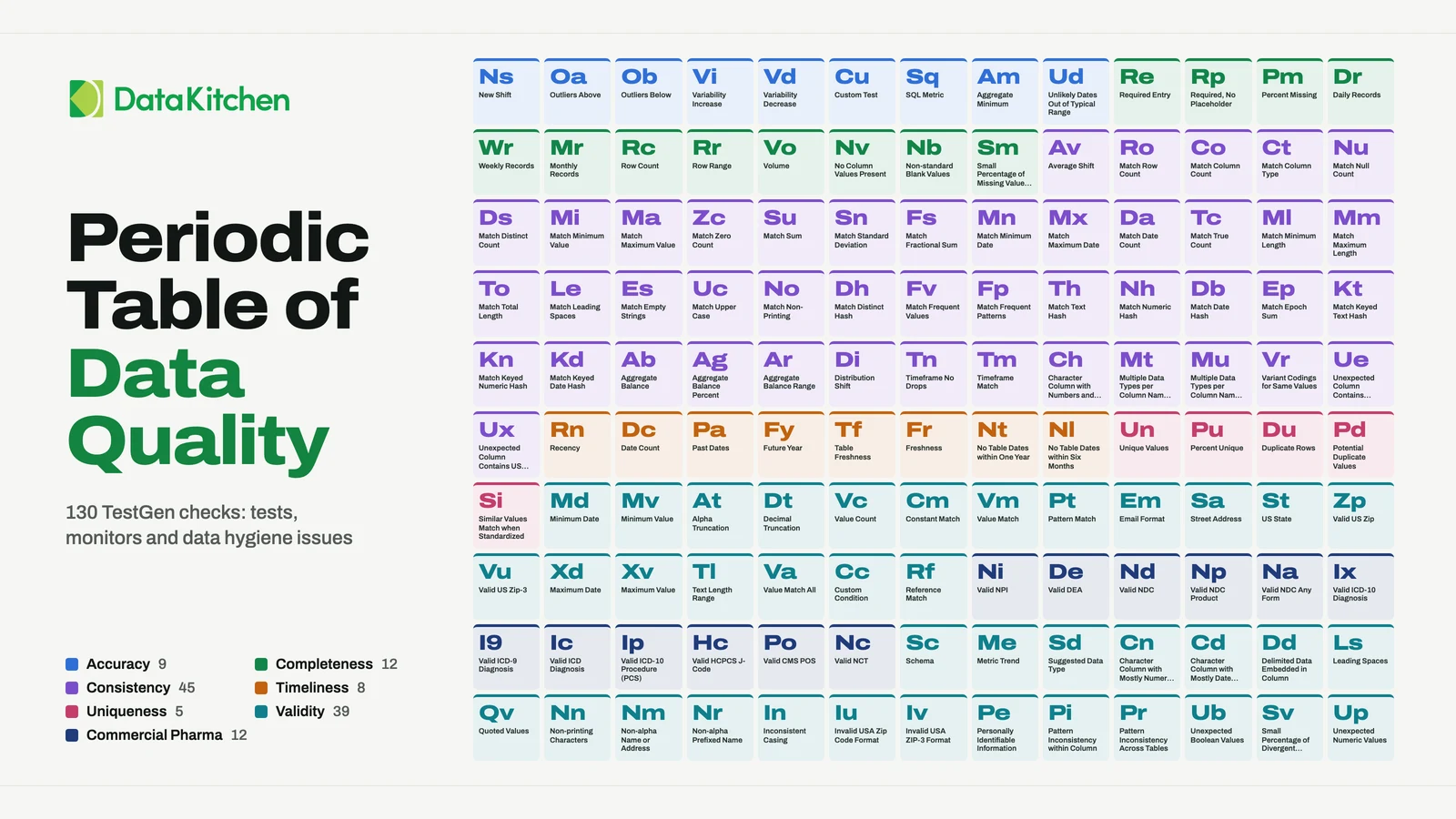
TestGen is built around the combination this post argues for. It profiles 55 characteristics per column and runs 32 hygiene detectors on the result. Point it at a few database tables, and in 60 seconds you have a working data contract with 80% of the data tests you need. Add your favorite LLM and the open source TestGen MCP server, which exposes the whole loop, profiling included, through more than 100 tools, plus the metadata TestGen already holds. Review what it proposes, and you’re at 90%. Total time: five minutes. The last 10% are unique to your business. Your business users create or configure those right in the TestGen UI, with no SQL and no ticket to the data team. That’s 100% contract test coverage. It’s Apache 2.0 with no seat count, so you can hand it to a supplier.
Where it falls short. ODCS import and export ship on November 12, 2026, so on the day this post goes up you’re taking our word for the round trip. The community is small: 223 GitHub stars against 1,101 for the Data Contract CLI and 15,586 for OpenMetadata. And if your contracts are already written and you only need to enforce them in CI, the Data Contract CLI is the most faithful free option on the list.
Install the open source TestGen. It takes about 10 minutes. TestGen Enterprise adds multi-user roles on the same engine.
Read more
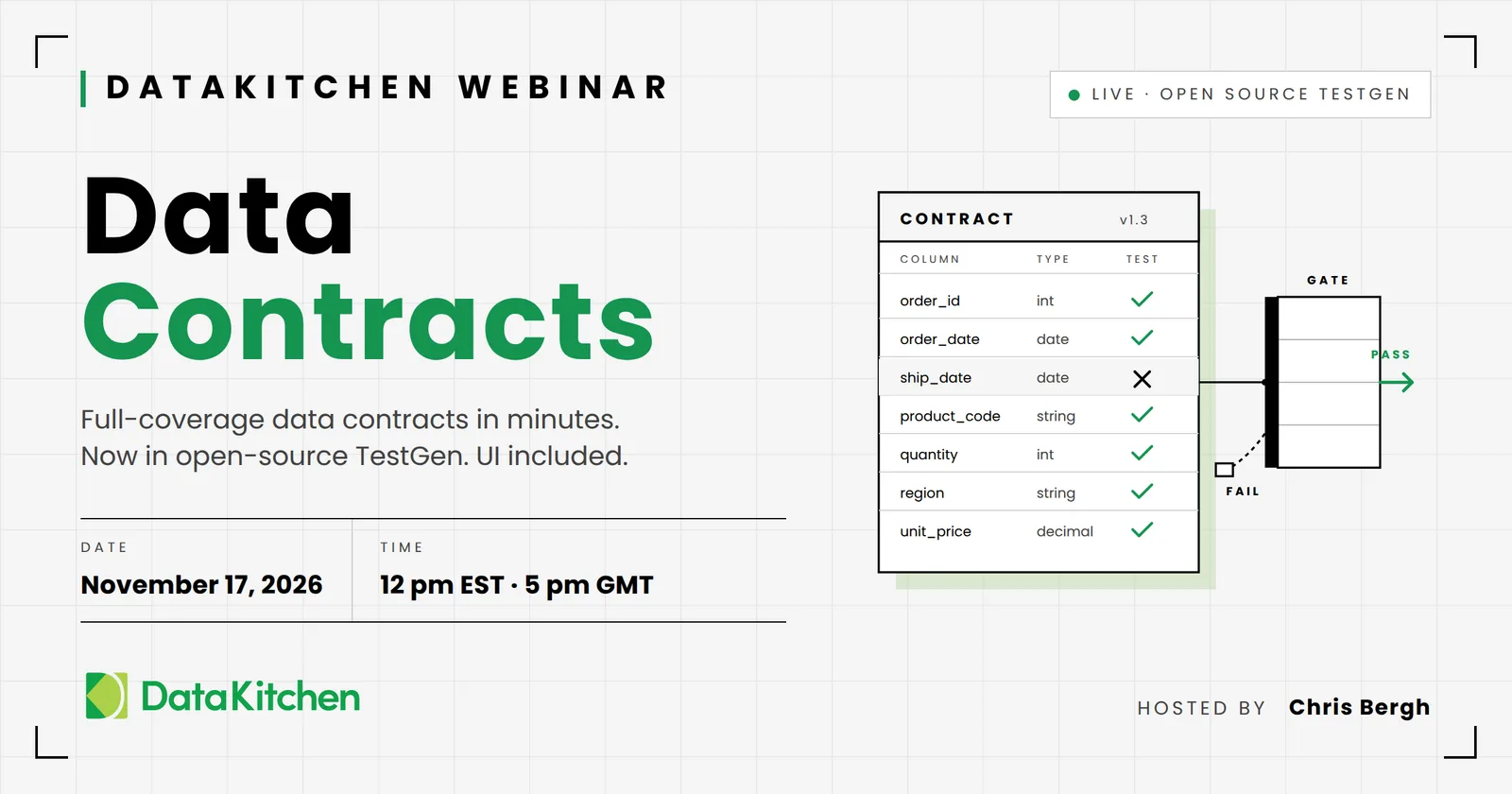
We wrote about why contracts are receipts, not documentation, in The Data Contract Is Your Receipt, and the Data Contracts solution page has the FAQ and the one-contract starting plan. We’re running a webinar on data contracts on November 17, 2026, at 12 pm ET, which will show the ODCS round trip in TestGen live.
FAQ
What are the key points in this blog?
Picking a data contract tool in 2026 comes down to two filters: an Open Data Contract Standard (ODCS) file has to survive import, edit, and export, and the tool has to run tests that fail when a term breaks. Five open source tools and four commercial vendors pass. Most build tests from the declared schema only, and a contract that only tests what you declared decays into a schema check.
What is the Open Data Contract Standard (ODCS)?
ODCS is the open YAML format for data contracts, maintained by Bitol under the Linux Foundation AI & Data. Version 3.1.0 shipped in December 2025, and the competing Data Contract Specification deprecated itself in favor of ODCS the same month. Bitol counts 114 adopting organizations, up from nine in 14 months. A contract written in ODCS can be handed to a supplier whatever tool they run.
What are the best open source data contract tools in 2026?
Five open source projects both round-trip ODCS and enforce contracts with tests: DataKitchen TestGen, the Data Contract CLI and Editor from Entropy Data, OpenMetadata, Databricks DQX, and vowl from GovTech Singapore. TestGen turns an existing table into a contract with tests from one profiling run, with ODCS export from November 12, 2026. OpenMetadata does it too but loses fields on ODCS export, and DQX runs only on Databricks under a non-OSI license.
Which commercial data contract tools publish their pricing?
Three of the five commercial tools in the 2026 comparison publish prices. TestGen Enterprise prices flat per user and connection, not per table or row. Entropy Data lists Team at EUR 20k a year, Business at EUR 75k, and Enterprise at EUR 200k. Soda is free to three datasets, then $8 per dataset per month on Team. Collibra and Collate Enterprise require a sales call.
Can a tool generate a data contract from an existing table?
Yes, but many stop at the schema. The Data Contract CLI, vowl, Entropy Data, and Soda read types and required flags and leave ranges, patterns, freshness, and volume for you to write. TestGen, whose ODCS support ships November 12, 2026, produces the schema and the tests from one profiling run of 55 characteristics per column. OpenMetadata and Collate propose tests from a profiler but lose fields on ODCS export. Collibra does it across two products.
Why can’t you write data contract tests by hand?
Because a real contract on a 40-column table needs about 150 terms covering types, nulls, ranges, patterns, uniqueness, referential checks, freshness, and volume. Nobody writes or maintains 150 tests by hand, so hand-written contracts decay into a schema check within six months. Profiling also finds what you never knew to declare, such as four different spellings of null in one column.
Where should you put a data contract?
Data contracts run in four places: at the supplier before the file ships, on ingest the moment it lands, on delivery before an export goes out, and in CI/CD before a pipeline change merges. Start where it hurts most. The supplier position works only with an open source tool and no seat count, because a supplier won’t buy a license to prove their own file is right.
Comparisons
DataKitchen TestGen vs the field
Head-to-head against every major data quality and observability vendor.
No vendors match. .