Introduction: The Pursuit of Quality in Data and Analytic Teams.
According to a study by HFS Research, 75 percent of business executives do not have a high level of trust in their data. High-quality data underpins the reliability of insights, models’ accuracy, and decision-making processes’ efficacy. Yet, ensuring this quality is often a complex challenge, requiring technical solutions and a cultural shift within teams. This is where the concept of Data Quality Circles comes into play—a structured yet collaborative approach modeled after the well-established Quality Circle method in manufacturing and service industries. It is a step to help avoid the terrible war room and the stress of a data team crisis.
The Culture: No Shame, No Blame—Love Your Errors
At the heart of Data Quality Circles is a culture that encourages learning from mistakes without fear of retribution. This “no shame, no blame” approach is crucial for fostering an environment where team members feel safe sharing and understanding incidents. The mantra “love your errors” is not about celebrating mistakes but viewing them as opportunities for improvement. This mindset is essential for continuously enhancing data operations, where the goal is to systematically identify and address the root causes of data quality issues.
The Objective: Improving Operational Quality
The primary objective of a Data Quality Circle is to improve the quality and, therefore, the efficiency of data operations. This is achieved by analyzing individual production incidents or groups of incidents categorized by root cause, particularly when there is a high volume of issues. Whether it’s a failed ETL job, a broken data pipeline, or a report with inaccurate figures, each incident provides a learning opportunity. The focus is not just on fixing the immediate problem but on understanding how to prevent similar issues from occurring in the future.
The Process: Retrospective in Spirit, Proactive in Action
Data Quality Circles are akin to retrospectives—structured processes designed to help teams learn from past incidents. However, they go beyond mere analysis by actively driving actionable improvements. The process typically involves the following steps:
Preparation
Compile a list of recent incidents, support calls, help desk tickets, or bugs. If the incidents are high, use Pareto analysis to identify the most frequent root causes, as 80% of issues typically stem from 20% of causes. Ensure that all attendees are equipped to contribute to the root cause analysis and generate preventive ideas.
Discussion and Documentation
Start by identifying the date and description of each incident, along with a timeline of events. Utilize the Five Whys technique to drill down to the root cause. For example: Problem: The vehicle will not start:
- Why? – The battery is dead.
- Why? – The alternator is not functioning.
- Why? – The alternator belt has broken.
- Why? – The alternator belt was well beyond its useful service life and not replaced.
- Why? – The vehicle was not maintained according to the recommended service schedule (root cause).
Brainstorm potential actions that could prevent similar incidents in the future. These actions should be practical, actionable, and focused on eliminating the root cause.
Action and Follow-Up
Create tickets or tasks for each identified action, ensuring a commitment to implementing at least one significant improvement. Document the facts and agreed-upon actions, avoiding any blame or negative language. The focus should remain on constructive problem-solving.
The Outcome: Continuous Improvement
The result of a successful Data Quality Circle is a set of concrete actions aimed at preventing future incidents. These actions should be tracked, implemented, and reviewed to ensure they have the desired impact. Over time, this process leads to a gradual but sustained improvement in the quality of data operations, reducing the frequency and severity of incidents.
Conclusion: Building a Culture of Continuous Improvement
Implementing Data Quality Circles in data and analytics teams requires commitment from all levels of the organization. It demands a culture shift, where errors are seen not as failures but as opportunities to learn and improve. By regularly convening to discuss and address data quality incidents, teams can foster a culture of continuous improvement, leading to more reliable data and, ultimately, better business outcomes.
Learning from past mistakes and proactively addressing root causes is invaluable in stressful data and analytic teams. Data Quality Circles provide a structured yet flexible framework for achieving this, helping teams resolve current issues and prevent future ones. They ensure the data foundation remains strong, resilient, improving, and ready to support the business’s needs.
IMPORTANT
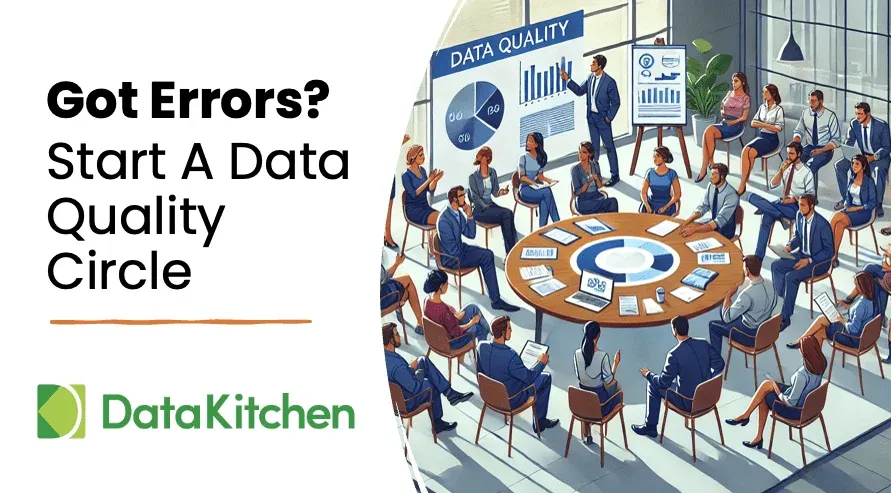
DataOps Quality Circles are focused teams within data and analytics organizations that meet weekly or monthly to drive continuous improvement, quality automation, and operational efficiency. By leveraging the principles of DataOps—such as automation, testing, and iterative development—these circles ensure that data and the processes acting on data are error-free, consistent, and aligned with business goals. The goal is to create a culture of accountability and innovation where every team member contributes to improving data quality and operational performance.
FAQ
What are the key points in this blog?
A Data Quality Circle is a focused team inside a data and analytics organization that meets weekly or monthly to work through production incidents and prevent them from recurring. HFS Research found 75 percent of business executives do not have a high level of trust in their data. The method borrows from manufacturing quality circles: a no shame, no blame culture, Pareto analysis, the Five Whys, and at least one committed improvement per session.
What is a Data Quality Circle?
A Data Quality Circle is a focused team within a data and analytics organization that meets weekly or monthly to improve the quality and efficiency of data operations. It examines individual production incidents, or groups of incidents categorized by root cause, and converts each one into a preventive action. The model comes from the quality circle method long used in manufacturing and service industries.
How is a Data Quality Circle different from a retrospective?
It carries past analysis into committed action. A retrospective is a structured way for a team to learn from what already happened; a Data Quality Circle does that and then creates a ticket or task for each preventive idea, with a commitment to implement at least one significant improvement. The actions are tracked and reviewed, so the meeting produces change rather than notes.
What does no shame, no blame mean in practice?
Incidents are examined without anyone being punished for having been involved. Documentation records the facts and the agreed actions while avoiding blame and negative language, and the discussion stays on the root cause rather than the person nearest to it. The companion mantra, love your errors, treats mistakes as raw material for improvement rather than something to celebrate.
What happens in a Data Quality Circle meeting?
Preparation compiles recent incidents, support calls, help desk tickets, and bugs, using Pareto analysis to find the most frequent root causes when the volume is high. Discussion records each incident’s date, description, and timeline, then applies the Five Whys until the root cause is reached. Brainstorming produces practical preventive actions, and each action becomes a ticket or task.
What is the Five Whys technique?
Asking why repeatedly until the answer stops being a symptom. The worked example is a vehicle that will not start: the battery is dead, the alternator is not functioning, the alternator belt has broken, the belt was well beyond its useful service life, and the vehicle was not maintained according to the recommended service schedule, which is the root cause.