A procurement lead asked me for a discount this week. It was a fair request. Their company runs a tight financial ship, and anything that reaches the finance committee needs a good story behind it.
I had no discount to give. I told them I probably should have opened with a higher number and a volume story, so I’d have something to give back. I didn’t, and I think that’s the better story. The best negotiation is the one you never have to hold.
The opening bid is the final price
Enterprise software pricing usually works like a car lot. The vendor opens high, procurement pushes back, and both sides declare victory at a number that was always the target. The dance costs the buyer more than the discount saves: weeks of calendar time, a pile of internal meetings, and a champion who loses momentum while the paperwork sits in a queue.
We skipped the dance. Our price is on our website, where anyone can read it, including the procurement team at your competitor. The published price already has the discount in it. You pay what every other customer pays, so there’s no risk that a sharper negotiator got a better deal.
Why we priced it this way
We priced for adoption. Data teams struggle to write data tests, and that includes experienced engineers. TestGen profiles your data and generates the tests for you. That only helps if your team actually uses it, and teams don’t use what they can’t get approved.
We refuse to meter data volume. Many tools in this category charge by rows, tables, or compute credits, which means you pay more every time you test more. So teams ration coverage to keep the bill down, which is the opposite of what a quality program needs. We made the long version of this argument in Stop Paying the Data Quality Tax. With TestGen you test every table and every row at the same price.
IMPORTANT
Your data quality and observability tooling should cost one data engineer’s salary for a month, not for a whole year. You shouldn’t have to choose between data quality and cutting a member of your data team.
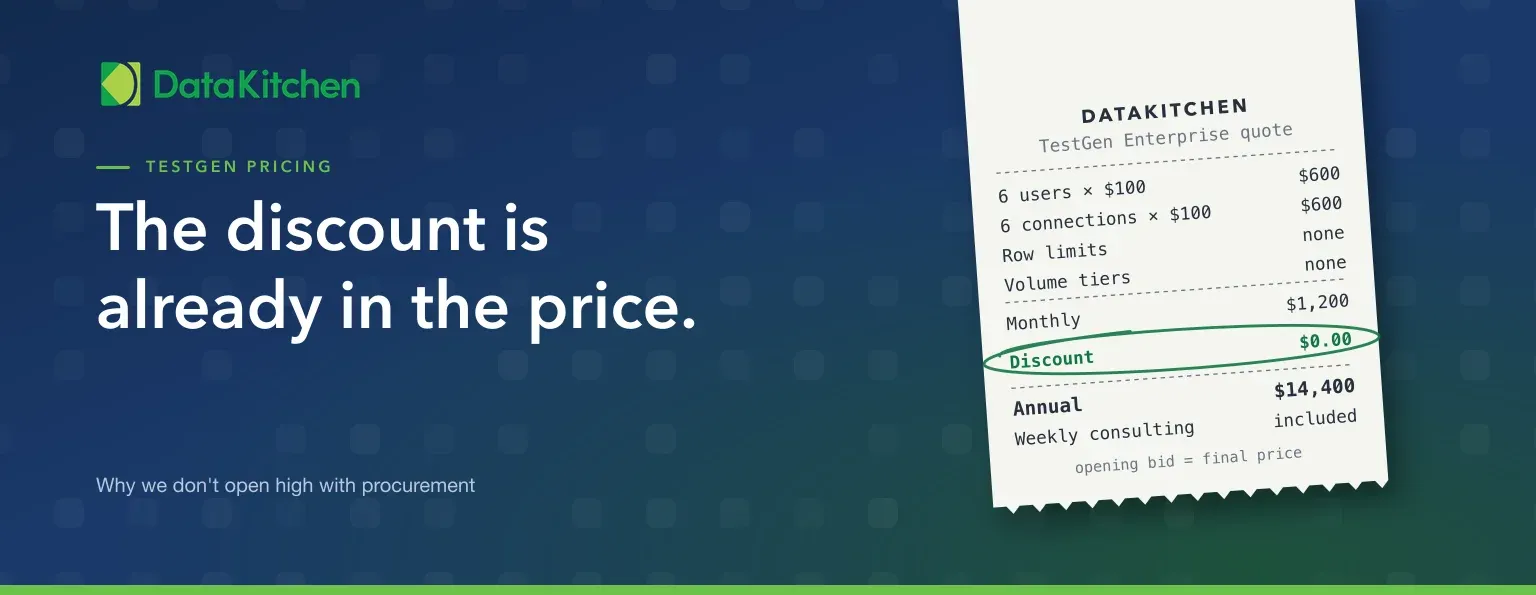
The math fits on a napkin. A starting team of six users and six database connections is 12 units at $100 each. That’s $1,200 a month, or $14,400 for the year.
What procurement can take to finance
Procurement needs a story when a request goes up for approval. Here’s the one we offer.
The discount is already in the price. Our pricing page runs the comparison: a team of 10 users and 3 database connections pays $15,600 a year for TestGen, and tools that charge per table or per credit typically run $120,000 to $360,000 for the same coverage. In our webinar You’re Massively Overpaying for Data Observability, a survey of public pricing put the average cost of monitoring a thousand tables at over $170,000 a year. That price has more to do with a billion dollars of venture capital looking for a return than with what the software costs to build. We said it in six words in Stop Burning Tokens: all the features, a tenth the price.
Consulting is included. For the first three months we meet weekly with your team, led by a senior person from DataKitchen (often our VP of Development, our product owner, or me). The people on those calls bring decades of data engineering and data quality practice, so the sessions go well past how to install and use TestGen. They cover how to actually be effective at data quality and observability. That’s free data quality consulting written into the contract.
The term is flexible. Most customers choose annual billing because one invoice beats twelve. If your team wants to start with six months and re-evaluate, we’ll agree to that.
Growth is simple. Some customers turn off telemetry for security or privacy reasons, which means we can’t see usage. So we work on the honor system. You tell us you added a user or a new group, and we send a one-page change order.
Your standard paper works too. Large companies often prefer their own agreement, and we’ll review redlines on either document.
That’s the story I gave the procurement lead.
They accepted the price as published.
TIP
Try the free open source version first: one user, one database connection, every feature. Install TestGen, or book 30 minutes with me to walk through your team’s numbers. And if you’re the data lead trying to get TestGen approved, send this post to your procurement team.
FAQ
What are the key points in this blog?
DataKitchen does not negotiate TestGen discounts because the published price already has the discount in it. TestGen Enterprise costs $100 per user and $100 per database connection per month, with no row, table, or volume limits, roughly a tenth of comparable tools. Contracts include three months of weekly consulting, and buyers get flexibility on term length and contract paper rather than on price.
How much does DataKitchen TestGen cost?
TestGen Enterprise costs $100 per user per month plus $100 per database connection per month. There are no row limits, table limits, or volume tiers. A team of six users and six connections pays $1,200 a month, or $14,400 a year. The open source version is free for one user and one database connection with every feature included. Full details are on the DataKitchen pricing page.
Does DataKitchen negotiate discounts on TestGen?
No. DataKitchen sets the TestGen price at roughly a tenth of comparable data quality tools and publishes it, so every customer pays the same rate. A buyer never has to worry that a sharper negotiator got a better deal. Where DataKitchen does flex is the terms: a six-month start, the buyer’s own contract paper, and simple change orders.
Why doesn’t TestGen charge by rows, tables, or data volume?
Because usage-based pricing charges you more for testing more data, which is the opposite of what a data quality program needs. When every added table raises the bill, teams ration coverage to control cost. TestGen charges per user and per database connection, so you can test every table and every row at the same price.
What does a TestGen Enterprise contract include besides the software?
Weekly consulting for the first three months, at no extra charge. A senior DataKitchen person leads each session, often the VP of Development, the product owner, or Gil Benghiat, bringing decades of data engineering and data quality practice. The sessions cover how to be effective at data quality and observability, not just how to install and use TestGen.
Can we start with a six-month TestGen contract or use our own agreement?
Yes to both. Most TestGen customers choose annual billing because one invoice beats twelve, but DataKitchen agrees to a six-month start for teams that want to re-evaluate. Large companies often prefer their own agreement, and DataKitchen reviews redlines on either its own paper or the customer’s.
How does TestGen licensing work if we turn off telemetry?
It runs on the honor system. Some customers turn off telemetry for security or privacy reasons, which means DataKitchen cannot see usage. When the team adds a user or a new group, it tells DataKitchen, and DataKitchen sends a one-page change order at the published $100 per user or per connection rate.
Why are data observability and data quality tools so expensive?
Mostly because of venture capital, not the cost of the technology. Roughly a billion dollars has gone into data observability, and that money needs a return, so vendors price high and meter usage. A survey of public pricing put the average cost of monitoring a thousand tables at over $170,000 a year. The anomaly detection underneath is commodity math.