Count how much of your day you spend in a chat window. At DataKitchen it’s about three-quarters, and climbing. We describe a change, an agent writes the code, we read the diff, we commit, we build the next tool. That’s the job now. Not a side task. The job.
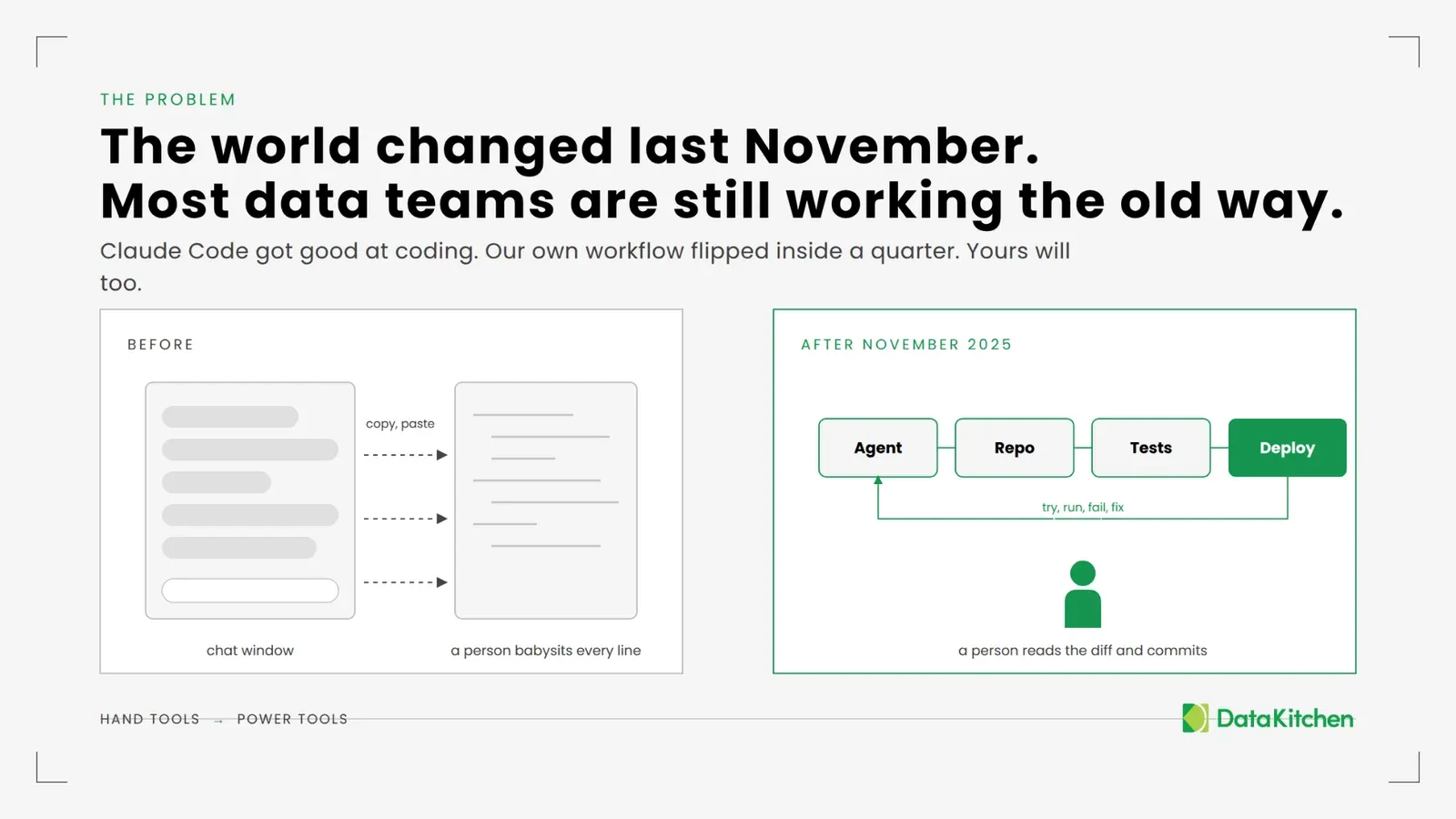
The world changed last November, when Claude Code finally got good at coding. Before that, agents wrote plausible code you had to babysit. After that, they wrote code you could ship. Our whole way of working flipped inside a quarter.
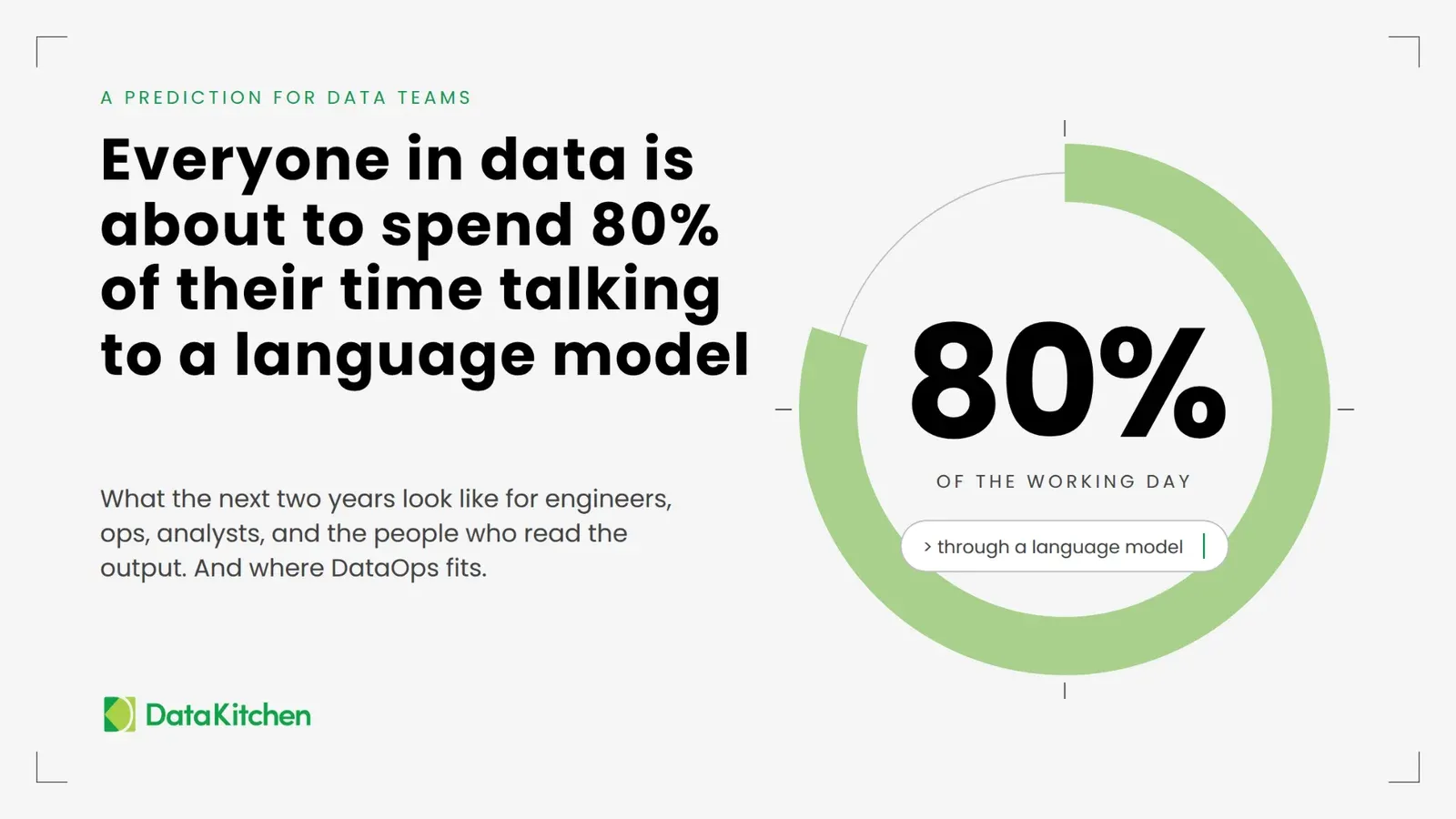
Here’s the bet: within a year or two, everyone in the data world spends 80% of their time interacting with data through a large language model. Engineers, ops, analysts, and the business users who read the output. Not a few early adopters. All of it. This is the world that’s coming. Here’s how we see it, what the platform underneath it looks like, and where a company like ours fits.
Part one: what the 80% AI-mediated world looks like
Picture the whole value chain. The engineer says, “Add the new CRM feed and backfill it.” The ops person says, “Why did the nightly load take three hours?” The analyst says, “Show me churn by cohort, and make it a dashboard I can share.” The VP asks the same question of the finished dashboard. Nobody opens a SQL editor first. Nobody opens a BI tool to build. The model is the front door to the data.
Some of this is already true. The escalation point is the coding harness. Pasting text into a chat window is a hand tool. Pointing Claude Code at a repo with tests, a build, and a deploy path is a nail gun with a compressor. Coding works so well because the loop is tight: try it, run it, see it fail, fix it. Verification is built in.
Most other work doesn’t have that. Ask an agent to write a brief from six months of email and it will produce something useful with one example that’s flat wrong. You still have to be the manager who reads the work.
Two things won’t change. First, people don’t want to consume information as if it were a conversation. Alexa was supposed to be a new storefront in every kitchen. People used it for the weather, music, and a timer. Business users want to see 10 charts at once and scan them in five seconds. They don’t want to interrogate a bot one fact at a time. The model is how you build the thing. It’s rarely how you read the thing.
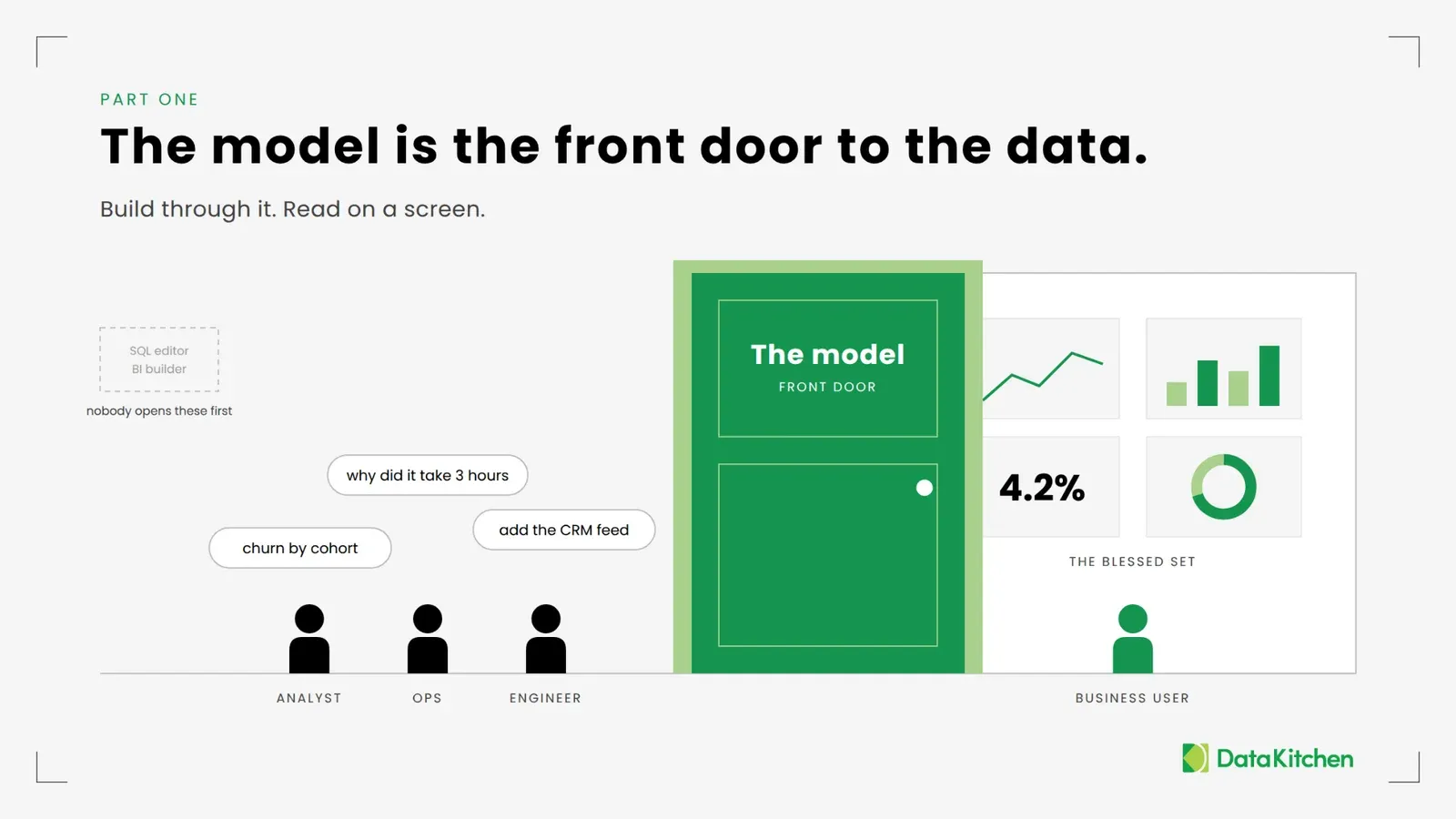
Second, if you run a company, you don’t want 40 people each generating their own revenue chart. That’s how you end up with 40 revenue numbers. There will be a constrained, blessed set of outputs, with drill-down underneath. Ad hoc lives at the edges.
Roles blur but don’t vanish. When 50 files land every week and one of them is late, somebody still has to find out why. The engineer who used to be “backend only” is now the product manager, the UI builder, and the database person on the same ticket. That’s the Jevons paradox at work: the tool gets cheaper, so you do more with it, and the scope of the job widens instead of the headcount shrinking. Watch what’s happened in sales. Clay built a nine-figure business around “go-to-market engineers,” people who came up through sales and now write automation scripts all day. No CS degree. The same thing is coming for analysts. The sharp ones will build, run, and ship, not just query.
Part two: the battle for the platform underneath
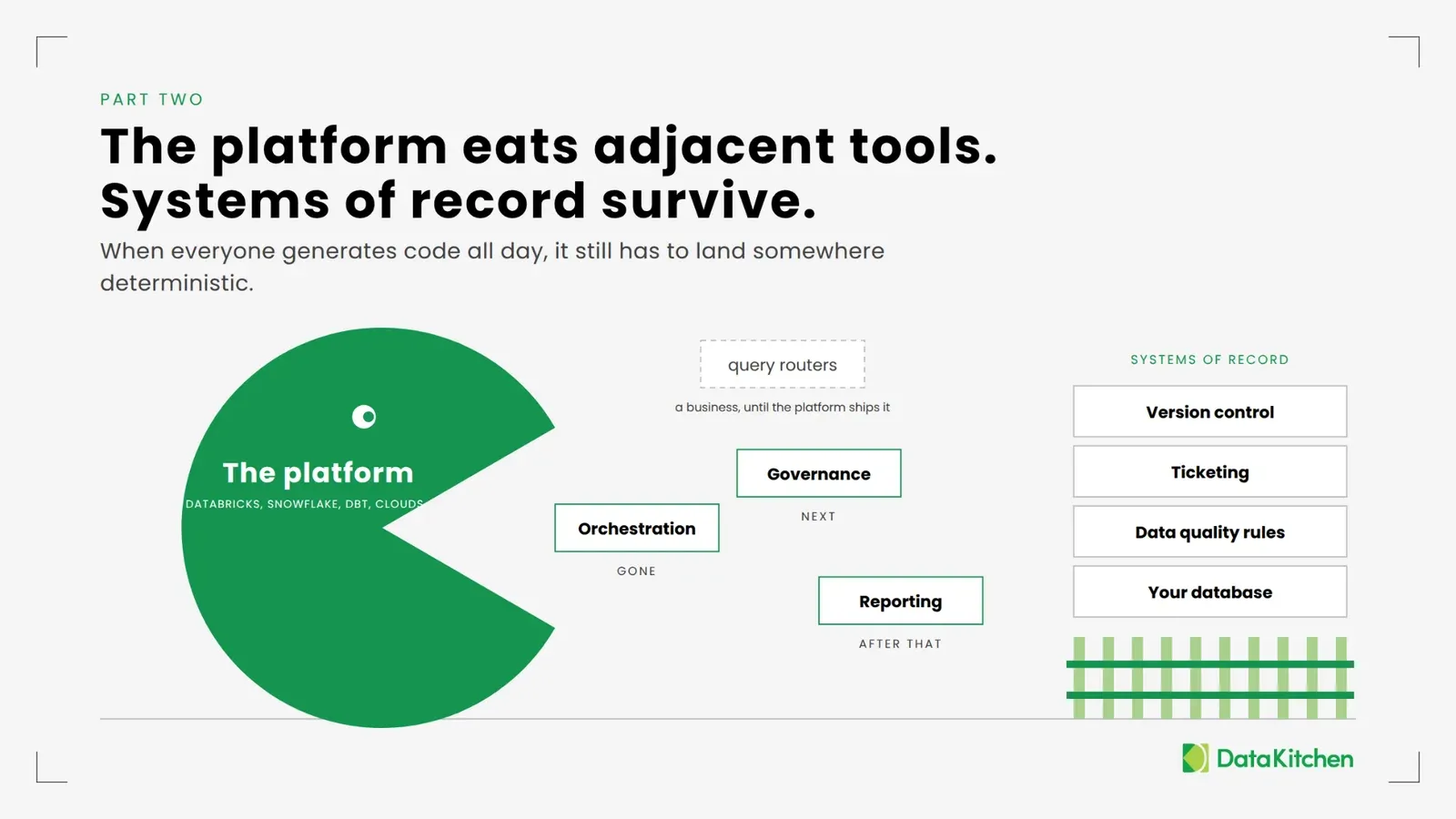
Databricks, Snowflake, dbt, and the cloud providers all want the same thing: everything in one place. Theirs.
This has happened before. Word processors and spreadsheets were separate markets until Microsoft shipped Office. The standalone orchestrator market existed five years ago. It’s gone. Why run orchestration in a separate tool when the database already does it? Governance is next. Reporting after that. The open question is what, if anything, stays out of the mouth of the platform vendor or the AI layer above it.
Meanwhile, the platforms fight each other. The newest dbt embeds DuckDB for unit tests and for routing queries away from expensive engines. Iceberg decouples storage from compute so you can, in theory, swap engines like light bulbs. A whole category of startups now sits in front of Snowflake, catches your repeated morning queries, and runs them on something cheaper. Save 20% on a seven-figure Snowflake bill, and you have a business. Until Snowflake builds the same feature. Every independent tool vendor lives with that clock ticking, including us.
And yet the SaaS apocalypse didn’t arrive. GitLab lost half its value between January and April on the theory that agents would roll their own version control. Then it got all of it back. Turns out when everyone is generating code all day, you need one deterministic place where it lands, with a pipeline, conventions, and a record of what happened. Same for ServiceNow. You have to put the stuff somewhere.
That’s the pattern. The model is the interface. Underneath it, you still need systems of record: your database, your version control, your ticketing, and a place where your data quality rules live and run the same way every night. TestGen is one of those tools in the harness. Not the harness itself.
Part three: productivity in the age of AI is a systems problem (some things never change)
Our mission has been the same for 13 years: make your data team more productive. In the 80% world, we see two places where a company like ours can help.
Whether someone is creating code or consuming results, data itself is no longer the hard part. The hard part is building things, building them fast, iterating on them, and improving them without breaking what already runs. Those are DataOps problems. They’re the ones we’ve been working on since we started.
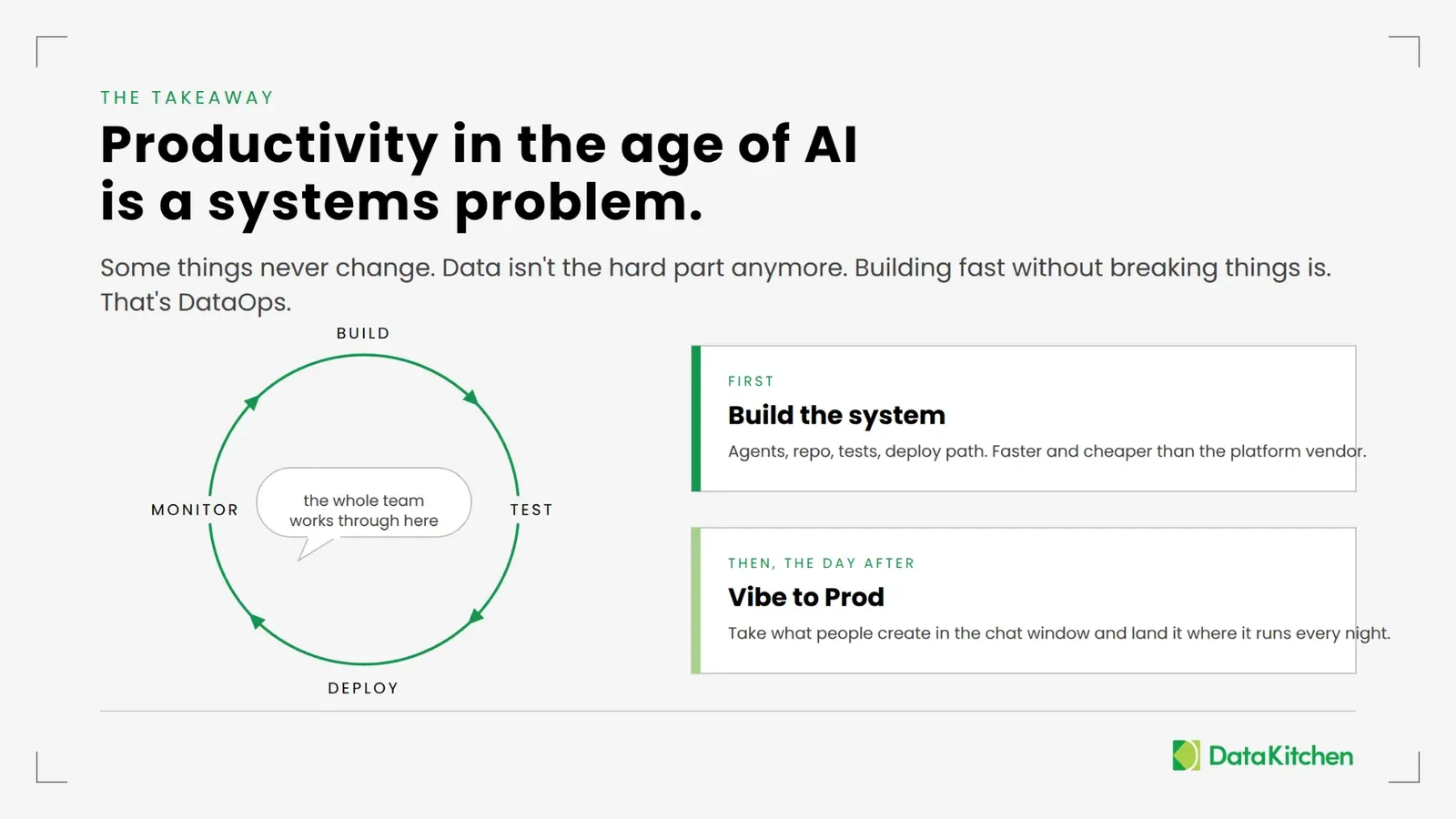
Start with the system. You know the end state. Your team works through agents, with a real repo, real tests, and a deploy path, on top of your existing warehouse. Getting there from where you are today is the hard part. We can build it for you faster than you’d build it yourself, and cheaper than the platform vendor’s professional services will. Call it AI data modernization.
The second job starts the day after. Once everyone can generate code, everyone will. Analysts vibe up a pipeline. A business user vibes up a dashboard. It works on their laptop, once. Then somebody wants version 1.1, and version 1.1 looks nothing like version 1.0 because nothing constrained it. Nobody wants to own the maintenance. There’s no “promote to prod” button in a chat window. Somebody has to build that button. Call it Vibe to Prod.
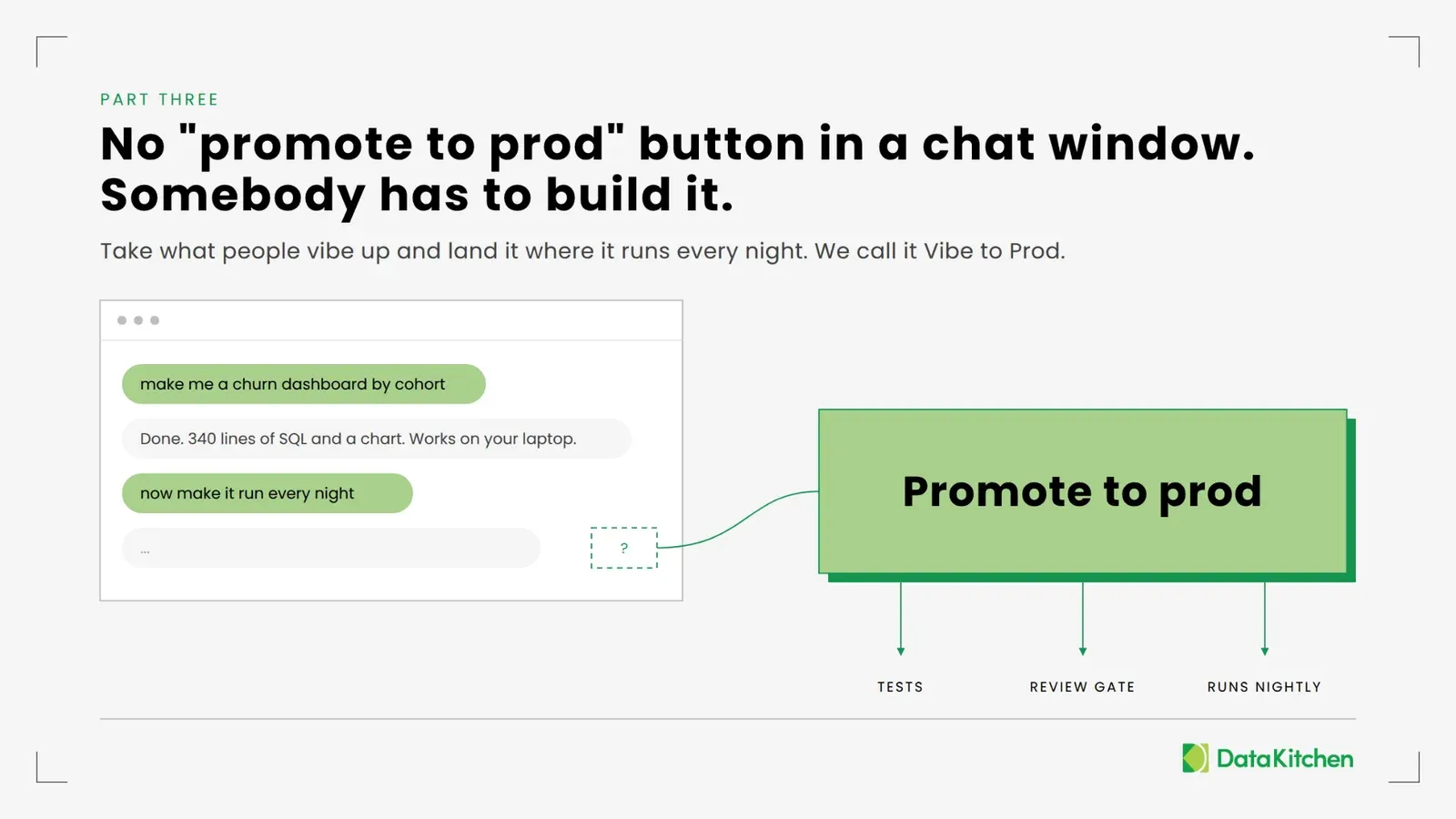
Take what people are creating in the chat window, add tests, add a review gate, add a promotion process, and land it in the deterministic system where it can run every night without anyone babysitting it. It’s where most of the mess will be, and mess is where we’ve always made our living.
Are you ready?
AI is going to change what every data team person, every data consumer, every user of data does in the next year or two. Are you ready for the change?
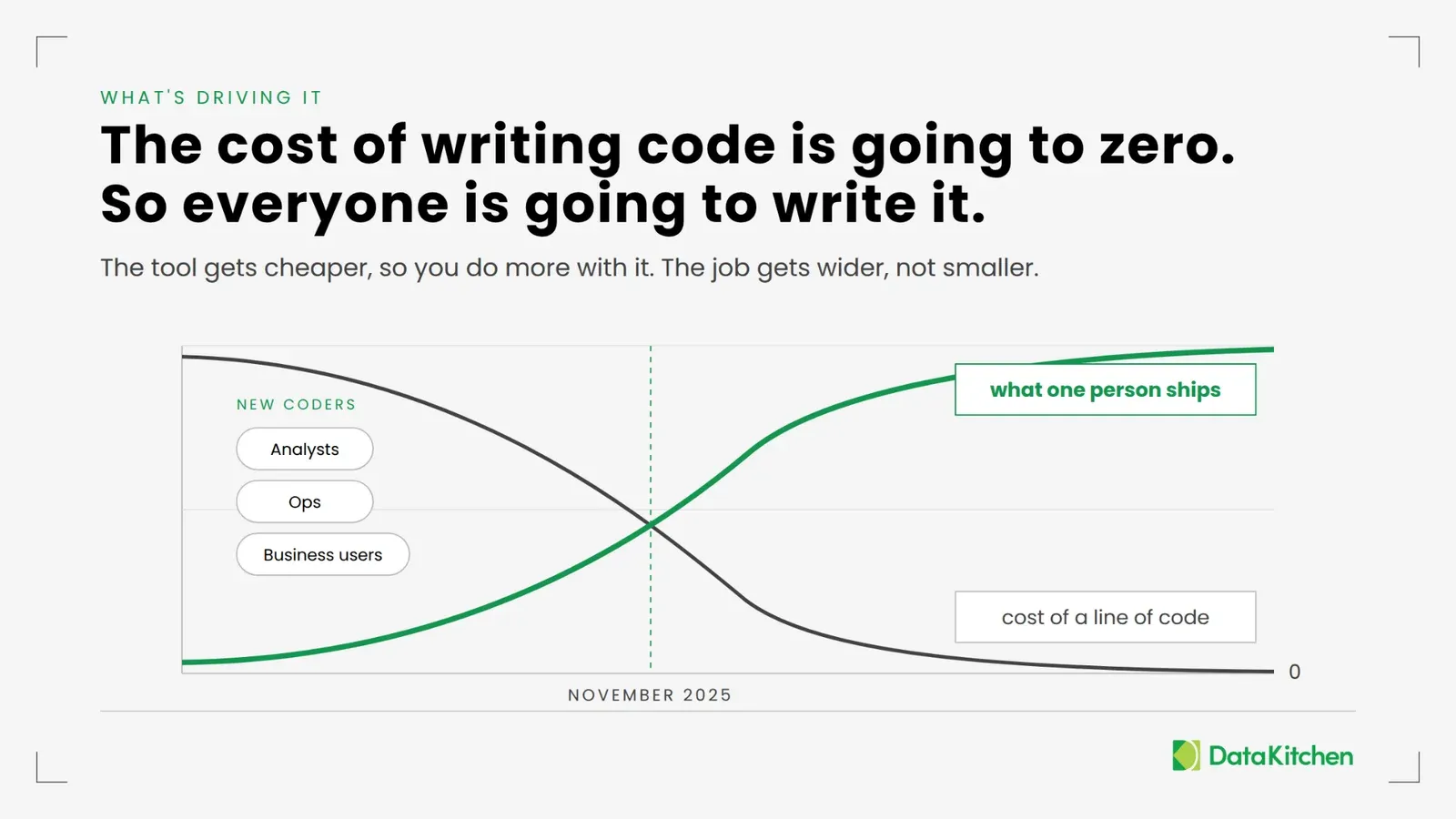
We were early on the cloud 13 years ago. Our DataOps habits held up. We’ve been using AI like crazy this last year, always with our DataOps habits in place. As the cost of creating new code and asking new questions approaches zero, building a stable, resilient system that enables a high rate of change using DataOps principles is even more necessary in the age of AI.
FAQ
What are the key points in this blog?
Within a year or two, everyone in data will spend 80% of their time working with data through a large language model. Coding agents succeed because their loop verifies itself, but people still read dashboards rather than chat. Platforms are consolidating, yet systems of record survive. The productivity problem is a DataOps problem: building the agent-ready system, then promoting what people vibe up into production.
What does it mean to spend 80% of your time talking to a language model?
It means the model becomes the front door to the data. The engineer asks it to add a new CRM feed and backfill it, the ops person asks why the nightly load took three hours, and the analyst asks for churn by cohort as a shareable dashboard. Nobody opens a SQL editor or a BI tool first. At DataKitchen that already covers about three-quarters of the day.
Why do AI coding agents work better than AI on other kinds of work?
Because coding has verification built in. An agent in a repo with tests, a build, and a deploy path can try something, run it, see it fail, and fix it. Most other work lacks that loop. Ask an agent for a brief from six months of email and it produces something useful with one example that is flat wrong, so a person still has to read the work.
Will business users consume data through a chat window instead of dashboards?
Mostly no. People do not want to consume information as a conversation. Alexa was meant to be a storefront in every kitchen and ended up doing weather, music, and timers. Business users want ten charts they can scan in five seconds, and a company wants a blessed set of outputs rather than 40 people generating 40 revenue numbers. The model builds the dashboard; people read it.
Will AI replace data engineers and analysts?
No. Roles blur rather than vanish. When a tool gets cheaper you do more with it, which is the Jevons paradox, so the job widens instead of the headcount shrinking. A backend engineer becomes the product manager, UI builder, and database person on the same ticket, and sharp analysts will build, run, and ship pipelines rather than only query them.
Which data tools survive as platforms like Databricks and Snowflake consolidate?
Systems of record. Standalone orchestration has largely been absorbed by the database, and governance and reporting are next. But when everyone generates code all day, you still need deterministic places to land it: the database, version control, ticketing, and a place where data quality rules live and run the same way every night. The model is the interface; those are the systems underneath it.
What is Vibe to Prod?
Vibe to Prod is DataKitchen’s name for taking what people build in a chat window and making it production-ready. Analysts and business users will vibe up pipelines and dashboards that work once on a laptop. Vibe to Prod adds tests, a review gate, and a promotion process, then lands the work in a deterministic system where it runs every night without anyone babysitting it.
What is AI data modernization?
AI data modernization is building the system an AI-first data team works in: agents on top of your existing warehouse, with a real repo, real tests, and a deploy path. Most teams know that end state but not how to reach it from where they are. DataKitchen builds it faster than a team would alone and cheaper than a platform vendor’s professional services.
Why does DataOps matter more as AI makes code cheap?
Because cheap code means more change, and more change breaks more things. As the cost of creating code and asking questions approaches zero, the hard part becomes building, iterating, and improving without breaking what already runs. That is what DataOps principles are for: a stable, resilient system that allows a high rate of change. DataKitchen has worked on those problems for 13 years.