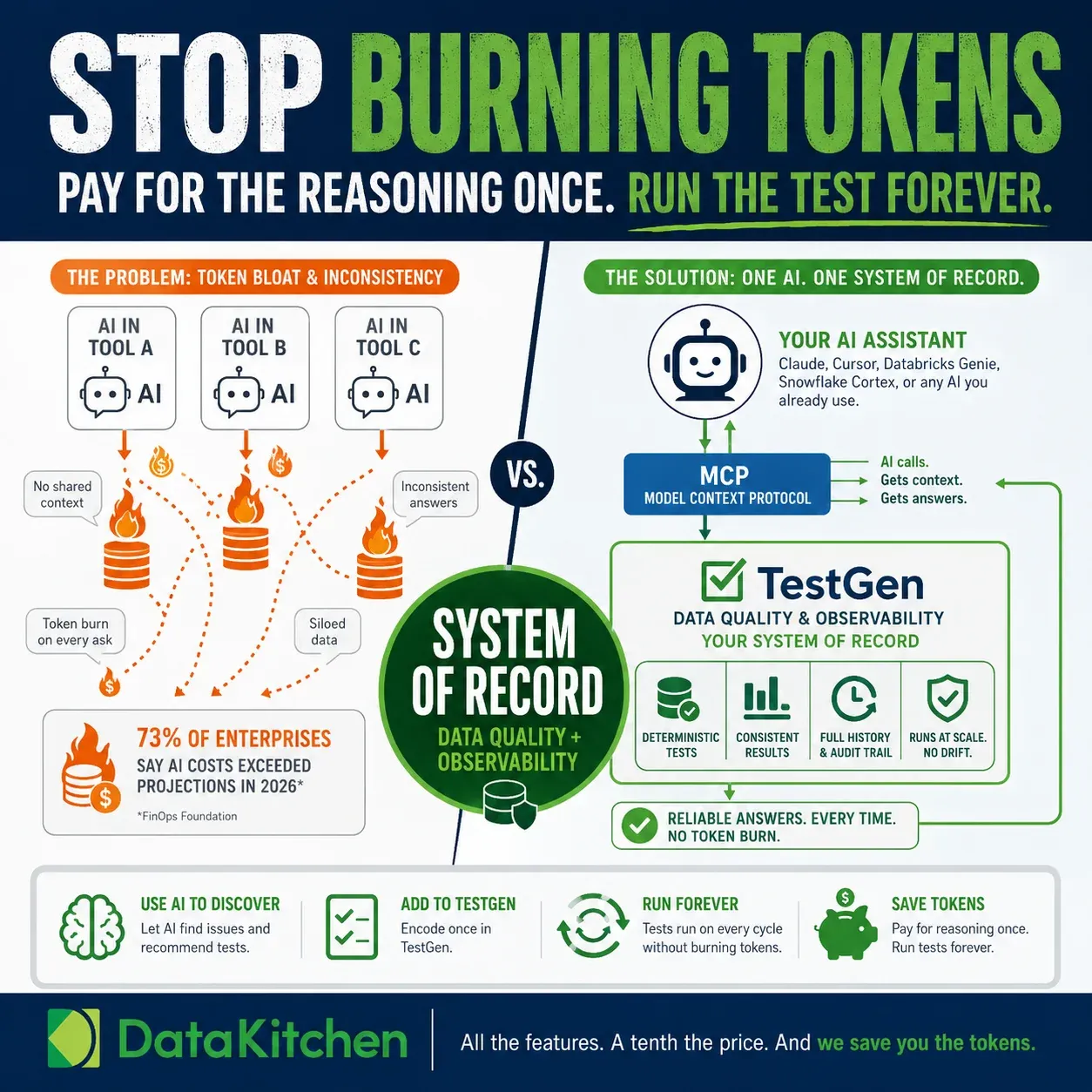
TL;DR: Embedding AI in every tool creates token bloat, inconsistency, and siloed context. The better pattern is to expose data quality and observability as a deterministic service via MCP and let whatever AI you already use call it. Use AI to discover what tests to add. Add them to TestGen. From that point forward, the tests run without burning another token.
Everyone Is Adding AI. That Is the Problem.
Atlassian has an AI assistant. Docker has one. Monte Carlo has AI, root cause analysis, lineage/impact analysis, and cost optimization. Every tool wants to be your AI interface and include every feature.
Here is what I notice when I use those tools: I ignore the embedded AI and just ask Claude. The tool’s AI does not have my context. It does not know my terminology, my priorities, or what happened last week. And now companies are starting to realize that convenience carries a bill. A DoiT survey (Sapio Research, Feb 2026, 500 finance leaders at orgs with 1,000+ employees) found that 79% of enterprises overspent on AI in 2026, even as per-token prices kept falling. Volume is the culprit, and it only gets worse when every tool in your stack burns tokens independently.
Context is the new oil. The question is: who does the refining?
The Factory Analogy
In a factory, you do not have nuts and bolts in random sizes. You standardize them, and that makes everything downstream faster and more reliable. You also do not manufacture the nuts and bolts yourself. You buy commodity parts and save your expertise for the next level of value.
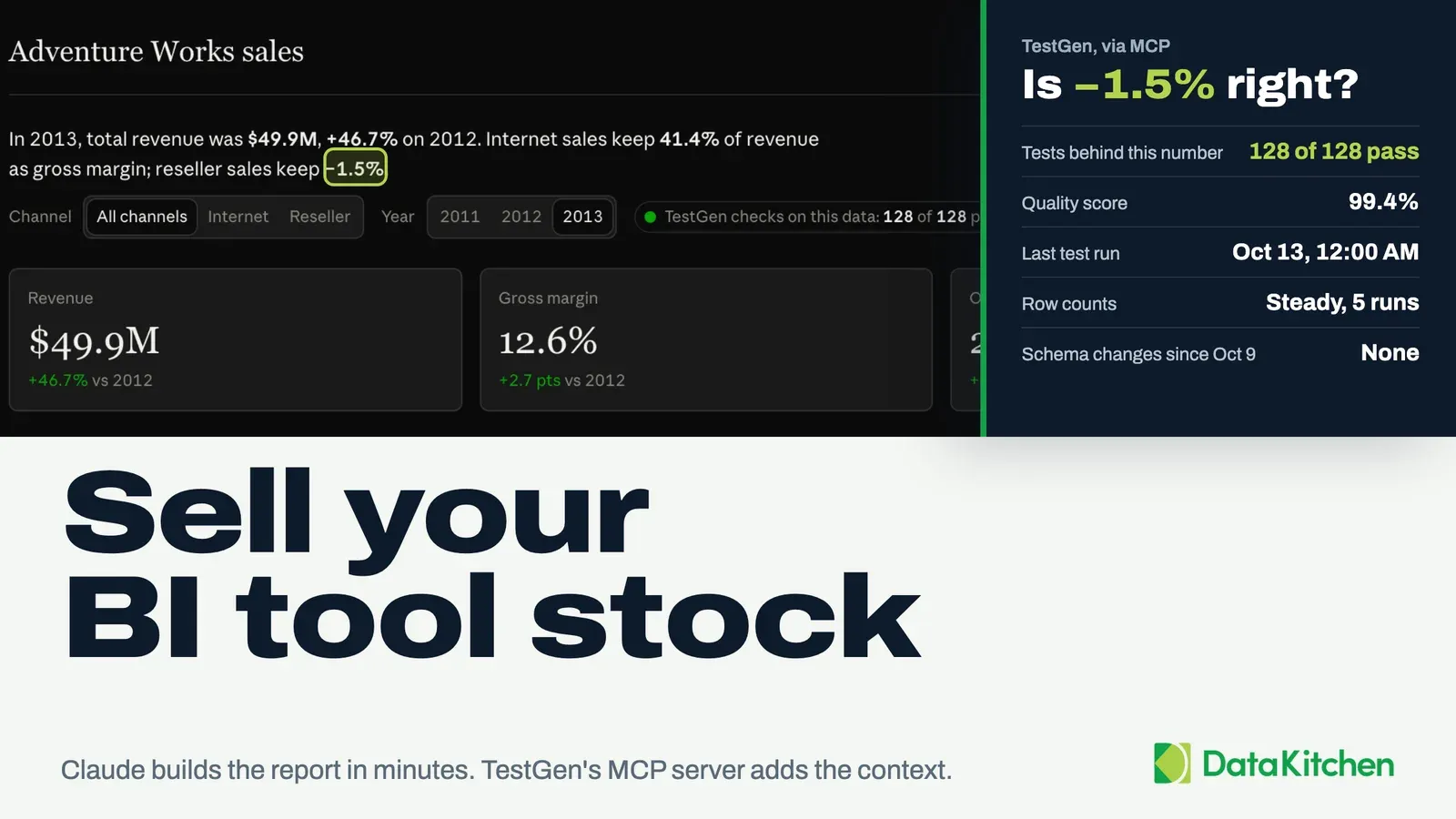
I ran a demo recently where I typed one prompt to Claude: “Look at all the hygiene issues and data test failures in TestGen and list the first three I should investigate.” Claude used the MCP interface (the Model Context Protocol, which lets AI tools call external services directly) and came back with three findings: duplicate customer IDs, two completely empty columns, and a product category field with inconsistent values. I asked Claude to fix the category field. It wrote SQL to normalize all variants to the dominant form, which is exactly the kind of query I write myself. Then I asked what custom test I should add. Claude scanned 214 existing single-column tests and suggested a cross-table check: discount amount should not exceed the maximum allowed discount for that product. When I asked how it knew to recommend that, it said the field names were descriptive enough to make the relationship obvious.
That is the right division of labor. TestGen (DataKitchen’s data quality and observability platform) held the test (rules) and test results. The AI read that context and reasoned from there. Each did its own job and nothing more.
Two Jobs That Should Stay Separate
Most vendors blur a boundary that should stay clear. On one side sits determinism, auditability, and a system of record. On the other sits reasoning, synthesis, and discovery.
TestGen lives on the first side. When you add a test, it runs. Every time. At scale. It never forgets, never drifts, and keeps a full history: when a test ran, when it failed, what the data looked like at that moment. For regulated industries and compliance-conscious teams, that auditability is required, not optional.
AI lives on the second side. It is good at reasoning over context and surfacing what you did not think to look for. Ask an AI to maintain a test suite indefinitely and you will eventually be disappointed. Ask it to reason over profiled, tested data exposed via MCP, and you will be impressed.
Embedding AI inside every tool collapses this boundary. You get a reasoning engine trying to act as a system of record, burning tokens every time, and producing slightly different answers each run. That is the wrong architecture.
MCP Changes the Equation
Connect TestGen as an MCP service and whatever AI you already use, Claude, Cursor, Databricks Genie, Snowflake Cortex, can talk to it directly. Your AI does not change. Your workflow does not change. TestGen becomes the backend service your AI calls when it needs to know what the data looks like, what tests exist, and what has failed.
This is also why we decided not to build lineage into TestGen. The answer to “what will this error affect” lives in the code, and any developer already has an AI connected to their repository. No reason to duplicate that inside a data quality tool. Three pieces of context, each living where it belongs, each accessible via the right tool. The architecture does not have to be complicated; it just has to respect the boundary.
Tests the agent can call for itself are also the only way it stops grading its own homework.
Save Tokens. Get Consistency.
I asked Claude what tests I should add. Claude recommended the cross-table discount check and added it to TestGen. That test now runs on every cycle without burning a single token. I paid for the reasoning once and the test runs forever.
That is the compounding advantage. Every test you encode is a question you never pay to answer again. TestGen always returns the same answer, auditable and traceable to the specific run.
All the features. A tenth the price. And we save you the tokens.
FAQ
What are the key points in this blog?
Embedding a separate AI assistant in every data tool produces token bloat, inconsistent answers, and context trapped inside each vendor. The better split is to keep data quality and observability as a deterministic service exposed over the Model Context Protocol, then let whatever AI a team already uses call it. Use AI to discover which tests to add, encode them once, and they run from then on without spending more tokens.
Why does putting an AI assistant inside every data tool waste tokens?
Because each tool reasons from scratch, on its own narrow context, every time you ask. The work is repeated per tool and per run, and the answers vary between runs. A DoiT survey of 500 finance leaders at organizations with 1,000 or more employees found 79% of enterprises overspent on AI in 2026 even as per-token prices fell, because volume, not unit price, drives the bill.
How does the Model Context Protocol change data quality tooling?
It lets an external service answer questions from the AI directly, so the data quality platform becomes a backend rather than a competing chat window. Connect TestGen as an MCP service and Claude, Cursor, Databricks Genie, or Snowflake Cortex can ask what the data looks like, which tests exist, and what has failed. Your AI and your workflow do not change. TestGen ships this MCP interface in its open source distribution.
Should an AI maintain my data quality tests?
No. Reasoning engines are good at discovery and synthesis, not at being a system of record. Asked to maintain a suite indefinitely, one will drift and produce slightly different answers each run. Let the AI propose tests and let a deterministic platform own them, running each test every cycle and keeping a full history of every run: when it ran, when it failed, and what the data looked like.
Why did DataKitchen decide not to build lineage into TestGen?
Because the answer to what an error will affect lives in the code, and developers already have an AI connected to their repository. Duplicating lineage inside a data quality tool would rebuild context that already exists somewhere better. Three pieces of context, each kept where it belongs and reachable through the right tool, beats one tool trying to hold all of them.
What does it mean to treat data quality as a system of record for AI?
It means the tests, the test results, and the run history live in a deterministic service that returns the same answer every time, and the AI reads that record instead of re-deriving it. Data observability supplies the history (when a test ran, when it failed, what the data looked like), which is what makes an answer auditable and traceable to a specific run.