As data engineers, we’ve all been there. A dashboard shows anomalous metrics, a machine learning model starts producing bizarre predictions, or stakeholders complain about inconsistent reports. We dive deep into data validation, check our transformations, and examine our schemas, only to discover the real culprit was something far more subtle: timing.
Process latency – the delays and misalignments when data moves through our systems – is one of the most underestimated threats to data quality in modern architectures. While we’ve gotten excellent at building robust pipelines and implementing data quality checks, we often treat timing as someone else’s problem. This is a dangerous oversight.
The Hidden Nature of Latency Problems
Unlike schema violations or null value issues that surface immediately in our monitoring dashboards, latency problems are insidious. They don’t break your pipelines – they corrupt your insights. A report might run successfully every morning, but if it’s pulling yesterday’s transactions against today’s customer dimensions, you’re serving up beautifully formatted garbage.
The challenge intensifies because latency issues rarely manifest as obvious timing problems. Instead, they masquerade as:
- Data inconsistencies when upstream sources haven’t synchronized properly
- Missing records that appear to be data loss, but are delayed deliveries
- Stale dimensions that make fact tables look wrong
- Integration conflicts between systems operating on different schedules
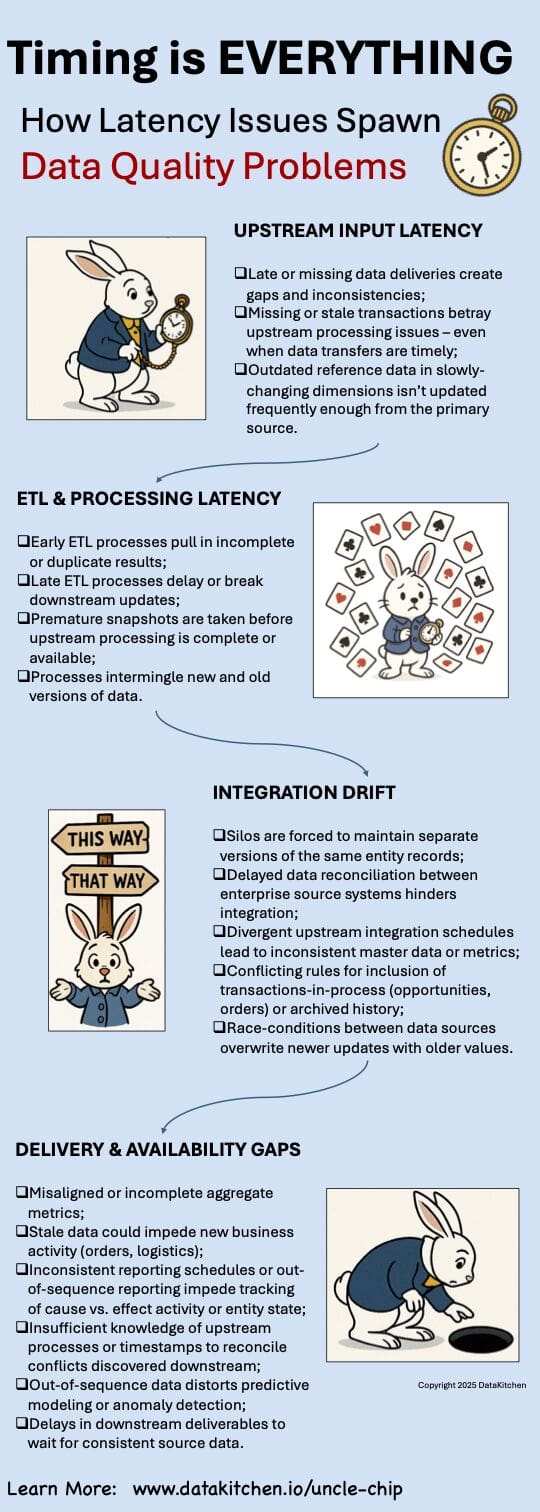
The Four Faces of Latency-Induced Data Quality Issues
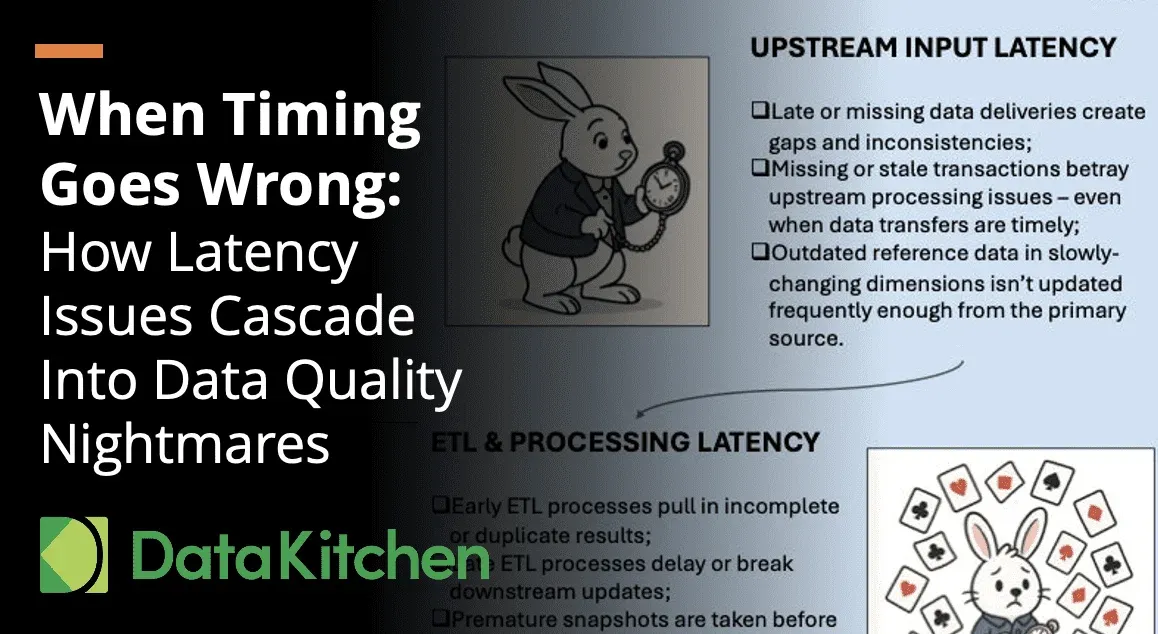
Upstream Input Latency
This is where data quality problems often begin. When source systems deliver data late or inconsistently, it creates gaps that propagate downstream. Missing transactions, stale reference data, and delayed dimension updates all stem from this root cause. Your perfectly architected data warehouse becomes unreliable not because of design flaws, but because the data it depends on arrives unpredictably.
ETL & Processing Latency
Even when source data arrives on time, processing delays create their own quality issues. Early ETL jobs might pull incomplete datasets, while late-running processes create cascading delays throughout your pipeline. Premature snapshots capture partial states, and overlapping batch windows intermingle different versions of the same data, creating temporal chaos.
Integration Drift
The most complex challenge emerges when different systems maintain separate versions of shared entities. Customer records updated in your CRM don’t immediately reflect in your analytics warehouse. Product catalogs in your e-commerce platform are updated, while your recommendation engine still references the old version. These synchronization gaps create a fragmented view of reality across your data ecosystem.
Delivery & Availability Gaps
The final manifestation occurs when downstream consumers expect fresh data that isn’t available. Reports are run on schedule, but they reflect outdated information. Machine learning models retrain on outdated features. Business users make decisions based on metrics that are hours or days behind reality, and they often remain unaware of this discrepancy.
Why We Ignore the Timing Problem
There’s a reason latency issues persist despite their impact: they’re fundamentally collaboration problems disguised as technical ones. It’s much easier to focus on what’s within our direct control – our schemas, our transformations, our infrastructure – than to coordinate schedules across teams, systems, and vendors.
We build our monitoring around what we can measure easily: pipeline success rates, data volumes, and schema compliance. But measuring cross-system timing dependencies? That requires visibility into other teams’ processes, understanding of business logic we didn’t design, and ongoing coordination that extends far beyond our immediate technical domain.
The Data Mesh Dilemma
As organizations embrace data mesh architectures, latency challenges multiply exponentially. When data ownership becomes distributed across multiple product teams, timing coordination becomes everyone’s responsibility, which often means it becomes no one’s responsibility.
Each domain team optimizes its data products independently. Sales refreshes customer segments nightly, marketing updates campaign performance hourly, and finance reconciles transactions on a weekly basis. These decisions make perfect sense within each domain, but the interactions between these schedules create systematic quality issues that no single team owns or can easily detect.
Taking Ownership of Time
The solution isn’t to abandon modern data architectures, but to explicitly own the timing aspects of data quality. This means:
Treating schedules as first-class design artifacts. Document not just what data moves where, but when it moves and what depends on that timing. Make schedule dependencies as visible as data lineage.
Building latency into your data quality framework. Monitor not just whether data arrived, but whether it arrived when expected relative to its dependencies. Alert on timing anomalies before they become data quality incidents.
Establishing cross-domain timing contracts. In data mesh implementations, service level agreements should cover temporal aspects: not just “we’ll provide customer data,” but “we’ll provide customer data by 2 AM EST, reflecting all transactions processed by midnight.” Make these explicit as part of your Data Journey.
Designing for timing failures. Build graceful degradation into your systems. When fresh data isn’t available, how does your system behave? Can it serve stale data with appropriate caveats rather than serving incorrect data silently?
Beyond Technical Solutions
Ultimately, addressing latency-induced data quality issues requires us to expand our definition of data engineering beyond purely technical concerns. We need to become coordinators of temporal complexity, building systems that not only move data efficiently but also do so predictably and transparently.
This means having uncomfortable conversations about cross-team dependencies. It means pushing back when unrealistic timing expectations create quality trade-offs. And it means designing systems that make timing problems visible rather than hiding them behind successful pipeline metrics.
The next time you’re debugging a mysterious data quality issue, don’t just look at the data – look at the clock. The problem might not be in your transformations or your infrastructure. It might be in time itself.
Timing issues in data systems are often the invisible root cause of visible data quality problems. By treating process latency as a first-class concern in our data architecture , we can build more reliable systems and prevent quality issues before they impact business decisions.
TIP
Want to fix these types of issues? Try our open-source tools
FAQ
What are the key points in this blog?
Process latency corrupts insights without breaking pipelines, so it rarely shows up in monitoring. It arrives in four forms: upstream input latency, ETL and processing latency, integration drift, and delivery and availability gaps. Each masquerades as something else — missing records, stale dimensions, integration conflicts. The fix is to treat schedules as first-class design artifacts, monitor arrival relative to dependencies, and write timing into service level agreements.
Why did my pipeline succeed but the report still show wrong numbers?
Because success only proves the job ran, not that the inputs were aligned in time. A report can run cleanly every morning and still pull yesterday’s transactions against today’s customer dimensions — beautifully formatted garbage. Pipeline success rates, row counts, and schema checks all pass in that scenario, because none of them compare a dataset’s arrival time against what depends on it.
What are the four types of latency that cause data quality problems?
Upstream input latency, when source systems deliver late or inconsistently. ETL and processing latency, where early jobs pull incomplete datasets and late ones cascade. Integration drift, where two systems hold different versions of the same customer or product. And delivery and availability gaps, where reports run on schedule against data that is hours or days behind reality.
How can I tell a delayed delivery from actual data loss?
Compare the arrival against the expected schedule, not against the previous run. Records that look lost are often delayed deliveries that land after your job read the table; the same lag makes stale dimensions look like a broken fact table. Without a documented expectation of when each input should arrive, the two symptoms are indistinguishable and teams debug the transformation instead of the clock.
Why does a data mesh make timing problems worse?
Because distributed ownership spreads the schedules out. Sales refreshes customer segments nightly, marketing updates campaign performance hourly, finance reconciles transactions weekly. Each choice is correct inside its own domain, but the interactions between those schedules create quality issues that no single team owns or can easily detect. Timing coordination becomes everyone’s responsibility, which usually means nobody’s.
How do you monitor for latency and timing problems?
Alert on timing anomalies rather than only on failures: record when each input is expected, compare actual arrival against that expectation, and treat a late dependency as an incident before the numbers are wrong. Cross-domain service level agreements should state the clock — customer data by 2 AM EST, reflecting all transactions processed by midnight — so lateness is a testable condition rather than an opinion.