https://datakitchen.io/partner-request/If you’ve worked in data and analytics consulting, you know the hardest part isn’t always the technical side. The real challenge is finding new clients, growing existing accounts, and proving your value to justify your fees.
The tools you choose make a difference. They impact the quality of your work and your ability to win and grow business. Expensive enterprise data quality platforms can be a barrier. Clients often hesitate at high licensing costs before seeing any value, and recommending pricey tools to budget-conscious organizations can stall deals for months.
This is where open source tools change everything.
DataKitchen’s open-source data quality and observability tools, especially DataOps Data Quality TestGen, give you a strong advantage. You can show your team’s value and highlight the need for your services without asking clients to commit to a budget right away. By connecting to their data and uncovering hidden issues, you can start conversations that lead to real projects.
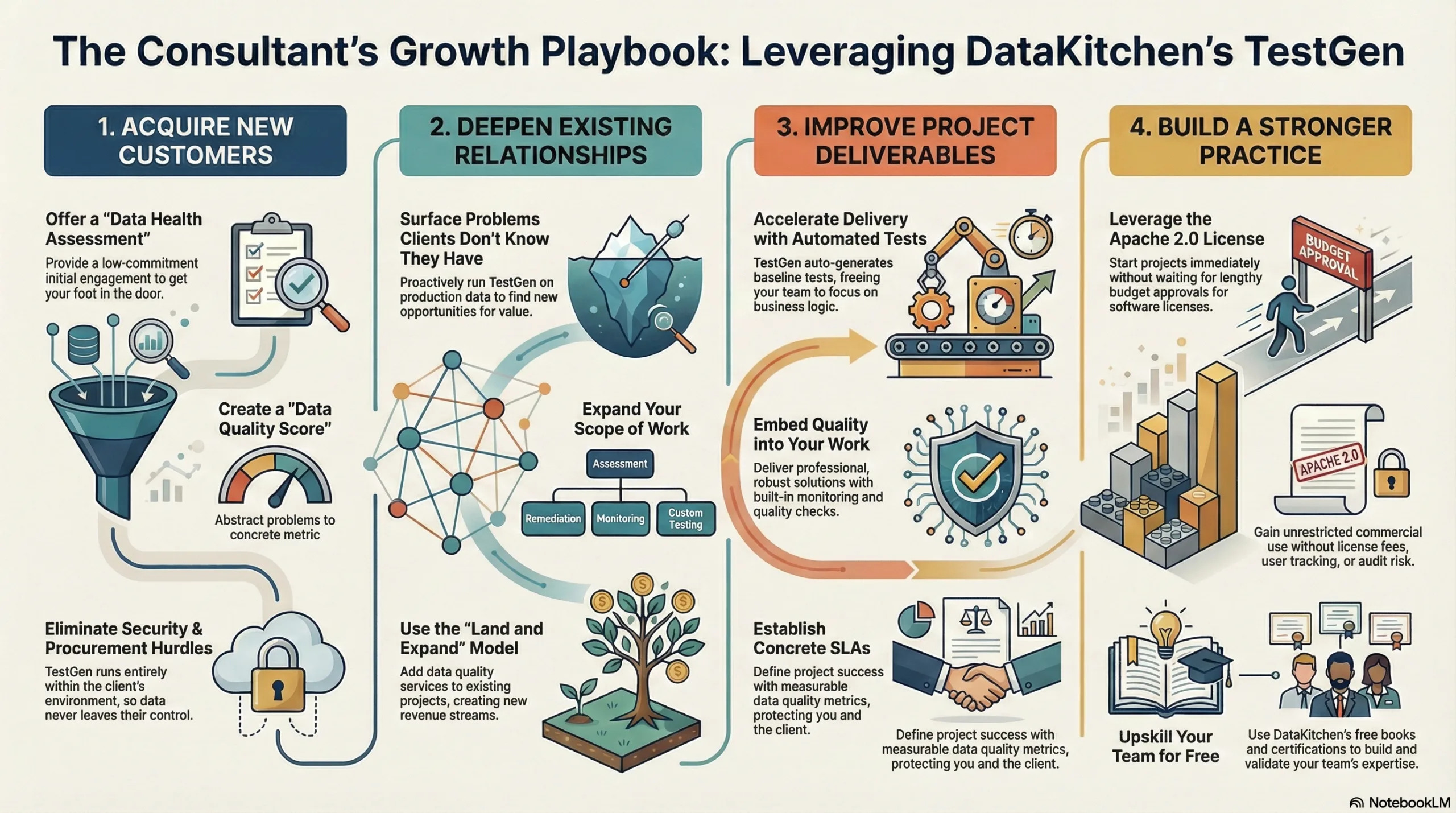
This post outlines four strategic ways to use these tools to grow your consulting practice.
Goal 1: Acquire New Customers
Every consultant faces the same question: how do you get started with a prospect who doesn’t know you? Cold emails and presentations only go so far. What really helps is showing you understand their specific problems, sometimes even better than they do. TestGen gives you a clear way to do this.
The Discovery Engagement Approach
One approach that works is to offer prospects a simple “data health assessment” to start. Present it as a quick exercise where you connect TestGen to a sample of their data and create a detailed data quality report.
The mechanics are straightforward. TestGen connects to major database platforms (including Snowflake, Databricks, PostgreSQL, SQL Server, and Redshift). Once connected, it automatically profiles the data and generates a baseline set of data hygiene metrics and a data quality score without requiring custom logic. Within hours, you have concrete findings.

TestGen is especially good for client assessments because it runs entirely in-house. You set it up in the client’s environment, so their data never leaves their systems. This removes security worries that can slow down discussions about data tools. If a CISO asks where the data goes, you can say it stays put. TestGen checks the data in place and saves results locally. For consultants, this means you can suggest running TestGen on production data without long security reviews or procurement delays.
Since TestGen works on unlimited tables, you aren’t limited in what you can check. Unlike commercial tools that charge per table or data source, you can profile and score all of a client’s data if needed. This allows you to give a complete assessment and show the full range of data quality issues across the organization.
Creating the Data Quality Score
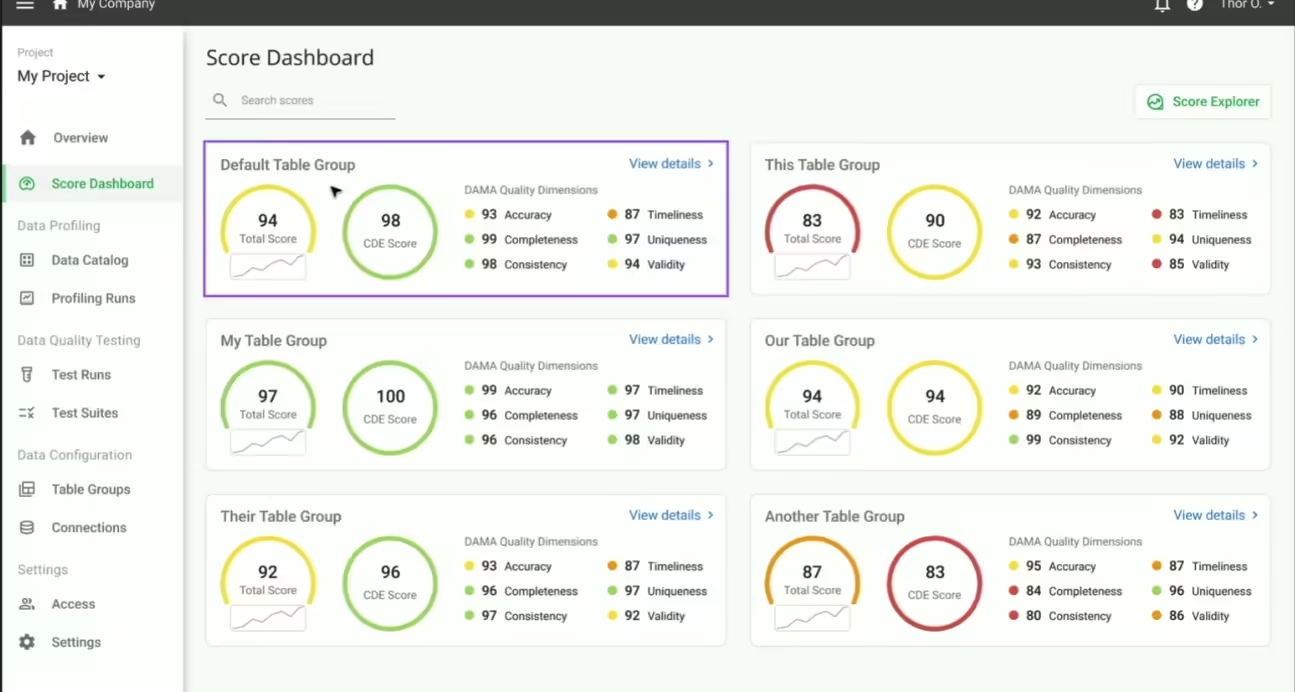
You can turn TestGen’s results into a data quality score—a single number that gives executives something clear to consider. Most organizations don’t know how to measure their data quality. They might say it’s “messy” or that some reports “can’t be trusted,” but they don’t have a consistent way to track it.
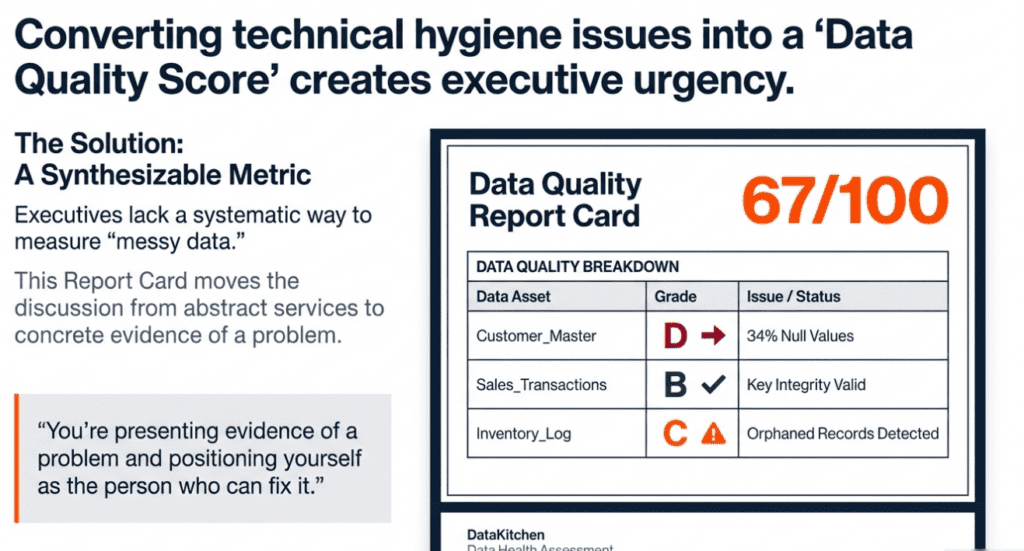
If you tell a VP of Analytics that their customer data scores 67 out of 100, and show which tables and columns are lowering that score, you change the conversation. You’re not just selling consulting services—you’re showing real evidence of a problem and positioning yourself as the one who can solve it.
Converting Assessments into Engagements
The assessment itself is a small task, but it reliably leads to larger conversations. Once you’ve shown a client their data quality issues, the natural next question is: what do we do about it? This opens doors to remediation work, data pipeline improvements, governance implementations, custom test development, and ongoing data quality monitoring arrangements.
Since TestGen is open source under the Apache 2.0 license, you don’t have to ask clients to buy expensive software before they see value. The only upfront cost is your consulting time, which you can price competitively for the first assessment, knowing more work may follow. The Apache 2.0 license also allows clients to use, modify, and deploy the tool however they want. With TestGen, there are no usage limits, no tracking, and no surprise licensing fees later.
Goal 2: Deepen an Existing Customer Relationship
It’s usually easier to grow a business with current clients rather than to find new ones. They already trust you, know how you work, and often have a budget set aside for your services. The key is to find new problems to solve and show value beyond what you’re already doing.
Data quality work is often a missed opportunity in accounts where you’re already handling analytics, pipeline development, or data science projects.
Surfacing Problems They Didn’t Know They Had
Even clients you know well may have data quality issues you haven’t found yet. This happens because data problems often stay hidden until something breaks later on. Teams usually focus on building new features instead of checking existing data, and no one wants to point out problems without offering solutions.
TestGen helps you spot issues early and come prepared with both the problem and a solution. Try running it on data sources you haven’t checked before. You can profile, test, and score datasets from other teams or systems that feed into your pipelines. You’ll likely find data hygiene issues worth talking about.
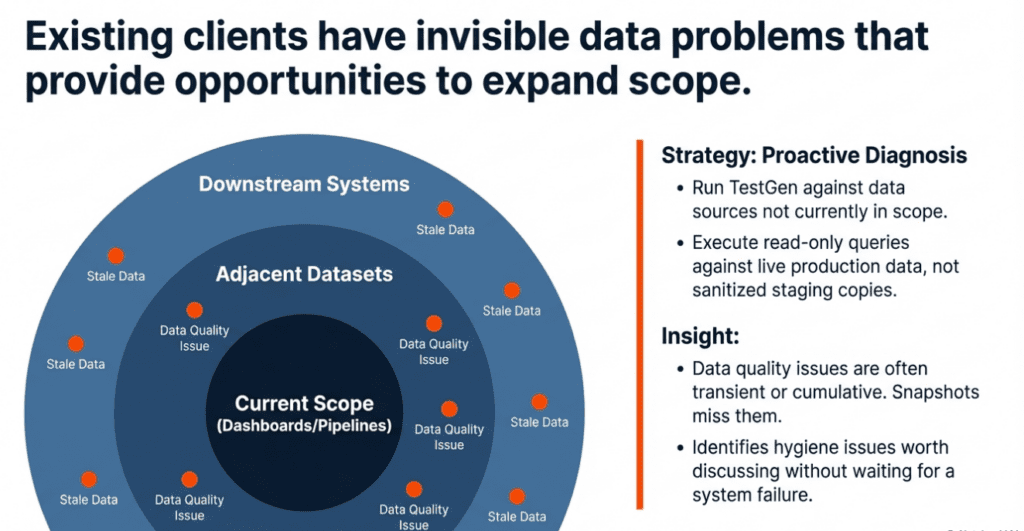
TestGen is built to run safely on production data, so you can use it on live systems. There’s no need to make sample datasets or use old copies. The tool runs read-only queries on the real data your client relies on, giving you results that reflect the current situation, not just a cleaned-up sample.
TestGen can also monitor data for unusual changes over time. It automatically spots shifts in frequency, volume, schema, and other patterns. You can set up TestGen on a database, let it generate alerts for a week or a month, and then share those alerts with your client. For example, you might ask, “Did you know this data was late? Did you notice the schema changed? Are you missing data here?”
Expanding Your Scope of Work
The results from a TestGen assessment often lead to different types of follow-up work.
First, there’s fixing the problems. When you find data quality issues, someone has to address them. This could mean updating source system checks, adding logic to pipelines, or working with other teams to solve the root causes. Since you found the issues, you’re in a good spot to lead this work.
Second, there’s monitoring. After fixing issues, clients want to be sure they won’t come back. This means building dashboards, setting up automated alerts, and creating ongoing monitoring processes. Clients often want to track both the data and the tools that use it, like pipelines and models. TestGen works well with DataOps Observability, making this step easier.
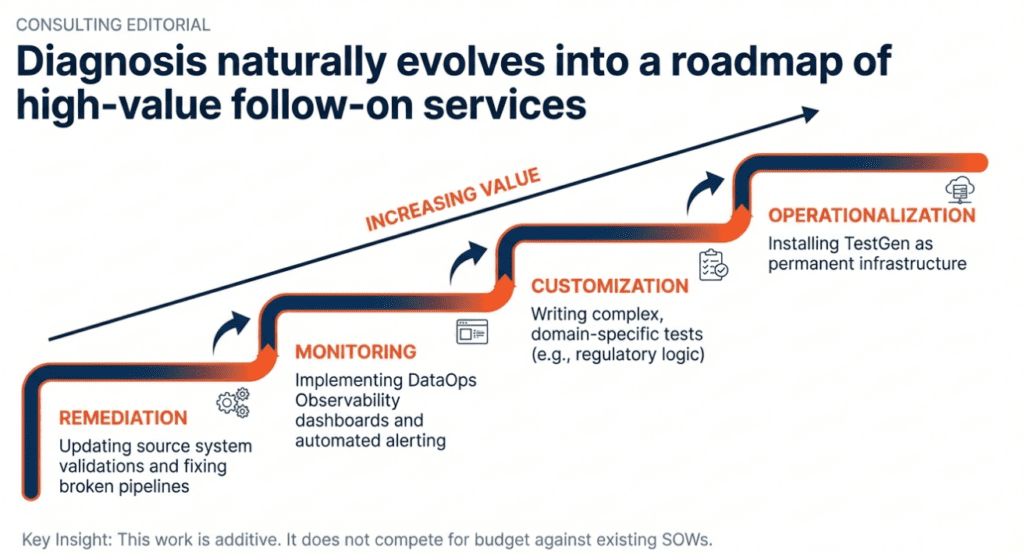
Third, there’s custom testing. While TestGen creates automated tests, clients often need custom tests for their specific business rules. For example, a retail client might want to check that inventory counts match physical audits, while a financial services client might need tests for regulatory metrics. Building these custom tests shows your deep understanding of their business. TestGen aims to cover about 80% of data quality tests automatically, but the remaining 20%—the unique ones—are often the most valuable and where your team’s expertise really matters.
Fourth, there’s the setup and making it part of daily operations. If a client finds TestGen useful during an assessment, they may want to add it to their regular systems. This means setting up the tool, connecting it to their workflows, training their team, and building processes for ongoing data quality management. With the Apache 2.0 license, there’s no need for commercial negotiations—you’re just helping them use open source software they can keep using as long as they want. And TestGen’s Enterprise license is a reasonable cost based on the number of users and connections – not data size or usage.
The Land and Expand Model
This approach is powerful because it adds value without taking away from existing work. You’re not fighting for the same budget as other projects. Instead, you’re finding new problems and creating new value. A client who hired you for dashboards might now want data quality help. A client who uses you for pipelines might add observability services. Each new skill opens up more opportunities.
Goal 3: Improve Project Deliverables
Beyond helping you win business, TestGen improves the quality of your technical work. In a competitive market, the quality of your deliverables sets you apart.
Automated Test Generation as an Accelerator
Writing tests is one of the most time-consuming parts of building production data pipelines. Sound engineers know that untested code is risky, but the push to deliver features often delays testing. This can lead to systems that work—until they suddenly don’t, often at the worst times. TestGen automatically generates a basic set of data tests based on profiling. When you connect it to a data source, it analyzes the actual data and generates tests for expected value ranges, missing-value frequency, uniqueness, referential integrity, and more.

Automation test creation doesn’t replace careful, domain-specific testing. Instead, it takes care of the basic tests, so you can focus on checking business logic that needs your expertise. The result is better test coverage, delivered more quickly.
Since TestGen can run on unlimited tables with no licensing limits, you can create complete test suites across all your data platforms. Commercial tools that charge per table often limit test coverage. With TestGen, you can test everything—staging tables, transformations, final outputs—without worrying about extra costs for your client.
Embedding Quality in Your Deliverables
When you deliver a data pipeline or analytics solution, what sets professional work apart is how robust it is. Amateur work fixes the immediate problem. Professional work solves the problem and also plans for possible future issues.
Adding automated data quality tests and observability tools to your deliverables shows this level of professionalism. When you hand over a pipeline that checks its own health, alerts on problems, and shows data quality metrics, you give your client something they can trust to run smoothly.

DataOps Observability lets you have clearer conversations with clients about what to expect. Instead of making vague promises that “the pipeline will work,” you can set specific SLAs with measurable goals. What does it mean for a data pipeline to be “working”? With observability, you can clearly define it: data arrives on time, row counts are within expected ranges, key metrics stay within set limits, and quality scores stay above agreed-upon levels. This clarity helps both you and your client by setting shared expectations.
Differentiation in Competitive Situations
When clients are choosing between consultants, showing advanced testing and observability can set you apart. Many consultants only focus on features. By highlighting quality, reliability, and long-term success, you show you’re a partner who thinks beyond just the first delivery.
Goal 4: Improve Staff Skills
If you run a consulting practice with multiple team members, the skills of your staff directly impact your capacity to win and deliver work. Investing in training pays dividends through better delivery, higher client satisfaction, and the ability to command premium rates.
DataKitchen offers a range of free resources to help you build data quality and DataOps skills.
Free Educational Resources And Certification Programs
DataKitchen has published detailed, free books on DataOps and DataOps change management. These resources give your team a solid foundation—not just in using the tools, but in understanding the bigger ideas behind good data operations. For consultants, this education helps in several ways. It builds technical skills, gives you a common language for talking about data challenges with clients, and shows that your team understands industry best practices.
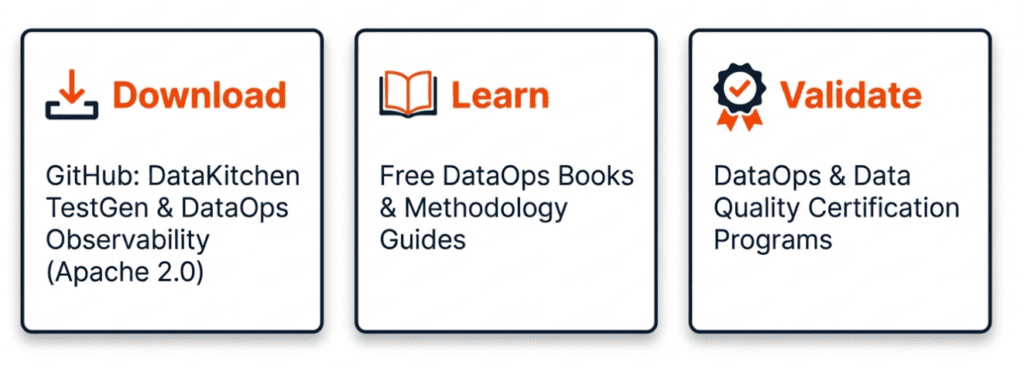
In addition to books, DataKitchen also offers free online certification programs in DataOps and data quality. These certifications give your team a clear learning path and help them fully understand key concepts. Certifications are essential for consulting teams. They show outside proof of your team’s skills, give clients confidence in your expertise, and set a clear standard for what “competent” means in your organization. This makes it easier to assess and grow your talent.
Using these free resources can become part of your company culture. New hires can complete certifications during onboarding. Teams can discuss book concepts in meetings, and delivery teams can apply best practices from these resources to client projects. Investing in skills pays off over time. Teams that keep learning and improving deliver better results, make clients happier, and earn more referrals and repeat business.
The Favorable Economics of Open Source for Consultants
It’s helpful to examine why open-source tools are handy for consulting firms.
Eliminating Procurement Friction
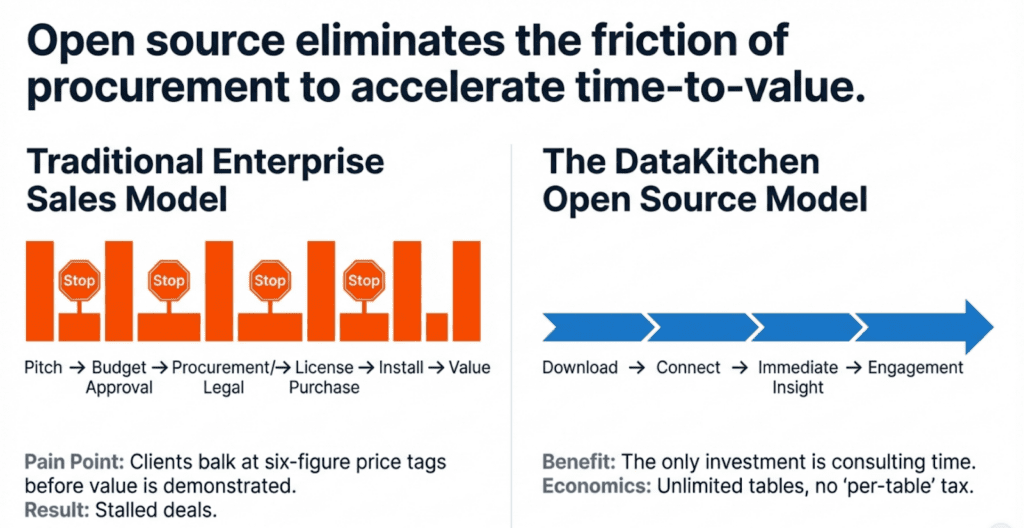
Enterprise software sales cycles are often long and unpredictable. If you recommend a tool that is a big investment, you add extra steps that you can’t control. Budget approvals can take months, procurement adds complexity, and other priorities can stop deals altogether.
Open source removes these obstacles. You can start using TestGen right away, with no software costs for the client. The only investment is your time, which you’re already billing. This makes it much faster to go from the first conversation to an active project.
The Apache 2.0 Advantage
TestGen’s Apache-2.0 license is ideal for consulting projects. It allows commercial use with no restrictions, lets you modify it without sharing changes, and you can distribute it without paying royalties. For clients, this means they can use TestGen across their whole organization, add it to their products, and build on it without legal headaches.
For consultants, this means you can recommend and use TestGen without worrying about license compliance. There’s no user counting, no usage tracking, and no risk of audits. You can build your own features on top, create custom add-ons for clients, and make it part of your regular toolkit.
Unlimited Data Test Coverage Without Unlimited Cost
A major economic benefit of TestGen is that it supports an unlimited number of tables. Most commercial data quality tools charge by table, data source, or data volume. These pricing models force you to choose between full coverage and saving money. They are too expensive.
With TestGen, you don’t have to make that tradeoff. You can profile and test every table in a client’s data warehouse at no extra cost. This lets you build truly comprehensive data quality programs rather than cutting corners due to budget constraints.
Security Without Compromise
Because TestGen runs entirely in-house, it solves a common concern with data tools. Many organizations, especially in regulated industries, can’t send data to outside services. Even those without strict rules are often careful about letting data leave their control.
TestGen avoids this issue altogether. You install it in the client’s environment, it checks the data in place, and the results stay local. There’s no SaaS, no cloud dependency, and no risk of data leaving. This makes it a good fit for clients who wouldn’t approve a cloud-based data quality tool.
Demonstrating Value Before Asking for Commitment
Traditional enterprise software asks clients to commit budget based on promises. They’re buying features they haven’t tried yet, often from vendors they don’t fully trust. The client takes all the risk. Open source flips this model. You show value first. The client sees real results from TestGen on their own data before making a decision. The risk moves to you as the consultant, but you can handle it with efficient work and good client relationships.
Most importantly, recommending open-source tools aligns your interests with your clients’. When they are ready to run production testing with multiple users, DataKitchen offers a low-cost enterprise version. DataKitchen has excellent support from experienced data people like you.
Clients notice and value this alignment. It builds trust, which is key to long-term consulting relationships.
Your Next Step
If you think TestGen and DataOps Observability can help your consulting business, getting started is simple.
Begin by learning the tools yourself. Install TestGen, connect it to some data you can access, and see what it finds. Get to know its profiling, test generation, and reporting features. The better you know the tools, the more confidently you can show them to clients.
Next, look for opportunities with your current clients. Are there accounts with data quality issues you haven’t tackled? Which clients could use a data health assessment? Which projects could benefit from better testing and observability? You probably have chances you haven’t noticed yet.

Then, define your service. How will you present data quality assessments? What’s the scope, timeline, and price? What will you deliver? A clear offering makes it easier to talk with prospects and clients.
Finally, invest in your team’s skills. Share the free DataKitchen resources with them. Encourage them to complete certifications. Make data quality and observability a core strength of your practice.
Conclusion
Consulting is all about creating value for clients and earning a share of that value as fees. The better you are at spotting client problems, showing solutions, and delivering results, the more successful your business will be.
DataKitchen’s open-source data quality and observability tools give consultants strong capabilities at every stage of the client relationship. They help you win new clients by showing value right away, deepen relationships by uncovering new problems, and improve your deliverables with automated testing and advanced monitoring. The free educational resources also help your team grow over time.

The Apache-2.0 license, unlimited table coverage, and in-house setup remove the usual barriers to using powerful data-quality tools in client projects. You can run TestGen on production data confidently, knowing security is built in and clients won’t face surprise costs as they use it more. In a market where data quality problems are everywhere but good solutions are rare, consultants who can find and fix these issues have a real edge. Open source tools make this advantage possible without the usual barriers of enterprise software.
The opportunity is there. The tools are free.
Like What You Hear? Become A DataKitchen Partner
Frequently Asked Questions, TLDR;
A Summary Of The Consultant’s Guide To Using DataKitchen’s Open Source Data Quality And Data Observability
The central point of the blog is that DataKitchen’s open-source tools—specifically TestGen and DataOps Observability—enable data consultants to grow their business and deliver superior results by removing the financial and technical friction typically associated with enterprise data quality platforms. By leveraging these tools, consultants can demonstrate immediate, tangible value to clients without requiring upfront budget approvals or navigating lengthy procurement cycles
To achieve this, the blog outlines four strategic goals for consultants:
- Acquire New Customers through Low-Commitment Assessments: Consultants can use TestGen to offer “data health assessments,” which connect the tool to a prospect’s data to generate a comprehensive data quality report and a concrete “data quality score.” This shifts the conversation from abstract services to evidence-based problem-solving.
- Deepen Existing Relationships by Surfacing Hidden Issues: Even in established accounts, TestGen can proactively identify hygiene issues in datasets that were previously unexamined. This naturally leads to expanded work in remediation, ongoing monitoring, custom testing, and operationalizing the tools within the client’s permanent infrastructure.
- Improve Project Deliverables via Automation: TestGen accelerates by automatically generating baseline tests from data profiling. This allows consultants to deliver more robust, professional-grade pipelines that include observability instrumentation and measurable Service Level Agreements (SLAs), serving as a major differentiator in a competitive market.
- Enhance Staff Skills with Free Resources: DataKitchen provides free books and certification programs for DataOps and data quality. Utilizing these resources helps consulting firms build a learning culture and provides clients with external validation of their team’s expertise.
The underlying advantage of this approach is the economics of open source. Because TestGen is licensed under Apache 2.0, it can be deployed in-house (addressing security concerns), run against unlimited tables without incremental costs, and used without royalty payments or licensing surprises. This aligns the consultant’s interests with the client’s, building long-term trust through a “value-first” model.
How Does DataOps Data Quality TestGen Help?
TestGen helps data consultants and engineers by providing a low-friction, automated way to identify, measure, and resolve data quality issues while simultaneously acting as a business development engine.
Technical and Operational Efficiency
- Automated Test Generation: TestGen accelerates projects by automatically profiling data and generating baseline tests for patterns such as uniqueness, null frequencies, and value ranges. This handles the mechanical work of foundational testing, allowing engineers to focus on high-value business logic.
- Support for Major Platforms: It connects directly to major database platforms, including Snowflake, Databricks, PostgreSQL, SQL Server, and Redshift.
- In-House Security: Because it runs entirely within the client’s environment, data never leaves their infrastructure. This sidesteps security concerns and lengthy CISO reviews that typically stall the adoption of cloud-based tools.
- Unlimited Table Coverage: Unlike commercial platforms that charge per table or data source, TestGen allows for unlimited testing and profiling across an organization’s entire data estate without incremental licensing costs.
Business Development and Client Management
- Low-Commitment Assessments: Consultants can use TestGen to offer “data health assessments”—short, high-value engagements that produce a comprehensive report and a concrete “data quality score”. This shifts the conversation from abstract services to evidence-based problem solving.
- Eliminating Financial Friction: As an open-source tool under the Apache 2.0 license, it requires no upfront licensing costs or procurement cycles. This allows consultants to demonstrate value before asking for budget commitment.
- Surfacing Hidden Issues: TestGen can be run against live production systems to proactively find hygiene issues that are often invisible until something breaks downstream. Identifying these issues creates opportunities for follow-on work in remediation, monitoring, and operationalization.
Project Quality and Differentiation
- Establishing SLAs: By providing concrete metrics, TestGen allows consultants to define and meet Service Level Agreements (SLAs), ensuring data arrives on time and meets specific quality thresholds.
- Professionalizing Deliverables: Including automated testing and observability instrumentation in a project demonstrates professionalism and operational excellence, distinguishing a consultant from competitors who focus only on the basics.
- Customization: Beyond automated tests, it provides a framework for consultants to build custom business-rule tests that reflect a client’s specific domain needs, such as validating inventory counts or regulatory calculations.