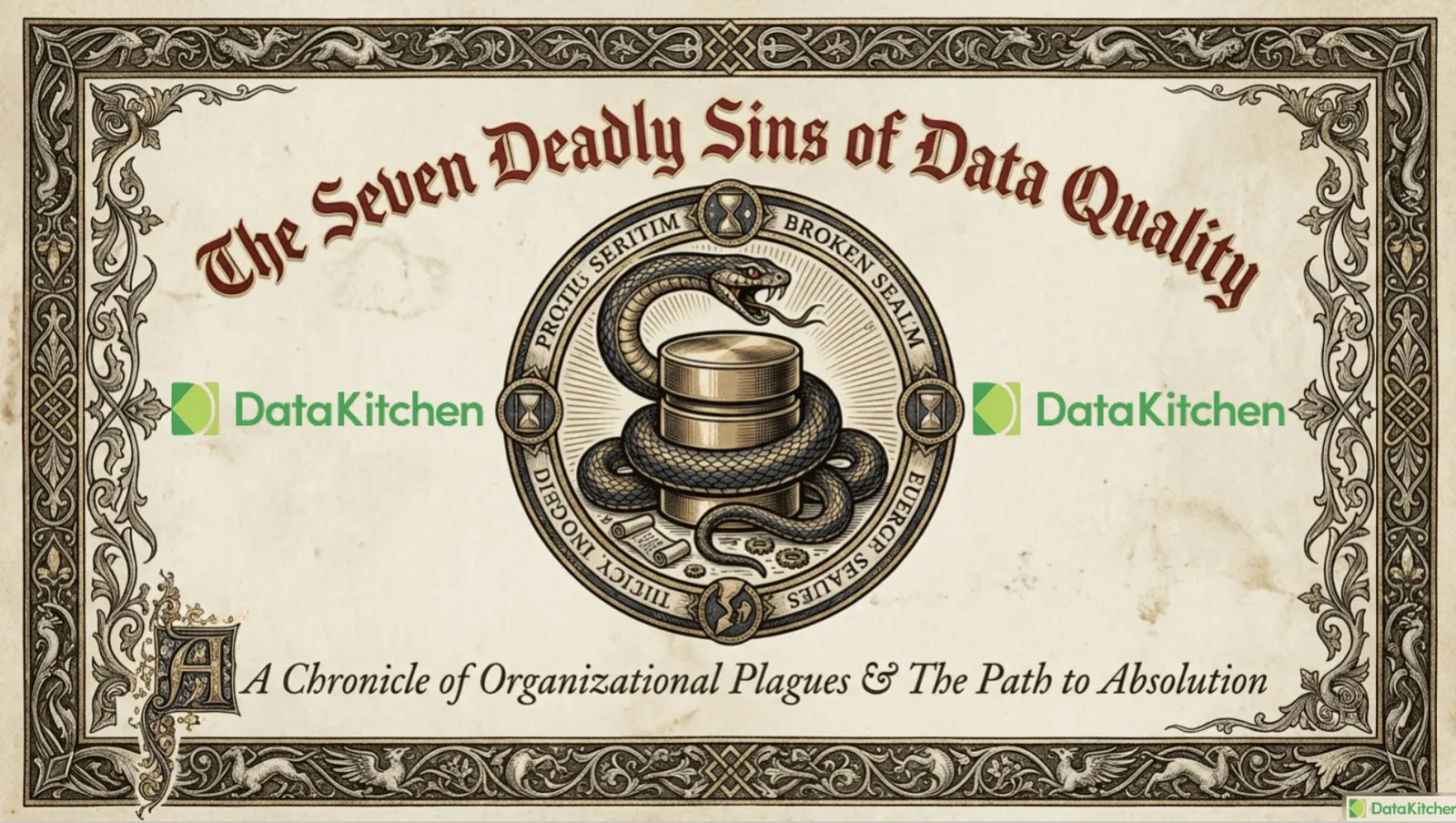
Data quality problems don’t just appear out of nowhere. They fester in organizational cultures where dysfunction becomes normalized, where warning signs are ignored, and where the path of least resistance leads to ever-growing data debt. After years of working with data teams across industries, we’ve identified seven behavioral patterns that consistently undermine data quality initiatives. Like the classical deadly sins, these aren’t simply technical failures—they’re deeply human tendencies that prevent teams from achieving the data quality their organizations desperately need.
Understanding these sins is the first step toward overcoming them. Each represents a common trap that even the most well-intentioned data teams fall into. The good news? Recognition is the beginning of recovery, and there are practical paths forward for teams willing to confront these challenges head-on.
1. Shame: The Fear of Finding Problems
Here’s something we don’t talk about enough in data engineering: shame. The quiet, corrosive feeling that if something is wrong with the data, it must be your fault. And if you’re the one who finds the problem, you’re the one who’ll have to answer for it. As explored in The Data Errors Shame Game, this shame creates a strange and painful paradox: the very people best positioned to catch data quality issues often develop an unspoken preference not to look too closely. Not because they don’t care, but because they’ve learned that discovering a problem means owning the blame for it.

When data quality responsibility lives entirely within the engineering team, every error feels personal. Engineers are expected to anticipate problems before they happen, catch them instantly when they do, and fix them without anyone noticing there was ever an issue. Over time, this creates a defensive posture: if I don’t find the error, I can’t be blamed for it. The antidote to shame is shared visibility. When data engineers and business users look at quality problems together, the dynamic shifts from “what did you miss?” to “what should we tackle first?” Building quality circles where stakeholders regularly review data issues together dissolves the isolation that makes shame thrive.
2. Denial: The Culture of Rationalization
In many organizations, data quality problems fester in the shadows—ignored, rationalized, or swept aside with confident-sounding statements that mask deeper dysfunction. As described in Is Your Team in Denial about Data Quality?, teams often build a culture of rationalization where signs of trouble are misread as proof of success. A pipeline ran “all green”? That doesn’t mean the data inside was correct. “I haven’t heard a single complaint.”? That usually means users have stopped expecting anything better or have worked around the data team entirely.
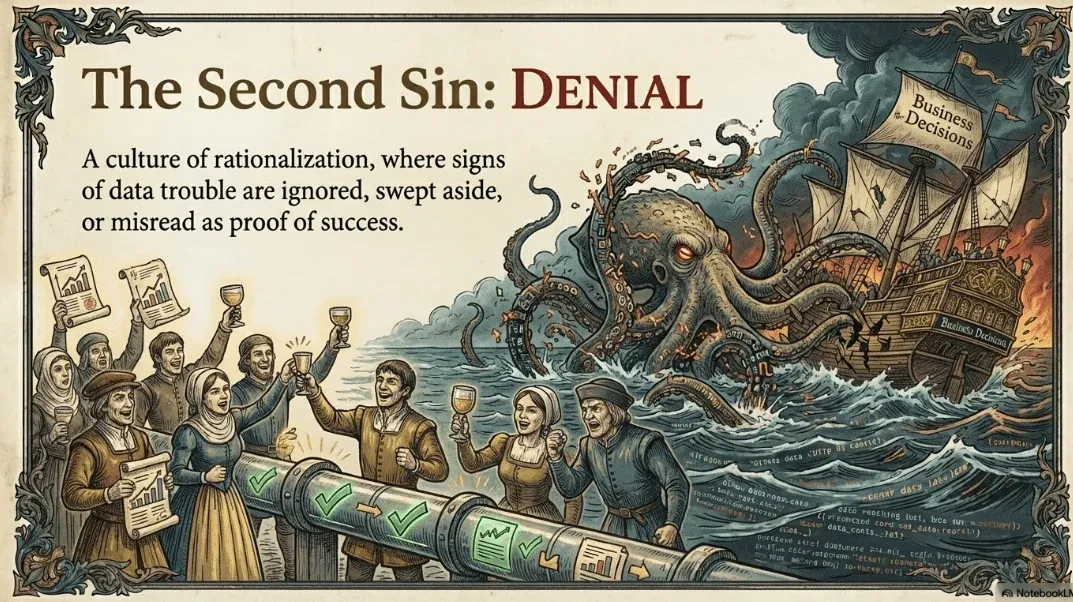
The woman on the phone saying “The users know about that—they have a workaround!” might be trying to help, but she’s normalizing failure. Workarounds don’t fix broken data; they institutionalize it. Confidence is not a substitute for verification—manual processes, however well-intentioned, are rarely repeatable, scalable, or trustworthy. Breaking the cycle of denial starts with playing “Data Quality Denial Bingo” with your team: printing out common rationalizations and checking off every statement team members have heard—or said themselves—in the past month. Use the laughter and mild embarrassment that follows as a gateway to having a serious conversation about your data quality practices.
3. Avoidance: The Ostrich Mentality
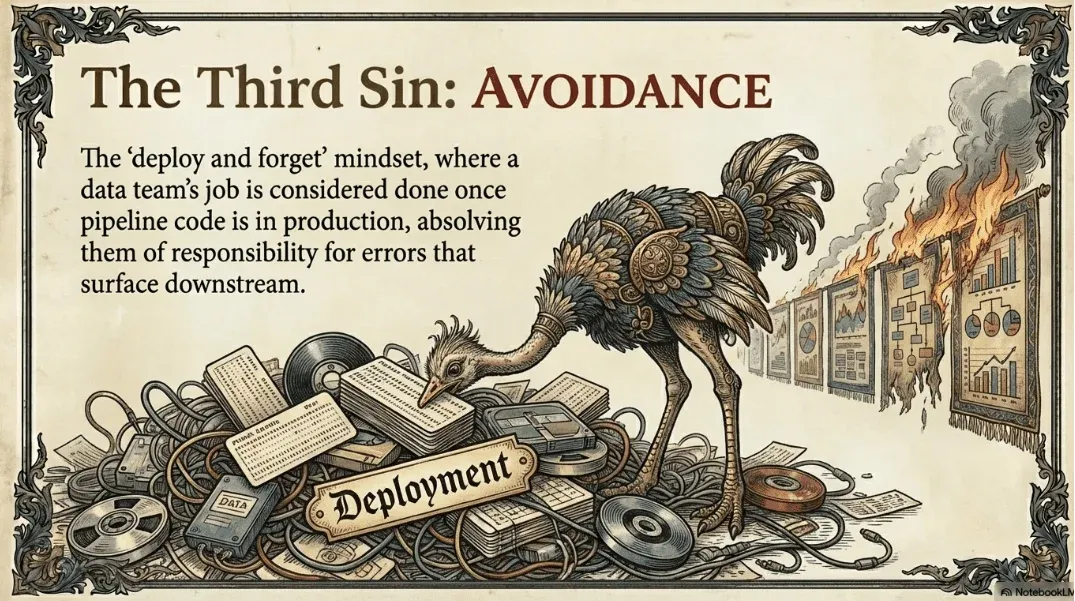
Your team has gone full ostrich. Heads buried deep in the sand, convinced that if they can’t see the production data errors, those errors must not exist. The pipeline is deployed. The tests passed. Job done, right? As examined in The Ostrich Problem: Your Data Team Thinks Their Job Ends at Deployment, this “deploy and forget” mindset is one of the most common—and most corrosive—patterns in data engineering teams. The team sees their job as done once pipeline code is in production. They don’t feel responsible for data quality problems that pop up after deployment
The frustrating part? Your team isn’t lazy or incompetent—they’re just overwhelmed with development work and genuinely don’t realize how bad things have gotten downstream. The ostrich approach feels safe when you’re already buried in sprint work. The fix starts with gathering the facts: survey end customers about their trust in the data, count recent data errors from tickets and Slack threads, and use tools to score your data quality. Share the results with your team. Most engineers don’t want to ship bad data; they just don’t have visibility into what’s happening after deployment. Turn on the lights, and the ostriches will lift their heads.
4. Passivity: Waiting for Permission
Picture this: You’re sitting in yet another meeting where someone asks, “Can we trust this data?” and the room falls silent. If you’re nodding along, you’ve identified yourself as the perfect candidate to become your organization’s data quality champion. As we discussed in The Data Quality Revolution Starts with You, data quality transformation doesn’t begin with company-wide initiatives or sweeping organizational changes. It starts with a single empowered individual who decides that enough is enough—and that person could be you, whether you’re a data engineer debugging pipeline issues at 2 AM or a data leader watching your team struggle.

The magic happens when you stop waiting for permission and start leveraging your personal influence. You already have more power than you think. You know which datasets cause the most headaches, which stakeholders ask the toughest questions, and which processes break down most frequently. This insider knowledge is your superpower. Instead of attempting to fix every data problem in your organization, focus on a specific end customer with a specific pain point. Choose one customer, understand their world, and make their life measurably better. When you transform someone’s work life by fixing their data headaches, you’re recruiting a champion who will advocate for your initiatives.
5. Laziness: The “Not Worth the Effort” Trap
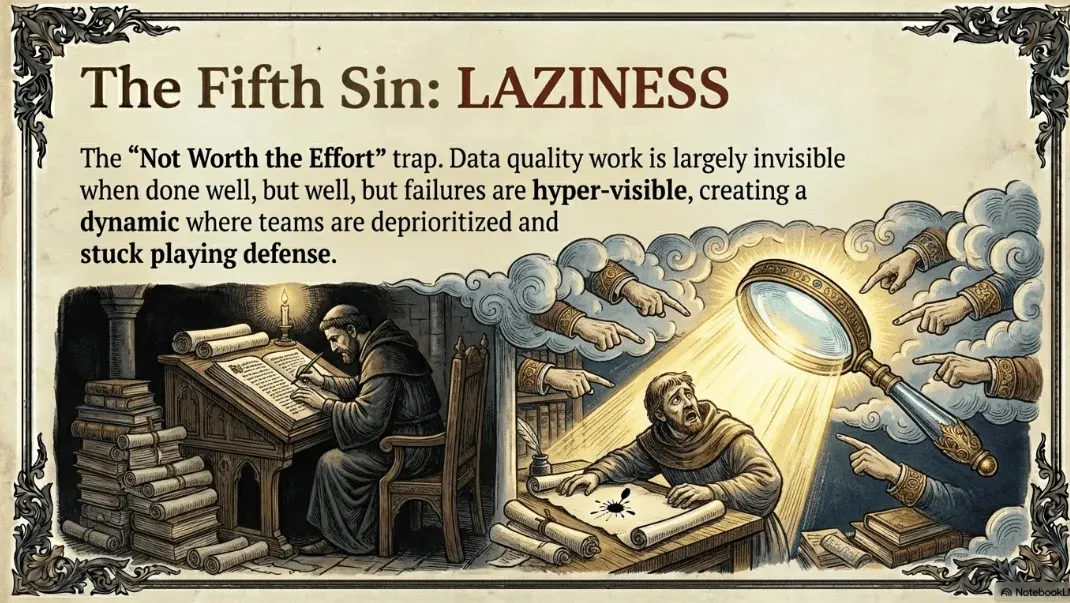
Data quality work is largely invisible. When everything is running smoothly, no one notices the effort behind it. But everyone notices the moment something breaks—when a report is wrong, or a dashboard fails. As discussed in Why Data Quality Isn’t Worth The Effort, this creates a dynamic where data teams are expected to prevent problems without being seen, making it hard to advocate for the time and resources required to do the job well. Data quality efforts are often deprioritized because they don’t directly generate revenue.
Data environments are constantly changing: new data sources are introduced, pipelines are updated, and business logic evolves. These changes often occur without proper cross-team communication, leaving data engineers and analysts to discover issues only after they’ve caused damage. The result is teams stuck playing defense, constantly reacting to problems rather than proactively preventing them. The key insight is that automation doesn’t have to be overwhelming. Tools that automatically generate tests based on the structure and behavior of the data itself can dramatically simplify the process, shifting data quality from a reactive chore to a proactive, integrated part of the development process.
6. Gluttony: Trying to Boil the Ocean
Here’s where most data quality initiatives go wrong: they try to boil the ocean. Improving data quality can feel overwhelming—there are so many things to fix and so many processes to improve. Where do you even start? As outlined in A DataOps Way To Data Quality, the answer lies in starting small, iterating quickly, and treating every improvement as a test or experiment. Instead of attempting to fix every data problem in your organization at once, focus on a specific pain point with a specific customer.

This laser focus does two things: it makes success achievable, and it creates visible wins that build momentum for bigger changes. Think of it like renovating a house—you wouldn’t tear down every wall at once. Instead, you’d start with one room, perfect the process, then apply those lessons to the next space. DataOps principles provide the roadmap: start small, iterate quickly, launch a simple data quality check, measure its impact, learn from what works, then iterate. This approach feels less intimidating than traditional “big bang” implementations and delivers results faster.
7. Ignorance: Not Understanding Your Data
The most fundamental sin is simply not understanding the data you’re responsible for. As explored in Data Quality When You Don’t Understand the Data, knowledge gaps—a lack of comprehensive understanding of the data being handled and the business context it serves—can lead to misinterpretations and incorrect data processing. This knowledge deficit can stem from insufficient training, high turnover rates, or poor knowledge transfer practices. When knowledge is concentrated among a few individuals rather than distributed across the team, it creates risky dependencies.

Poor documentation exacerbates this issue, making it difficult for new team members to get up to speed or for others to fill in during absences. In fast-paced environments, teams often prioritize immediate deliverables over long-term quality improvements. This lack of time for collaboration and learning can lead to shortcuts that compromise data quality. The path forward involves building institutional knowledge through data profiling, creating documentation that travels with the data, and establishing quality circles where cross-functional teams regularly discuss data issues and share context.
Acceptance And Recovery
Understanding these sins is critical because recognition is the first step toward recovery. These behaviors explain why, despite the availability of tools and methodologies, data quality remains a persistent struggle for many organizations.
- They Prevent Proactivity: These sins trap teams in a reactive “firefighting” mode, where they spend significant time (up to 40%) responding to defects rather than building new value.
- They Erode Trust: When these sins lead to poor data quality, they undermine customer trust and confidence in decision-making, potentially costing organizations millions annually.
- They Mask Structural Issues: Sins like Denial and Ignorance hide the fact that technical teams and domain experts often operate in silos, speaking different languages and failing to share context.

To solidify this concept, think of your data infrastructure like a high-performance sports car.
If the mechanics (data engineers) are afraid to open the hood because they might be blamed for what they find (Shame), or if they ignore a rattling noise because “the radio still works” (Denial), the car will eventually break down on the highway. If they believe their job ends the moment the car leaves the garage (Avoidance) or refuse to perform maintenance because no one applauds an oil change (Laziness), the engine will fail. The Seven Sins are the bad habits of the mechanics that guarantee the car will crash, regardless of how expensive or well-designed the vehicle originally was.
Breaking Free from the Seven Sins
The path from data quality dysfunction to data quality leadership isn’t as long as you think. It starts with one person making one small improvement for one specific customer. From there, it’s about building momentum, measuring impact, and expanding your influence one success at a time. The tools are available—including open-source options that remove budget barriers—the methodologies are proven, and the need is obvious.
Getting your team to overcome these seven deadly sins isn’t about shame or blame—it’s about showing them there’s a better way. When they can spot data problems before customers do, when the same issues stop breaking things week after week, and when those dreaded stakeholder calls turn into the occasional “hey, nice work”—suddenly, caring about data quality doesn’t feel like a burden anymore. It feels like the thing that makes their jobs less stressful. Your organization’s data quality transformation is waiting for someone to take the first step.
TIP
Want to learn more? Watch the webinar: Seven Sins Of Data Quality
TIP
Read the companion blog on team ‘sins’: The Five Organizational Sins of Data Teams
FAQ
What are the key points in this blog?
Seven behaviors keep data quality work from happening, and all of them are human rather than technical: shame, denial, avoidance, passivity, laziness, gluttony, and ignorance. Each has a specific antidote. The post argues that fixing data quality is mostly about removing the conditions that make these behaviors rational, not about buying better tooling.
What are the seven deadly sins of data quality?
Shame, the fear of finding problems. Denial, the culture of rationalization. Avoidance, the ostrich mentality of ignoring what happens after deployment. Passivity, waiting for permission to act. Laziness, the belief it is not worth the effort. Gluttony, trying to boil the ocean. And ignorance, not actually understanding the data you are responsible for.
Why is shame the first sin of data quality?
Because in most organizations the person who finds a data error inherits it. That makes looking for problems personally costly, so people stop looking. Nothing else in the list can be fixed while this one holds, since every other remedy starts with somebody being willing to surface bad news about data they touched.
What does gluttony mean in data quality?
Trying to boil the ocean: launching a program to fix data quality everywhere at once, which produces a long assessment and no working tests. The pattern fails because the effort collapses under its own scope before anything ships. The antidote is to start with one schema and one consumer, then expand from something that already works.
How do you fix the cultural side of data quality?
Remove the penalty for finding problems, then give people something to point at that is not an opinion. Automated test results depersonalize the conversation, because the finding belongs to the tool rather than to whoever raised it. That single change addresses shame, denial, and avoidance at once, which is why it is worth doing before anything else.
How does DataOps TestGen help with these behaviors?
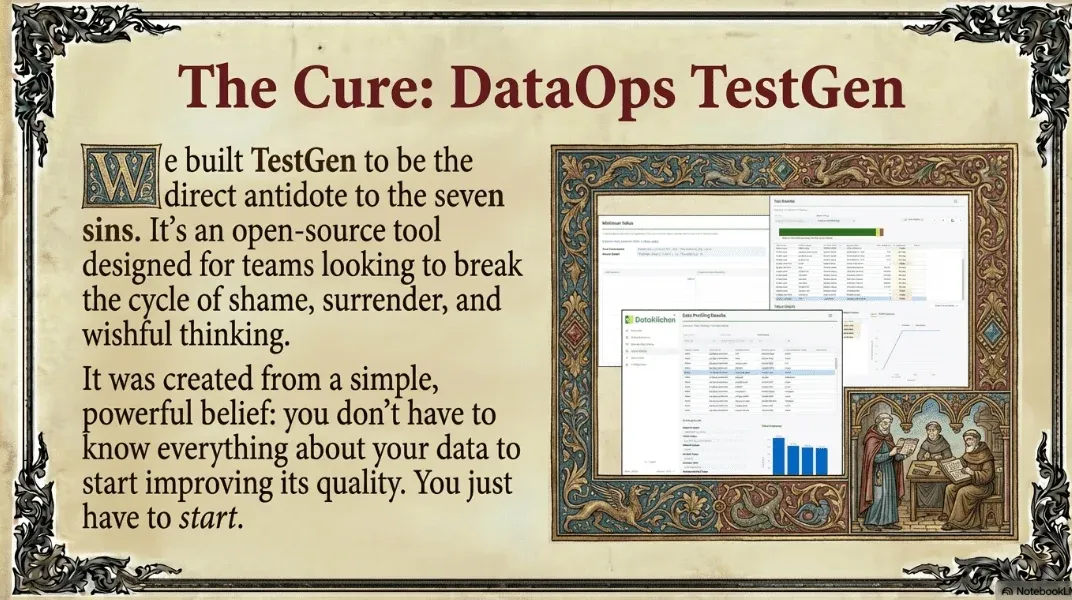
It generates tests from profiling rather than asking someone to author them, which removes the effort objection behind laziness and the expertise objection behind ignorance. Because findings arrive as tool output rather than as one person’s accusation, it also lowers the cost of surfacing bad news, which is the shame problem underneath the other six.