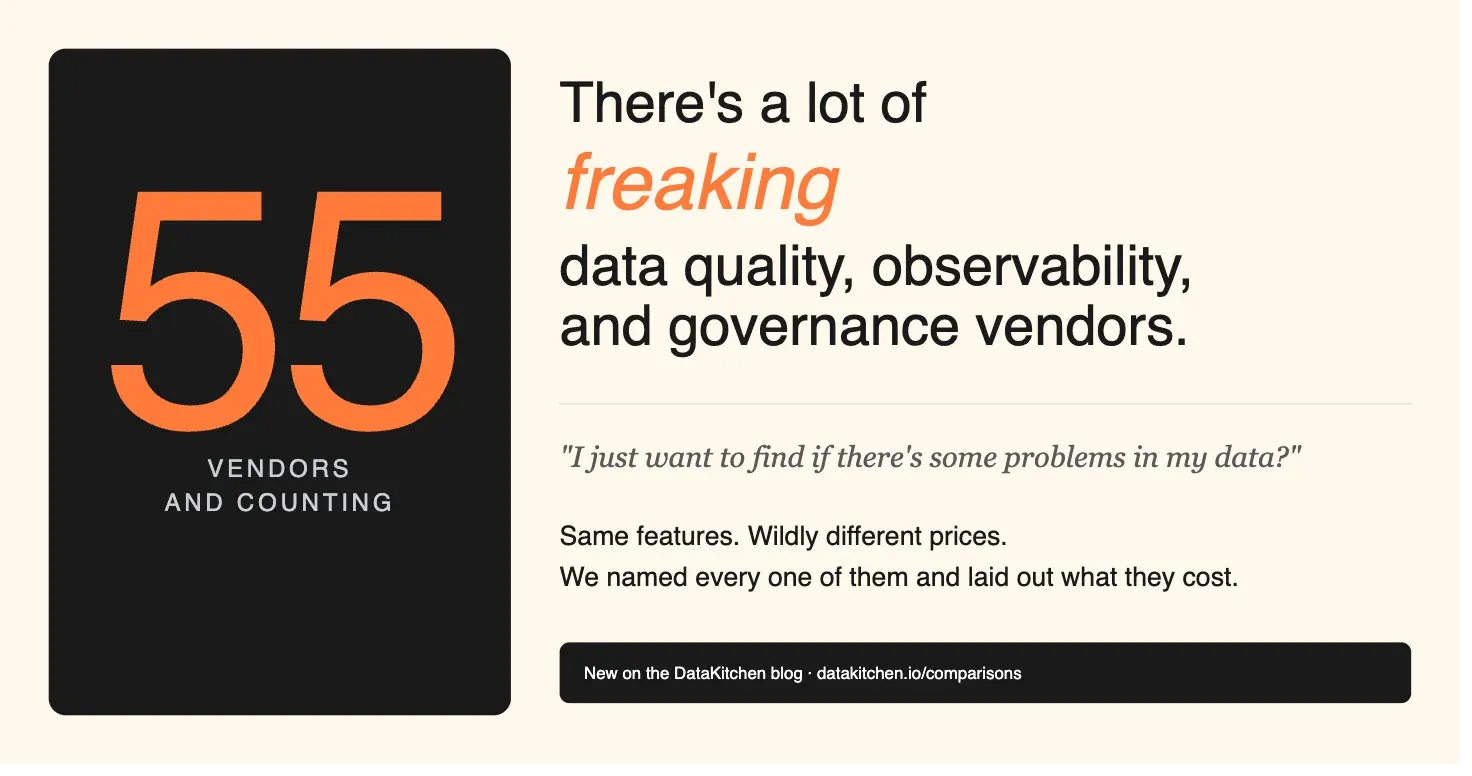
We just published a comparison page that lays out 55 vendors in the data quality, data observability, and data governance (with data quality testing) space side by side. License model, deployment, capabilities, and price. One table. No “request a demo to see pricing.”
The list is long because the category is crowded. Soda, Monte Carlo, Bigeye, Anomalo, Acceldata, Lightup, Validio, Sifflet, Metaplane, Datafold, Collibra, Alation, Atlan, Informatica, Talend, Ataccama, and another three dozen vendors all sell some flavor of “we watch your data.” The capabilities have converged. The prices have not. We’ve written three deep-dive landscape posts if you want the full map: the 2026 commercial software landscape, the 2026 open-source data quality and observability landscape, and the 2026 open-source data profiling landscape.
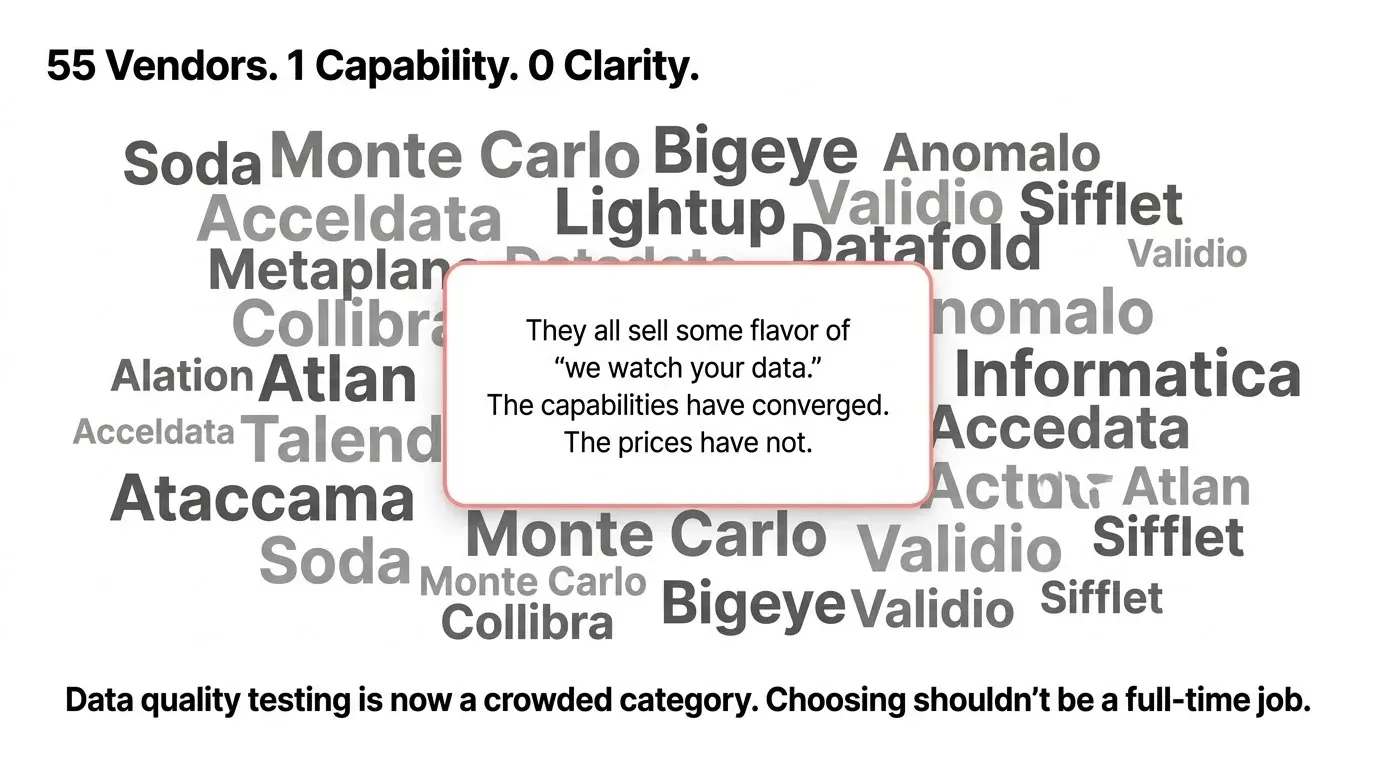
Psychologists call this choice overload. Sheena Iyengar’s jam study showed that shoppers given 24 jams to taste bought ten times less jam than shoppers given 6. More options, fewer decisions. The data quality category has 55 jams.
Here’s where TestGen stands out.
What you get in 15 minutes
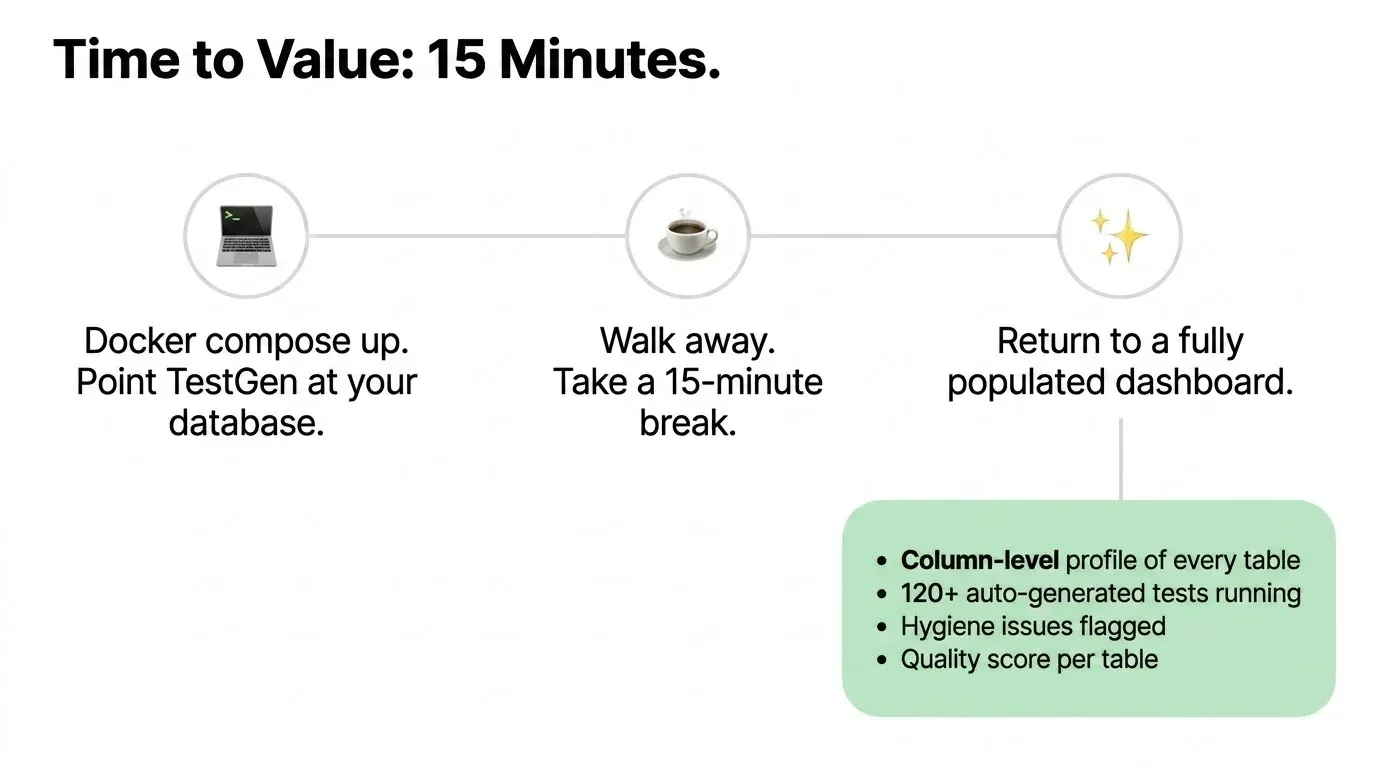
Docker compose up. Point TestGen at your database. Walk away for a coffee. When you come back, you have a column-level profile of every table, 120-plus auto-generated tests running against your data, hygiene issues flagged, and a quality score per table. That’s the whole onboarding. No checks.yml to write. No schema.yml to maintain. No vendor solutions architect on the calendar.
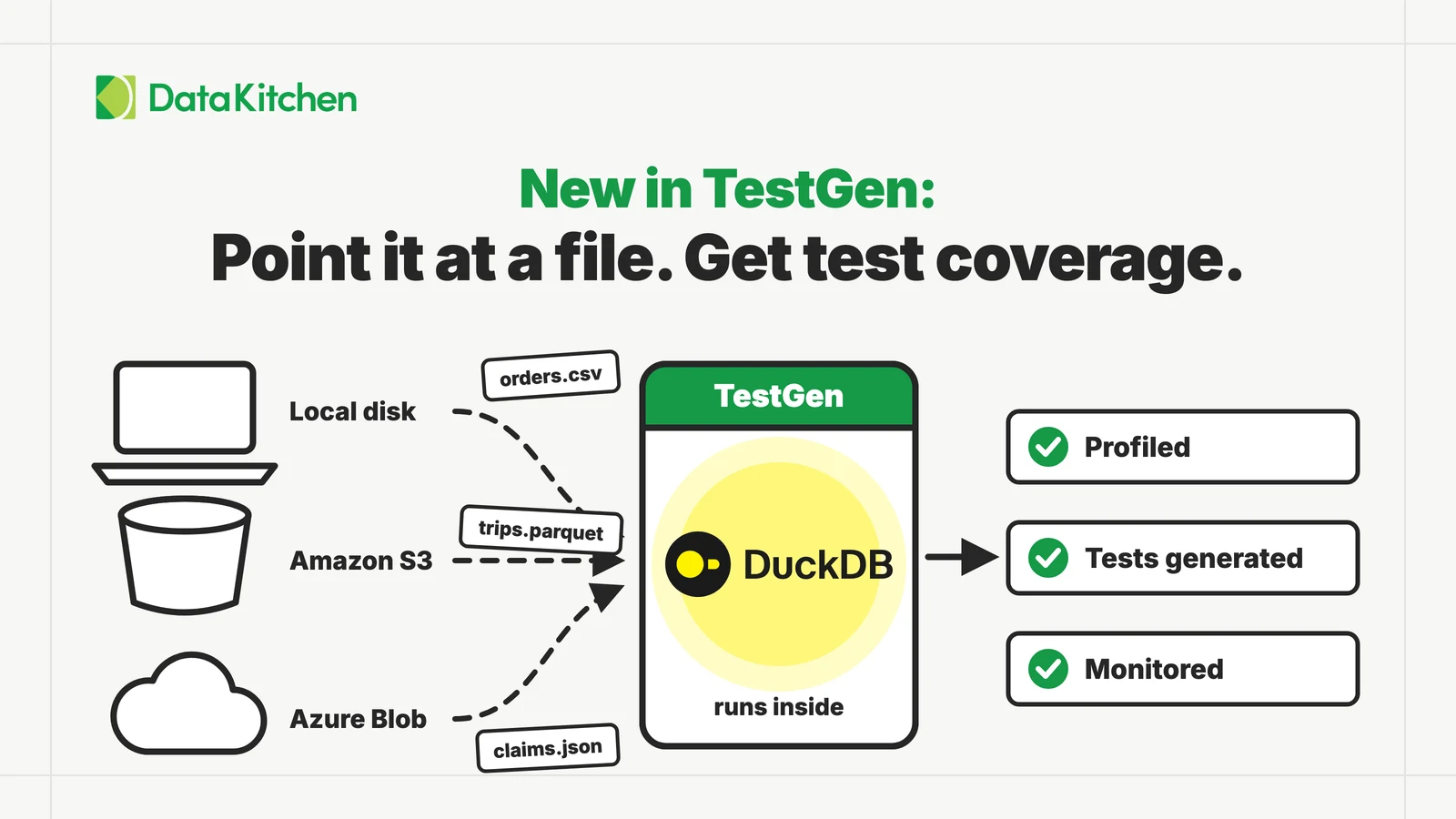
TestGen runs on Snowflake, Databricks, DuckDB, Azure Synapse, Azure SQL, SQL Server, Microsoft OneLake, BigQuery, Redshift, Aurora PostgreSQL, Oracle, SAP HANA, PostgreSQL, and Salesforce Data 360. If your warehouse is on that list, you’re done with the connector question. Install instructions are at docs.datakitchen.io.
Open source, you can actually run
TestGen is Apache 2.0. The full testing engine, profiling, auto-generated tests, hygiene detection, and anomaly monitoring run on your laptop or your cluster. No commercial license needed. Same code in both the open-source and enterprise editions.
The 120-plus auto-generated tests aren’t 120 null checks dressed up as tests. They cover functional dependency violations, referential integrity gaps, distribution shifts, cardinality surprises, pattern violations, value-range issues, type mismatches, and freshness and volume drift. Soda Core makes you write checks.yml. dbt tests make you write schema.yml. TestGen writes the tests for you. You edit the ones you don’t like.
In-database execution, your data never leaves the perimeter
Point TestGen at a database. It profiles every column, writes the tests, and pushes the queries into your database for speed and security. Your data never leaves the perimeter. Security review goes faster when you can tell the team there’s no data egress.
TestGen also runs as a quality gate inside your pipeline. Drop it into an Airflow task, a Databricks job DAG, or a CI step. Bad data fails the build the same way bad code does.
Real support from the people who built it
DataKitchen is a profitable, bootstrapped company that has shipped DataOps software since 2013. Same team, same product line, same pricing. The engineers who wrote TestGen answer support tickets. No chatbot wall. No offshore tier-one triage. No acquisition shutdown email landing in your inbox.
Bristol Myers Squibb runs TestGen on the commercial datasets behind its specialty drug reporting. Progeny Health runs it on neonatal claims data. Pharma and healthcare don’t tolerate flaky tooling.
Fair, predictable pricing
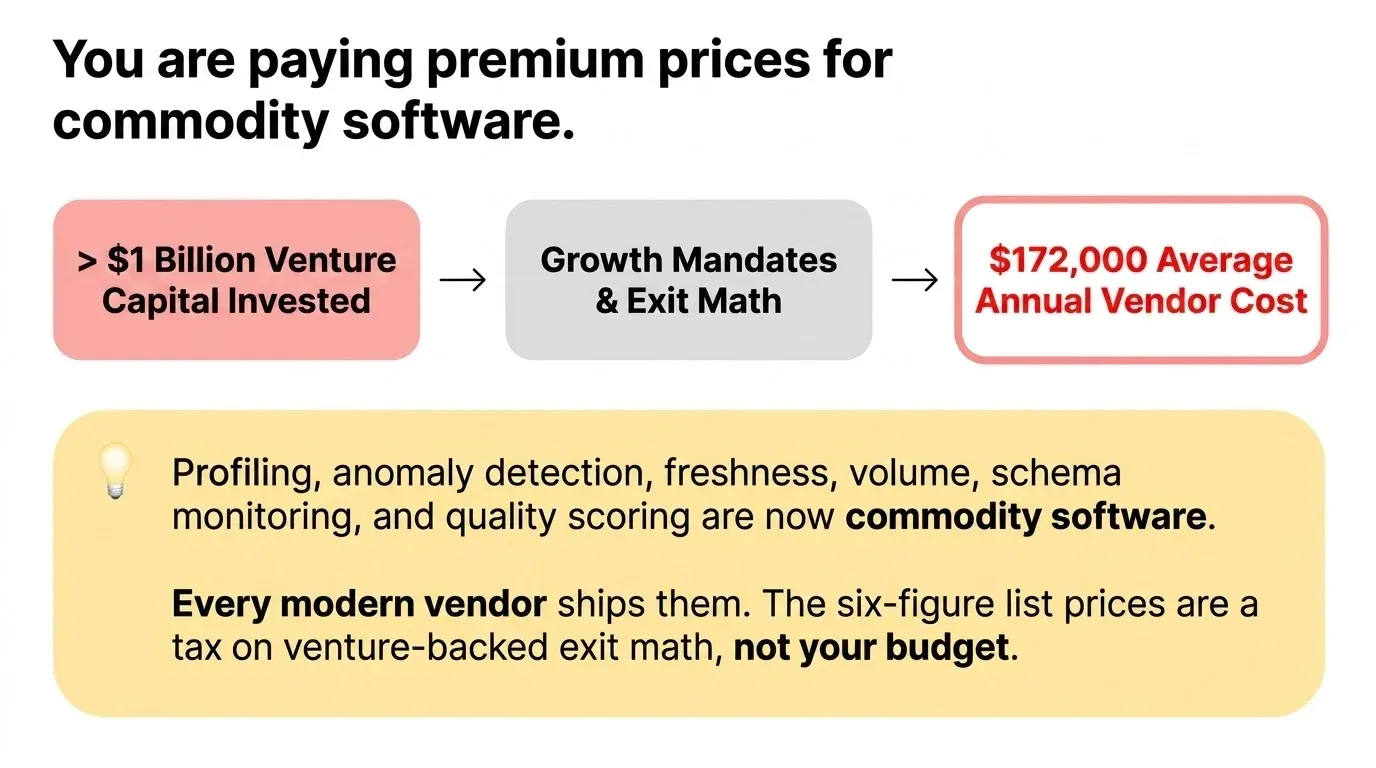
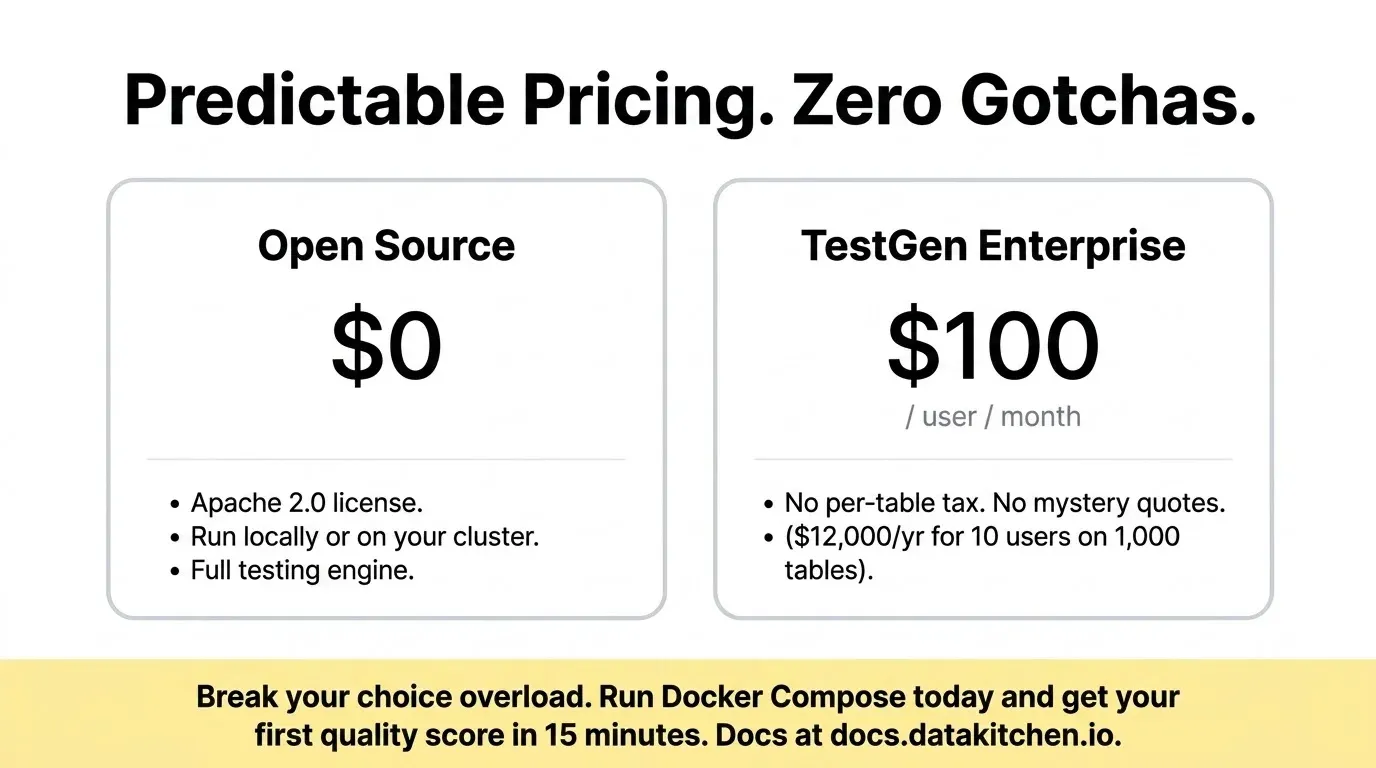
TestGen Enterprise is a flat $100 per month per user and database connection. No per-table tax. No credit metering. No negotiated mystery quote. Enterprise vendors on the comparison page average $172,000 a year. TestGen Enterprise is $12,000 a year for 10 users on 1,000 tables.
Data quality and data observability are now commodity software
You should not be paying premium prices for any of it: profiling, anomaly detection, freshness, volume and schema monitoring, quality scoring. Every modern vendor on the list ships them. The six-figure list prices in this category are premium charges for what has become commodity software. We laid out the math in You’re Massively Overpaying for Data Observability.
Anomaly detection and a catalog you’ll actually use
TestGen runs out-of-the-box freshness, volume, schema, and data drift monitors. The data catalog gives you metadata, hygiene issues, PII risk, test results, and Critical Data Elements in a single view. Shareable issue reports route the right ticket to the right Slack channel with one click.
Pairs with open-source DataKitchen Observability
TestGen monitors your tables. DataKitchen Observability monitors every tool acting on your data, from Airflow and dbt to Fivetran, Snowflake, and the BI layer. Most modern data quality vendors stop at the warehouse.
DataKitchen Observability ships the Data Journeys feature. Combine it with TestGen’s test coverage, and you see the actual impact of a change, not the guess you get from data lineage. Lineage tells you which tables touch which tables. Data Journeys tells you which tests passed, which broke, and which downstream report just went red because of the change you pushed an hour ago.
Venture-backed, growth-mandated
Most vendors on the comparison page are backed by venture capital. The pricing, the roadmap, and the support model are built around exit math, not your budget. The data observability category has attracted more than a billion dollars in venture investment, and we wrote about why that’s not going to end well for buyers.
Break your Choice Overload
Install the open-source TestGen and try it on your data. Fifteen minutes from Docker Compose up to your first quality score. The auto-generated tests, profiling, and anomaly monitors cover what most teams need without writing a line of YAML.
We’ll become your favorite jam.
FAQ
What are the key points in this blog?
The data quality and data observability category is crowded: DataKitchen’s comparison page lays out 55 vendors side by side as of April 2026, with license model, deployment, capabilities, and price in one table. The capabilities have converged and the prices have not. TestGen is Apache 2.0, installs with Docker Compose, and profiles a database and writes its own tests in about fifteen minutes. TestGen Enterprise is a flat $100 per month per user and database connection.
How many data quality and data observability vendors are there?
DataKitchen’s comparison page lays out 55 vendors across data quality, data observability, and data governance with data quality testing, as of April 2026. Every row carries license model, deployment, capabilities, and price, so the field sits in one table instead of behind a demo request. Vendor counts move, so read 55 as the April 2026 figure rather than a permanent one.
Why is it so hard to choose a data quality vendor?
Choice overload. Sheena Iyengar’s jam study found that shoppers given 24 jams to taste bought ten times less jam than shoppers given 6, and the data quality and observability category put 55 options in front of a buyer as of April 2026. The capabilities have largely converged, so what still separates vendors is license model, deployment, support, and price. Category roundups that group the modern data quality tools separately narrow the field faster than a feature checklist.
What do you get from TestGen in the first fifteen minutes?
Run Docker Compose, point the open-source TestGen at a database, and walk away for a coffee. When you come back you have a column-level profile of every table, 120-plus auto-generated tests running against your data, hygiene issues flagged, and a quality score per table. No test YAML to write first. Supported databases include Snowflake, Databricks, Azure Synapse, Azure SQL, Postgres, BigQuery, Redshift, SQL Server, Oracle, and SAP HANA.
Is DataKitchen TestGen open source?
Yes, under Apache 2.0. The full testing engine runs on your laptop or your cluster with no commercial license: profiling, auto-generated tests, hygiene detection, and anomaly monitoring, with the same code in the open-source and enterprise editions. TestGen pushes its queries into your database rather than pulling data out, so your data never leaves the perimeter and a security review has less to argue about.
What does TestGen Enterprise cost?
A flat $100 per month per user and database connection, which works out to $12,000 a year for 10 users on 1,000 tables. No per-table tax, no credit metering, no negotiated quote. Enterprise vendors on DataKitchen’s comparison page average $172,000 a year as of April 2026. The argument in this post is that six-figure list prices are a premium charge for commodity software.
Comparisons
DataKitchen TestGen vs the field
Head-to-head against every major data quality and observability vendor.
No vendors match. .