The 2026 Reality: When Bad Data Turns AI Against You
The world did not ease into AI. It sprinted past you. One month you were managing dashboards and debugging pipelines. The next, your LLM was telling the CEO that revenue was up 40 percent while sales were in freefall. Your analytics engineers were vibe-coding SQL transforms at midnight, hoping today wasn’t the day they broke every downstream model. Your predictive systems, once the pride of the data science program, were degrading faster than you could retrain them. And the BI reports? Nobody trusts them. Worse, nobody trusts you.
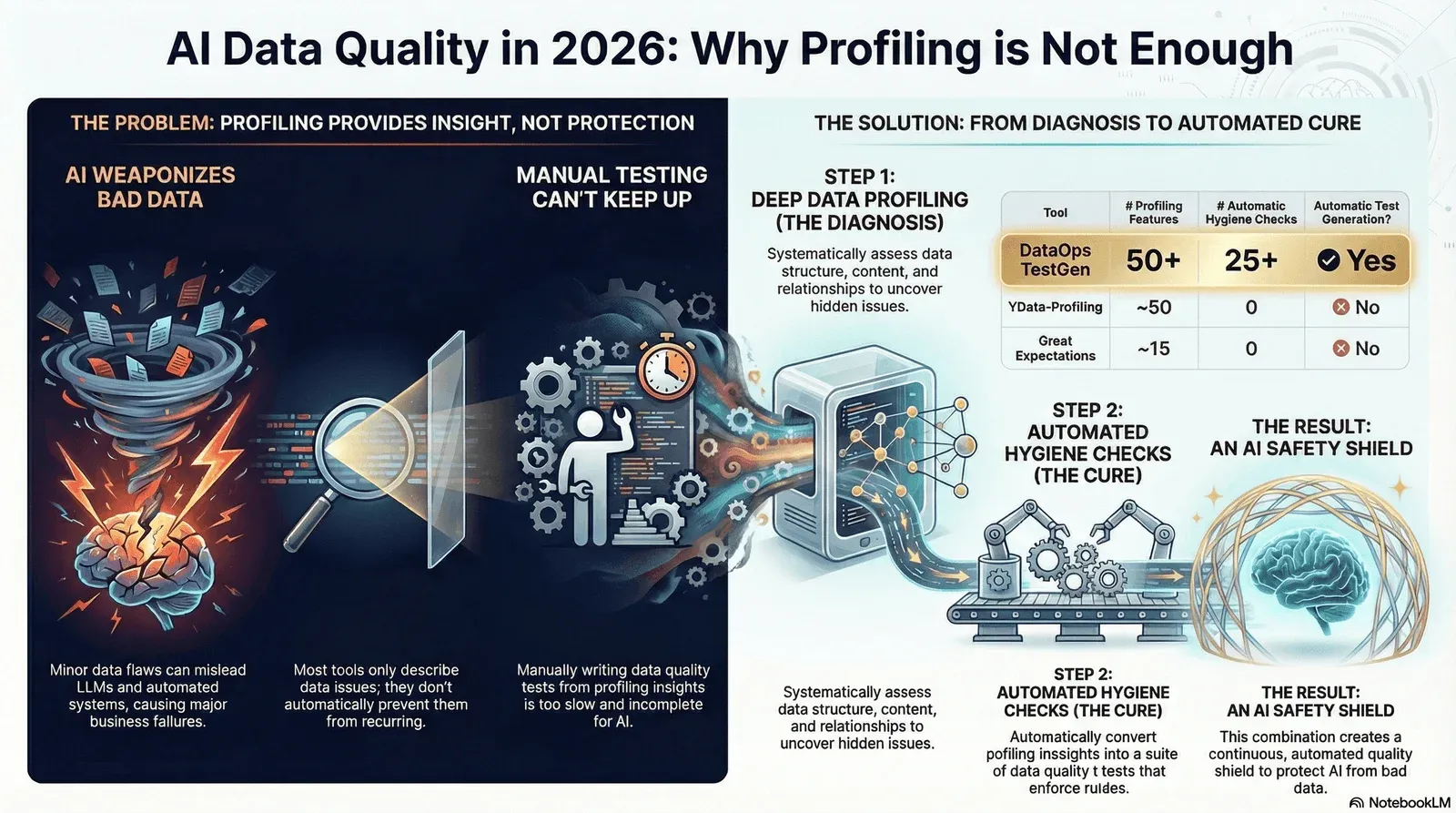
Welcome to 2026, where bad data doesn’t stop at a broken dashboard. It gets fed to a model that acts on it. The bind is that AI demands clean data at the exact moment when volume, velocity, and complexity have made hand-written testing impossible to keep up. Your pipelines feed systems that retrain every hour, decide in milliseconds, and ingest dozens of sources your team barely understands. Your quality process is still SQL tests written like it’s 2015: slow, brittle, incomplete.
Data quality is no longer a governance checkbox. It is AI safety at enterprise scale, and it starts with knowing what is in your columns.
What Is Data Profiling? And Why AI Has Made It Urgent Again
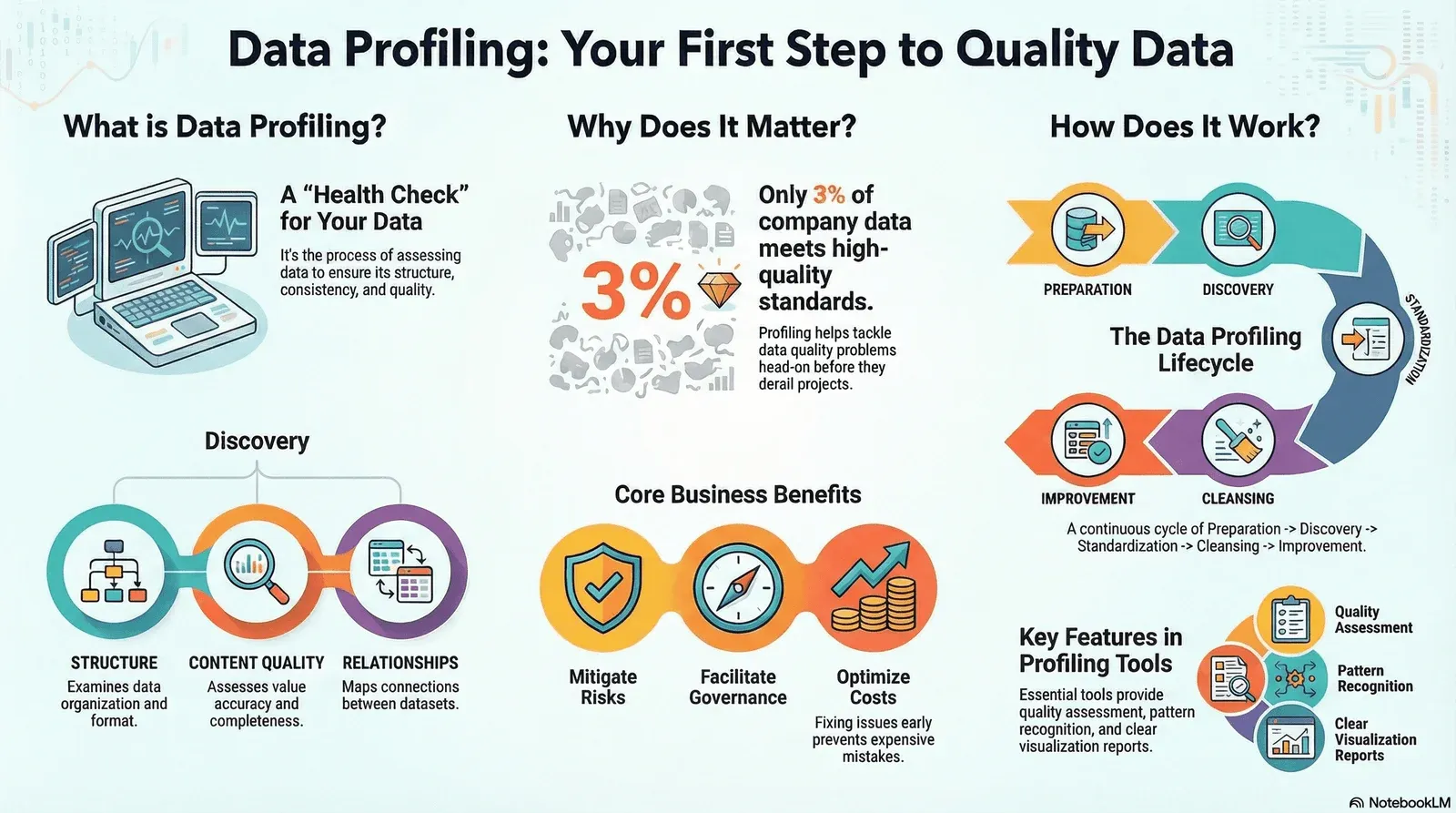
Data profiling computes statistics that describe what is in your data: distributions, null rates, distinct counts, minimums and maximums, value patterns. It is the diagnostic step that tells you whether your AI systems are being fed truth or poison. It comes before modeling, visualization, or any decision, especially a decision a model makes on its own.
Gartner defines profiling as a technology used for “discovering and investigating data quality issues,” which lets you trace errors to their origin and certify data as fit for use. In an AI pipeline the definition has teeth. A column that quietly went 40 percent null does not produce an error. It produces a model that is confidently wrong, with no step in between where a person would have noticed.
Core Techniques of Data Profiling
Profiling splits into three techniques.
Structure discovery checks format and consistency. It catches misformatted postal codes, phone numbers containing letters, and fields whose values break the schema’s assumptions. The question it answers: does this data look like what it is supposed to be?
Content discovery looks inside the values: patterns, missingness, anomalies, inconsistencies. It finds nulls, misspellings, invalid values, and systemic errors. The question: what is actually in here, and does it make sense?
Relationship discovery analyzes connections between tables and fields. Dependencies, correlations, referential integrity. The question: how do these datasets relate, and can those relationships be trusted?
What Profiling Buys You
Done well, profiling exposes governance and compliance risk early, catches errors before they propagate downstream, and gives you a map of sources, relationships, and lineage. It is the first serious act of data hygiene. And in a world where AI consumes data continuously and silently, hygiene is everything.
But a profile on its own is a document. Nothing enforces it.
Why Traditional Profiling Tools Are Falling Short
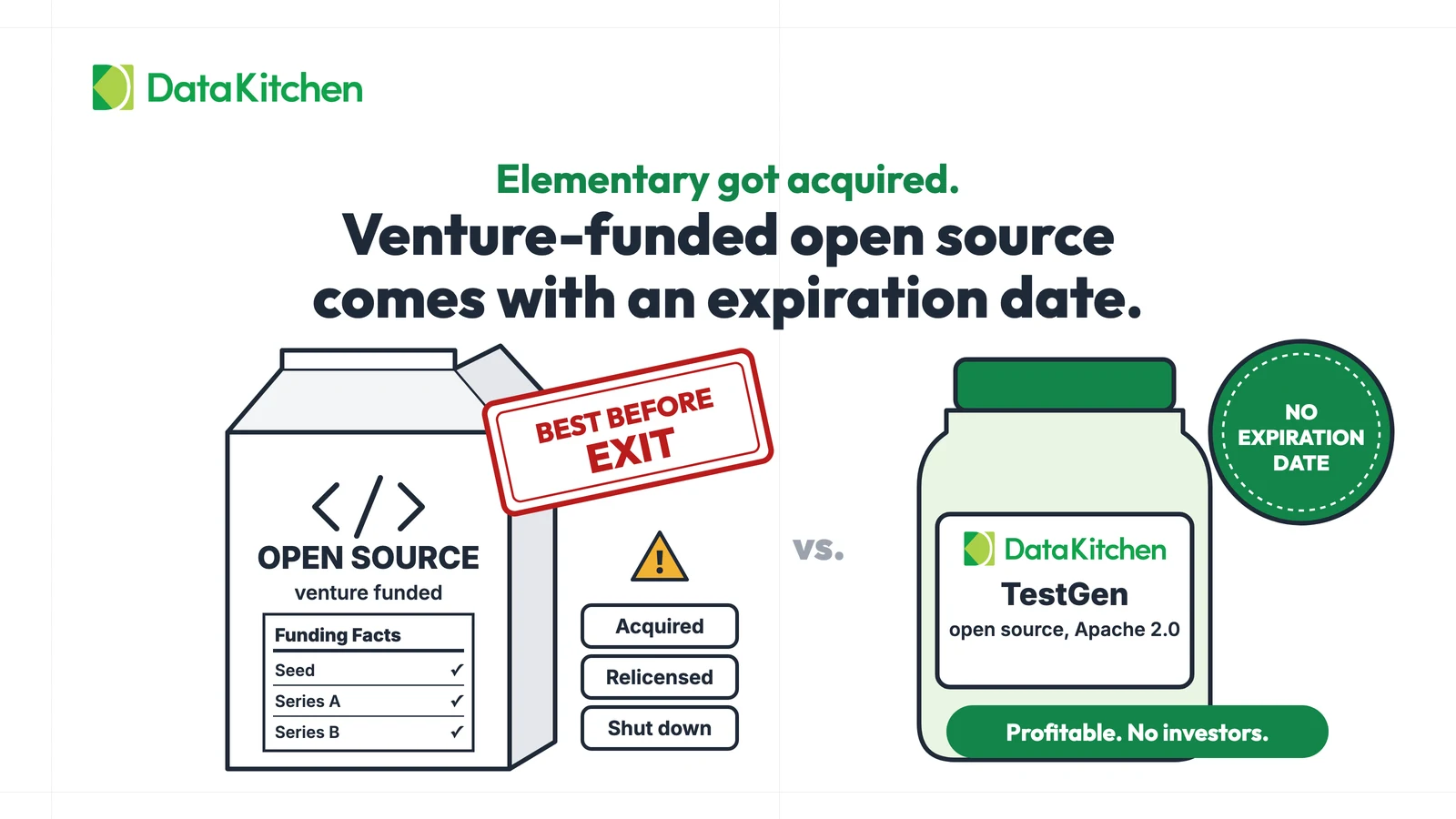
The open-source projects in this space are good at what they do. YData-Profiling generates a rich report with one line of code. Deequ profiles at Spark scale. DataCleaner, OpenRefine, Aggregate Profiler, Metabase, and Apache Griffin each earn their place. Great Expectations ships a profiler that suggests expectations, though its story changed this year: the company was acquired and its commercial product, GX Cloud, shut down on June 1, 2026. The open-source GX Core continues under Fivetran stewardship, so the profiler is still there. The paid product that used to sit on top of it is not.
All of them share one flaw. They stop at insight.
They describe the data and do not enforce its quality. They identify problems and do not prevent them. They produce visibility, not safety.
That gap used to be tolerable. A human read the report, wrote a rule, and moved on. In the AI era there is no human in that seat. When an LLM reads malformed data it does not ask for clarification. It hallucinates. When a model sees unexpected categories it does not ask for help. It degrades silently. What you need is not descriptive profiling but prescriptive, automated hygiene enforcement.
The Comparison: Profiling Depth vs. Hygiene Automation
| Tool | URL | Profiling Descriptions | Profiling Checks | Automatic Data Hygiene Checks | Automatic Test Generation? | The 2026 Verdict |
|---|---|---|---|---|---|---|
| DataOps TestGen (Open Source) | github.com/DataKitchen/dataops-testgen | 55 | 50+ | 32 | Yes | Turns profiling results into runnable hygiene and validation tests automatically. |
| YData-Profiling | github.com/ydataai/ydata-profiling | ~35 to 45 | ~50 | 0 | No | Rich profiling, zero protection. |
| Great Expectations (Profiler) | github.com/great-expectations/great_expectations | ~10 to 15 | ~15 | 0 | No | Manual expectation writing is still required. GX Core continues under Fivetran; GX Cloud shut down June 1, 2026. |
| Deequ | github.com/awslabs/deequ | ~10 to 15 | ~20 | 0 | No | Strong at scale, weak at hygiene. |
| DataCleaner | sourceforge.net/projects/dataquality | ~20+ | ~25 | 0 | No | A strong profiler that stops short of enforcement. |
| OpenRefine | github.com/OpenRefine/OpenRefine | ~15 | ~15 | 0 | No | Great for cleanup, not for automated quality. |
| Aggregate Profiler | sourceforge.net/projects/dataquality | ~10 | ~10 | 0 | No | Lightweight; not enough for an AI-driven organization. |
| Metabase (OSS) | github.com/metabase/metabase | ~5 to 10 | ~10 | 0 | No | Useful for BI; irrelevant for AI safety. |
IMPORTANT
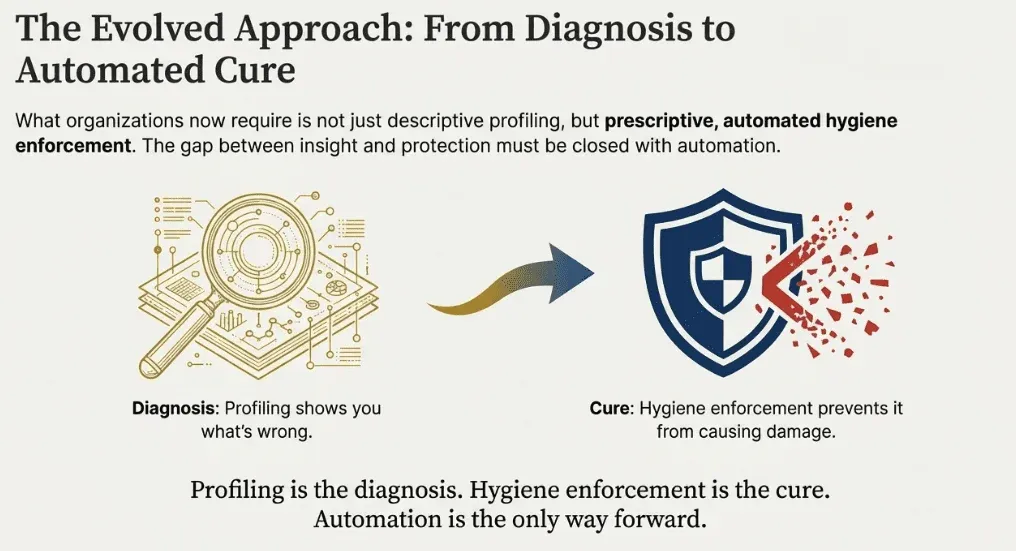
Profiling shows you what’s wrong.
Hygiene automation prevents it from causing damage.
AI needs both.
The Breakthrough: Automated Data Hygiene Testing From Profiling Signals
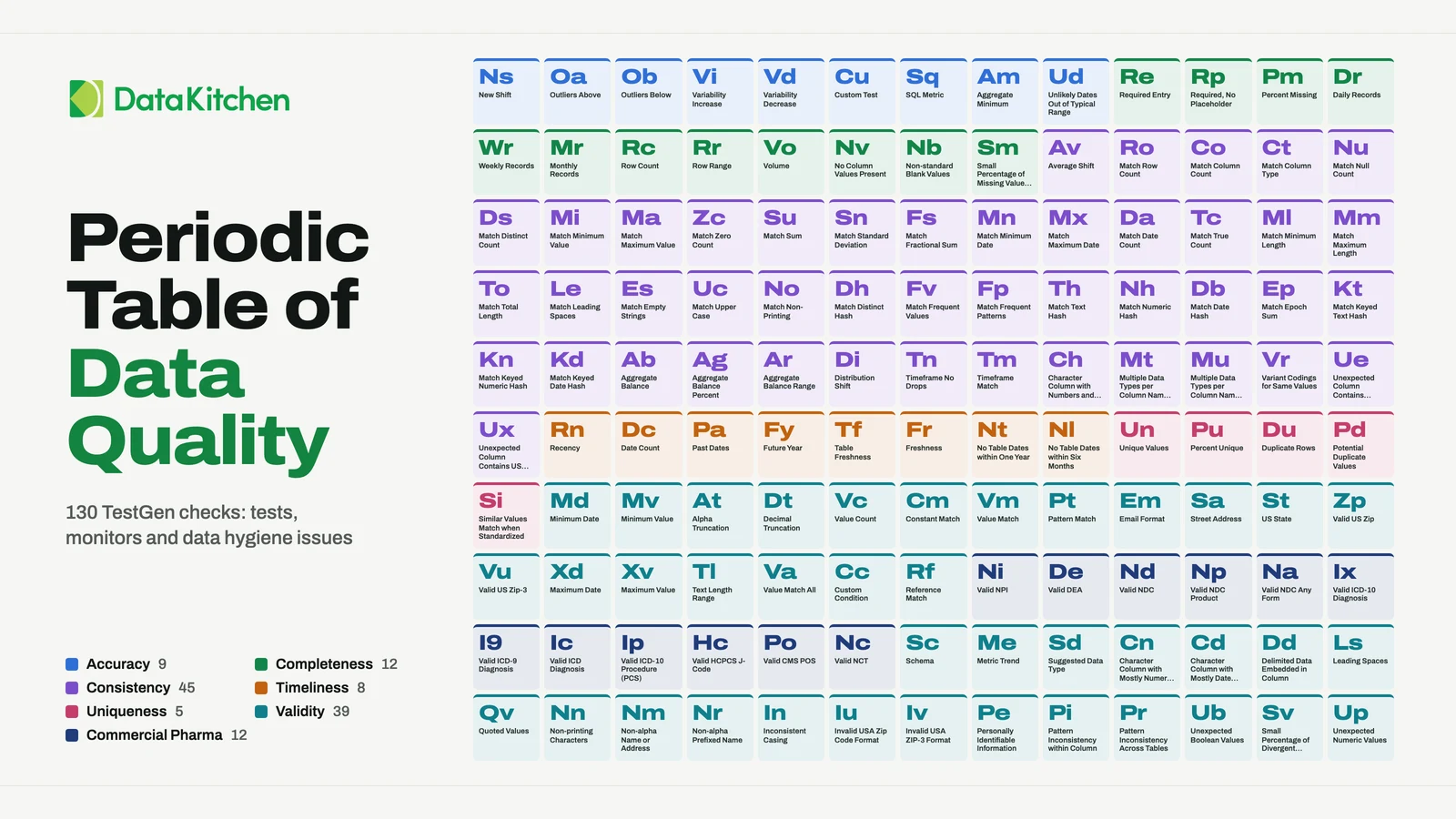
DataOps TestGen is the only open-source tool on that table that links profiling to action. It profiles 55 characteristics per column, then uses the results to generate tests from 34 test types and run 32 data hygiene detectors (as of TestGen 5.134.0, October 2026): missingness, null anomalies, duplicates, type mismatches, pattern violations, value-range issues, cardinality surprises, referential failures, and distribution shifts.
The profile becomes enforcement instead of a report you skim once.
Nobody writes rules. Nobody maintains YAML. Nobody has to anticipate every way a column can fail, because the profiler already measured how it behaves. That is the shift from passive understanding to running AI safety: deep profiling across the whole estate, prescriptive hygiene checks instead of descriptive statistics, and no manual quality process anywhere it can be avoided.
IMPORTANT
Profiling is the diagnosis. Hygiene enforcement is the cure.
The Profile Has to Reach the AI, Not Just the Engineer
There is a second gap in the table above, and it is newer. Every one of those tools writes its profile for a human to read: an HTML report, a notebook cell, a dashboard. Your assistant cannot read any of it. So when you ask Claude or Cursor whether a column is safe to train on, it guesses from whatever you pasted into the chat.
The Model Context Protocol (MCP) is the open standard that closes this. A profiler with a complete MCP interface hands the assistant the actual statistics, the hygiene findings, and the test history, and lets it act on them under your permissions. TestGen’s MCP server exposes 112 tools across the whole data quality loop, profiling included, in the open-source edition. In one session, a single question about a database’s inventory and health came back with a quality score of 78.9 and 30 hygiene issues nobody had tested for. One supposedly clean table was still carrying names, emails, zip codes, and income flagged as PII. No report was opened. The assistant read the profile directly.
A profiling tool your AI cannot call is a PDF.
Final Word: Data Must Be Understood & Clean Before It Is Powerful
In 2026, data quality is a matter of AI, decision, and business integrity. Open-source profilers remain essential for visibility. Visibility without action is no longer enough. Only DataOps TestGen turns the profile into automated enforcement and hands the result to your assistant, which is what operating safely with AI now requires.
Profiling is insight. Hygiene is protection. TestGen is both.
FAQ
What are the key points in this blog?
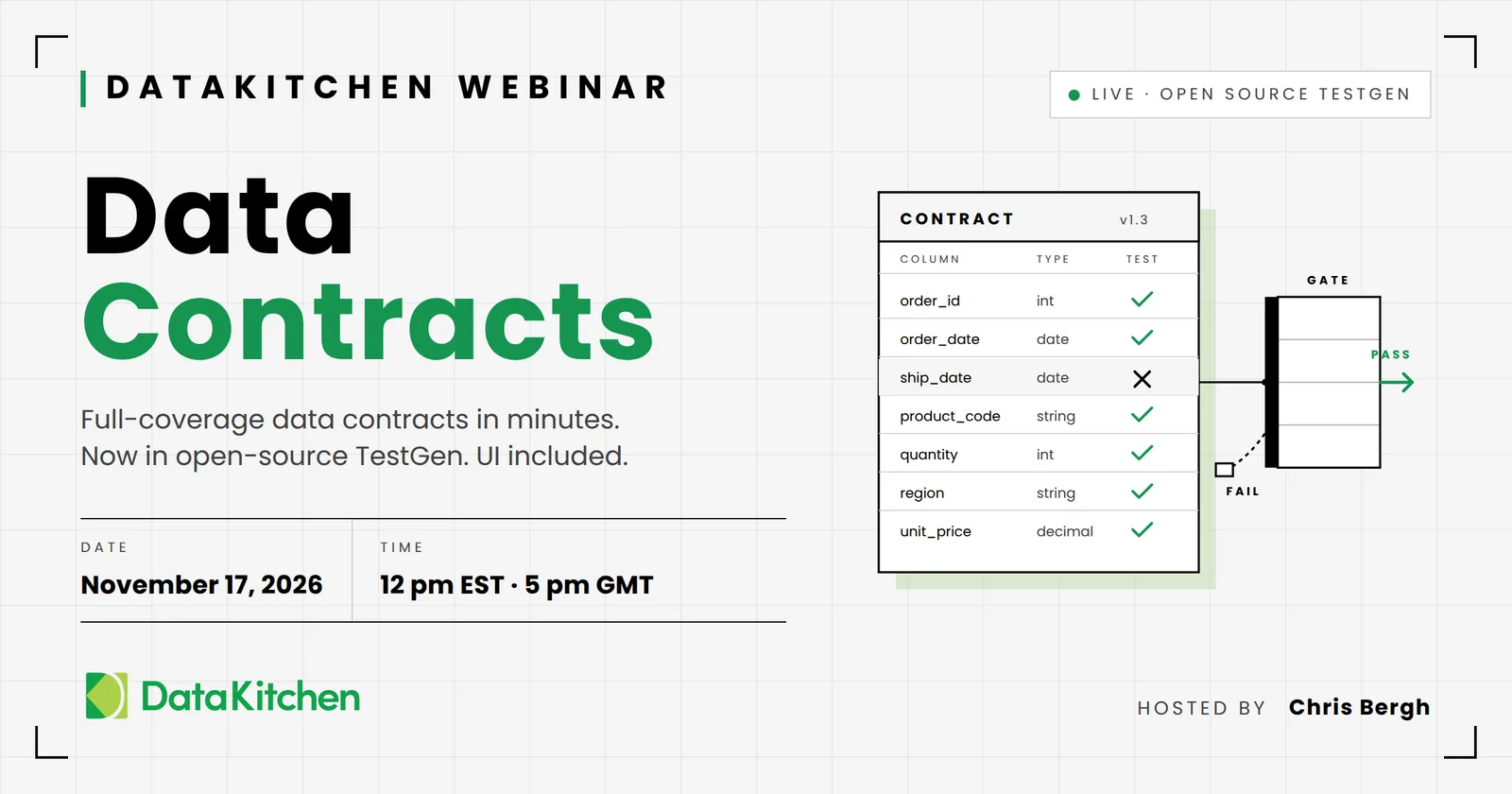
Data profiling computes statistics about what is actually in your columns, and AI has made it urgent again. The post compares the main open-source profilers, including YData-Profiling, Great Expectations, Deequ, DataCleaner, OpenRefine, and DataOps TestGen. Its central finding is that almost all of them describe data and stop there. Only TestGen converts profiling results into data hygiene tests automatically.
What is data profiling?
Data profiling computes statistics that describe what is in your data: distributions, null rates, distinct counts, minimums and maximums, and value patterns. It splits into three techniques. Structure discovery examines format and consistency. Content discovery examines individual records for errors. Relationship discovery finds how tables and columns connect. Profiling tells you what you have before you decide what to test.
What are the best open source data profiling tools?
YData-Profiling produces the richest single-table reports. Deequ profiles well at Spark scale. DataCleaner and OpenRefine handle interactive exploration and cleanup. Great Expectations includes a profiler aimed at bootstrapping expectations. DataOps TestGen analyzes 55 column characteristics and is the one that turns those findings into runnable hygiene tests rather than a report you read once.
What is the difference between data profiling and data quality testing?
Profiling describes what is in your data right now. Testing asserts what should be true and fails when it is not. Profiling is exploratory and produces a snapshot; testing is a pass or fail check you run on a schedule. Profiling comes first, because you cannot set a sensible threshold on a column you have never measured.
Why does profiling matter more now that teams are building with AI?
Because AI systems consume data without a human reading it first. A model trained on a column that silently went 40 percent null will produce confident, wrong output, and nobody sees the intermediate step where a person would have noticed. Profiling is how you learn what normal looks like for a column before an automated system starts depending on it.
Can an AI assistant read profiling results directly?
Only if the profiler exposes them through the Model Context Protocol (MCP). Most open-source profilers write an HTML report or a notebook cell that an assistant cannot see, so it guesses from whatever you paste into the chat. DataOps TestGen’s open-source MCP server exposes profiling statistics, hygiene findings, and test history through 112 tools, each running under the connected user’s own role, so Claude, Cursor, Copilot, or an agent reads the real numbers and can act on them.
Can profiling tools generate data quality tests automatically?
Almost none of them can, which is the gap the post is about. Most open-source profilers produce a report and stop, leaving you to read the statistics and hand-write rules. DataOps TestGen derives validation and hygiene tests directly from its profiling run, so the profile becomes enforcement instead of a document somebody skims once and forgets.
Comparisons
DataKitchen TestGen vs the field
Head-to-head against every major data quality and observability vendor.
No vendors match. .