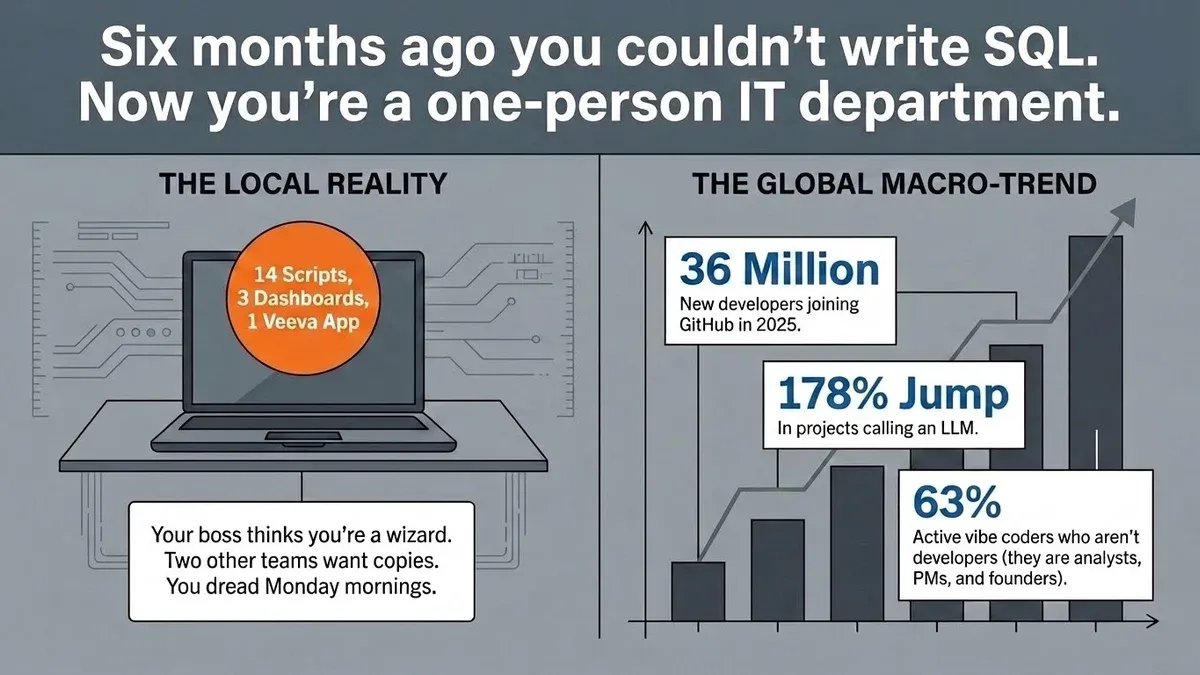
Six months ago you couldn’t write a line of SQL. Now you have 14 scripts, three dashboards, and a small app that pulls call notes out of Veeva and scores them. You built it all yourself, with an AI coding tool and a lot of “no, the other date column.” Your boss thinks you’re a wizard. Two other teams have asked for copies.
And you have started to dread Monday mornings.
You are not alone in this. GitHub’s 2025 Octoverse report counted more than 36 million new developers joining in a single year, over 230 new repositories created every minute, and a 178% jump in projects that call an LLM. A lot of those new developers are people like you. In one analysis of the vibe coding community, about 63% of active members weren’t developers at all. They were analysts, product managers, ops leads, and founders, and roughly one in five things they built was an internal business tool, and another one in eleven was a dashboard.
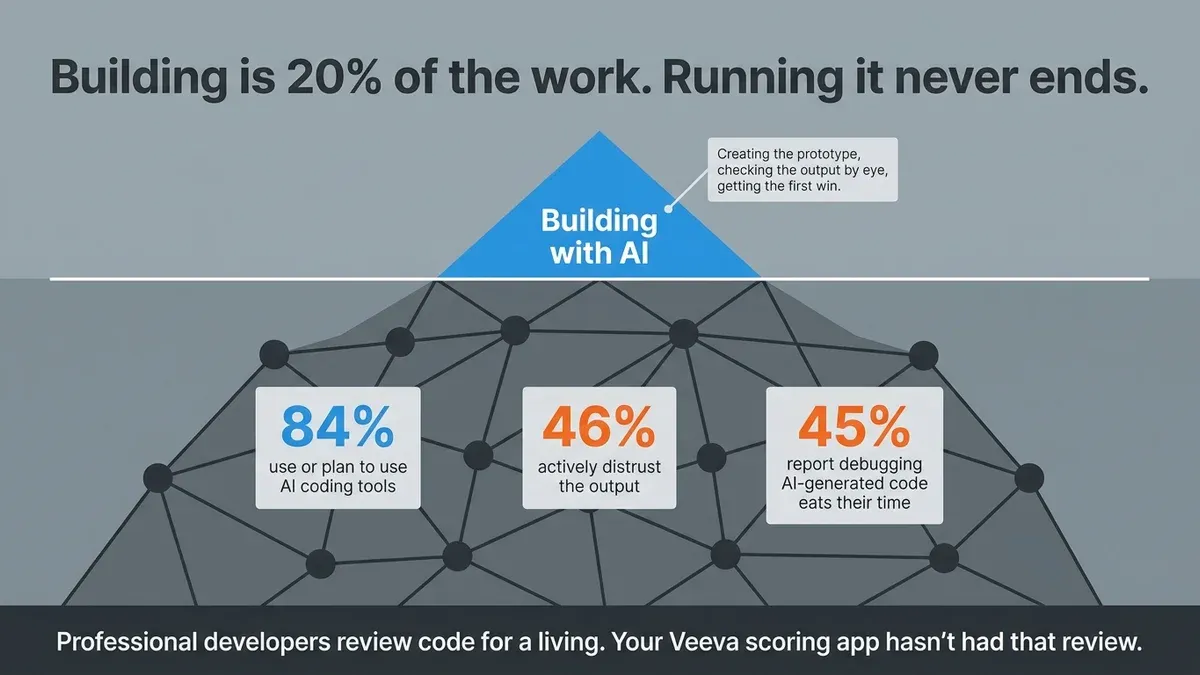
The quality data is less cheerful. In Stack Overflow’s 2025 Developer Survey of 49,000 developers, 84% said they use or plan to use AI coding tools, but only 29% trust the output to be accurate and 46% actively distrust it. Their top frustration was code that is almost right but not quite, and 45% said debugging AI-generated code eats their time. Those are professionals who review code for a living. Your Veeva scoring app almost certainly hasn’t had that review.
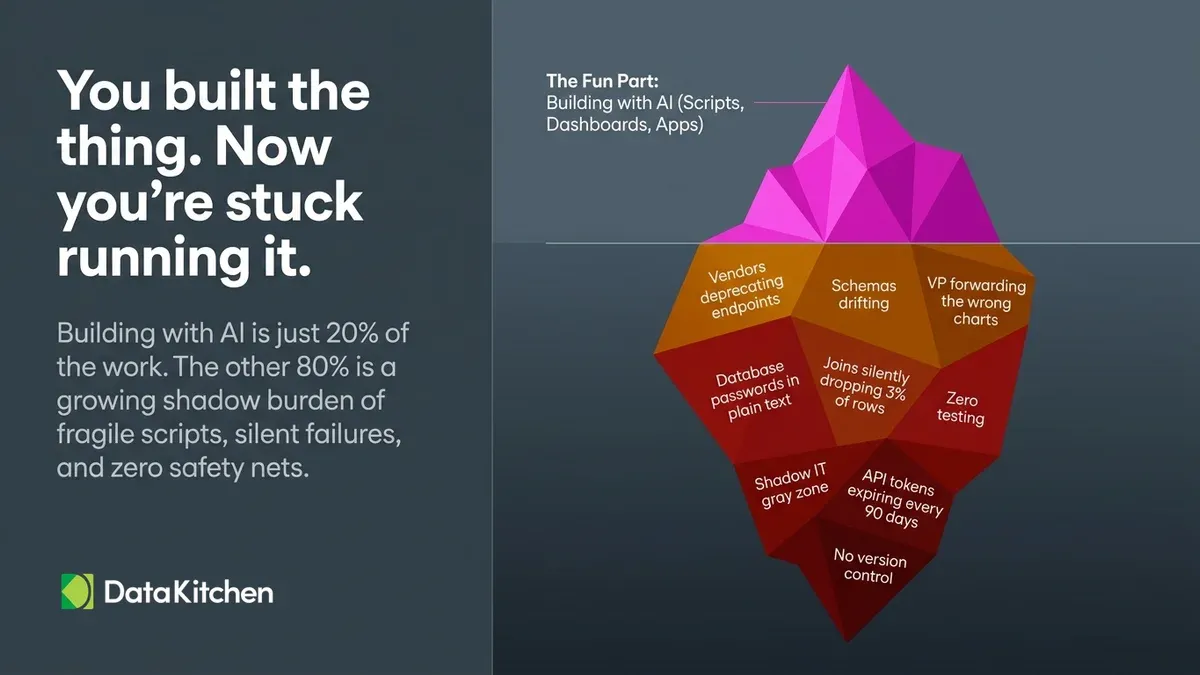
Building is 20% of the work. Running it never ends.
Here’s what nobody told you about vibe coding. Building the thing is the fun part. It’s also about 20% of the work. The other 80% is keeping it alive, and that part never ends.
Think about what your week actually looks like now. The territory alignment script runs when you remember to run it, which means it runs when someone asks why the numbers are stale. The dashboard that pulls from the data warehouse broke last Tuesday because someone renamed a column, and you found out from a VP who had already forwarded the wrong chart to her boss. The Veeva app works, unless the API token expires, which it does every 90 days, which you learned the hard way. You have a Python script with your database password in plain text. You know that’s bad. You haven’t had time to fix it.
None of these tools has a test. Not one. When you built them, you checked the output by eye, saw a number that looked right, and moved on. That was fine for a prototype. It’s not fine for a report that finance now uses to true up bonuses. If the join silently drops 3% of rows, you won’t know until someone gets underpaid and complains.
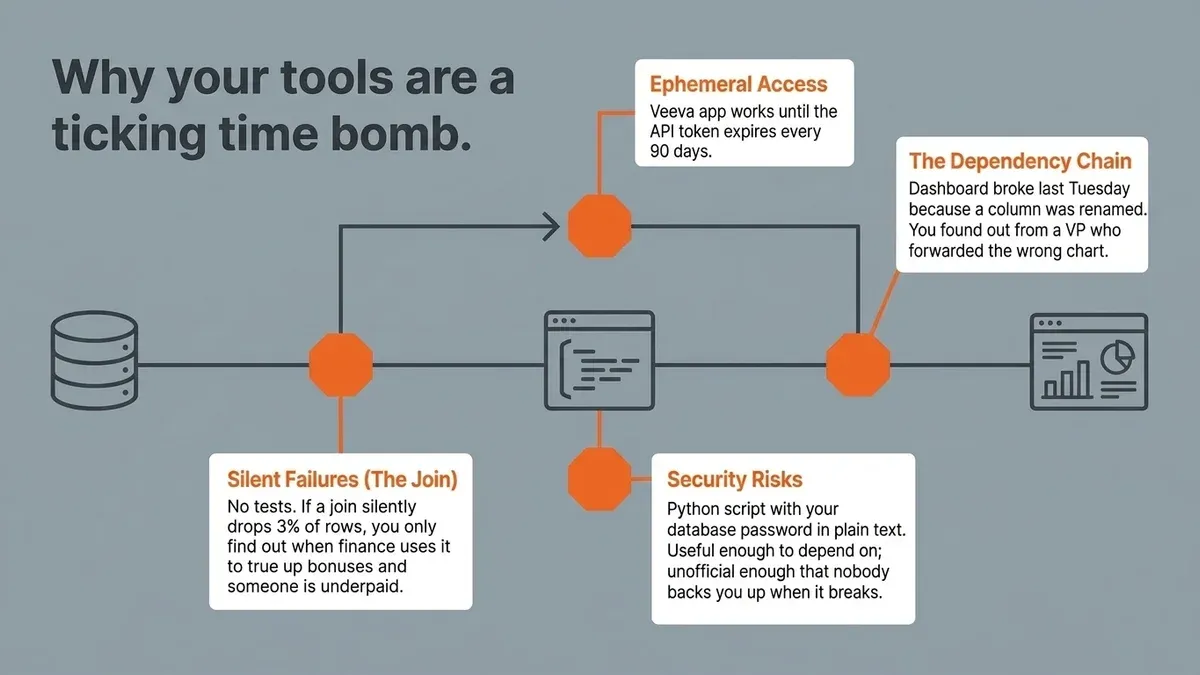
Then there’s IT. You haven’t told them about most of this. Not because you’re hiding it, but because the first conversation would be about why you’re running production code off your laptop, and the second would be about a six-month project to “do it right,” and by then the business would have moved on. So the tools live in a gray zone. Useful enough that people depend on them. Unofficial enough that nobody will back you up when one of them breaks.
And they will break. That’s not a knock on your code. All code breaks. Schemas change, vendors deprecate endpoints, a source system gets migrated, a laptop gets replaced. The difference between a professional data team and you isn’t that their code is better. It’s that they have machinery around the code that catches the break before a VP does.
Here’s the part that stings. The more useful your tools are, the worse this gets. Every new dashboard someone asks for is another thing you own forever. Every copy you hand to another team is another version that will drift, and none of it is in source control. When finance asks which version produced last quarter’s number, you won’t know. When a change breaks something, there’s nothing to roll back to. You are becoming a one-person IT department for a portfolio of software you built on the side, and the job you were hired for is still there waiting.
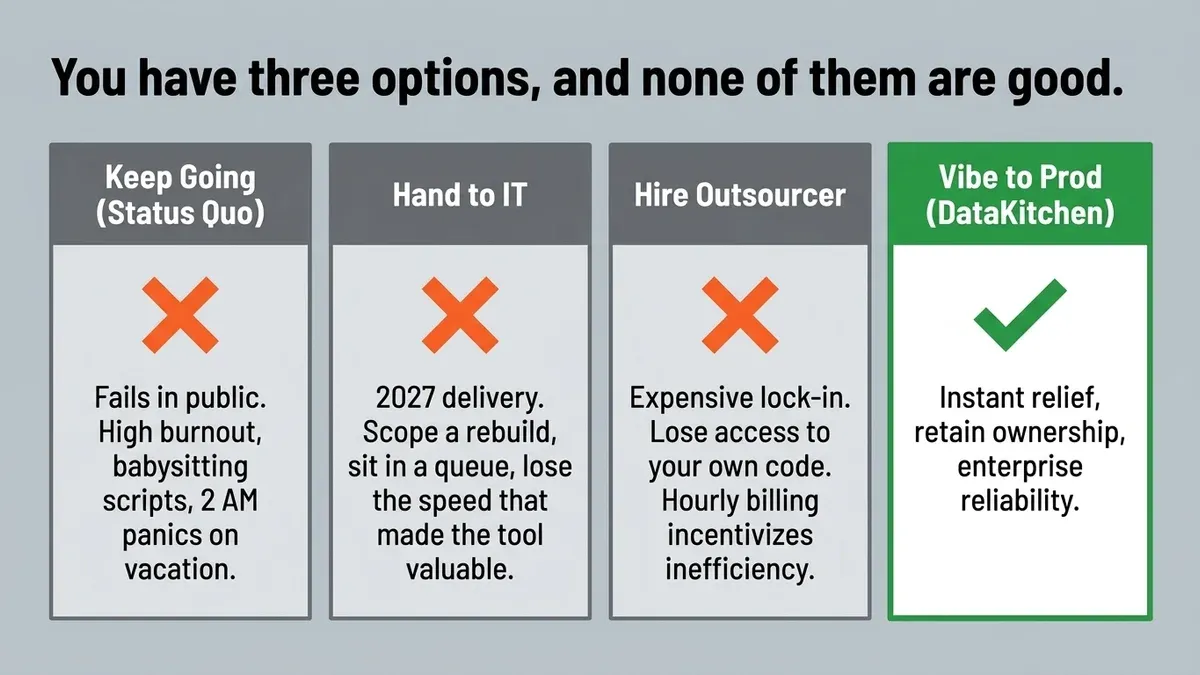
You have three options, and none of them are good
Keep going
Wake up early, babysit the scripts, fix what breaks, hope nothing important fails during your vacation. This works until it doesn’t, and when it doesn’t, it fails in public.
Hand it all to IT
They will be polite about it. Their caution is earned, too: they’re the ones who get paged when it breaks, who answer to audit when an unreviewed script touches patient data, and who inherit it when you move on. So they’ll put it in a queue, scope a rebuild, and deliver something in 2027 that does less than what you have now. The speed that made these tools valuable in the first place is gone.
Hire an outsourcer
They’ll take it over by the hour. You’ll lose the ability to open the code and change it yourself, because now it’s theirs. And their bill has no reason to ever get smaller, because smaller bills mean less revenue for them.
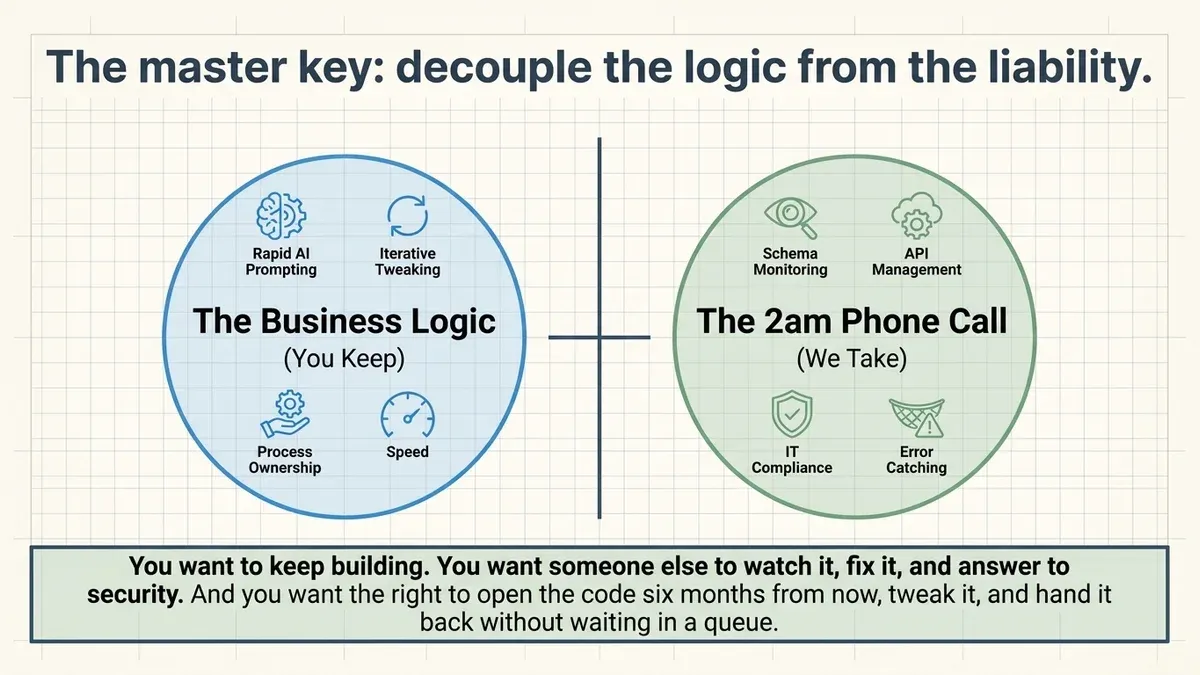
Keep the logic. Hand off the 2am phone call.
What you actually want is simple to describe and, until recently, impossible to buy. You want to keep building. You’re good at it and it’s the reason your team is ahead. You want someone else to run what you build, watch it, fix it when the schema changes, and answer to IT and security so you don’t have to. And you want to keep the right to open the code six months from now, improve it with whatever AI tool you like, and hand it back without waiting in a queue.
Ownership of the ideas and the business logic stays with you. Ownership of the 2am phone call goes to somebody else.
Vibe to Prod: we make your messy code real
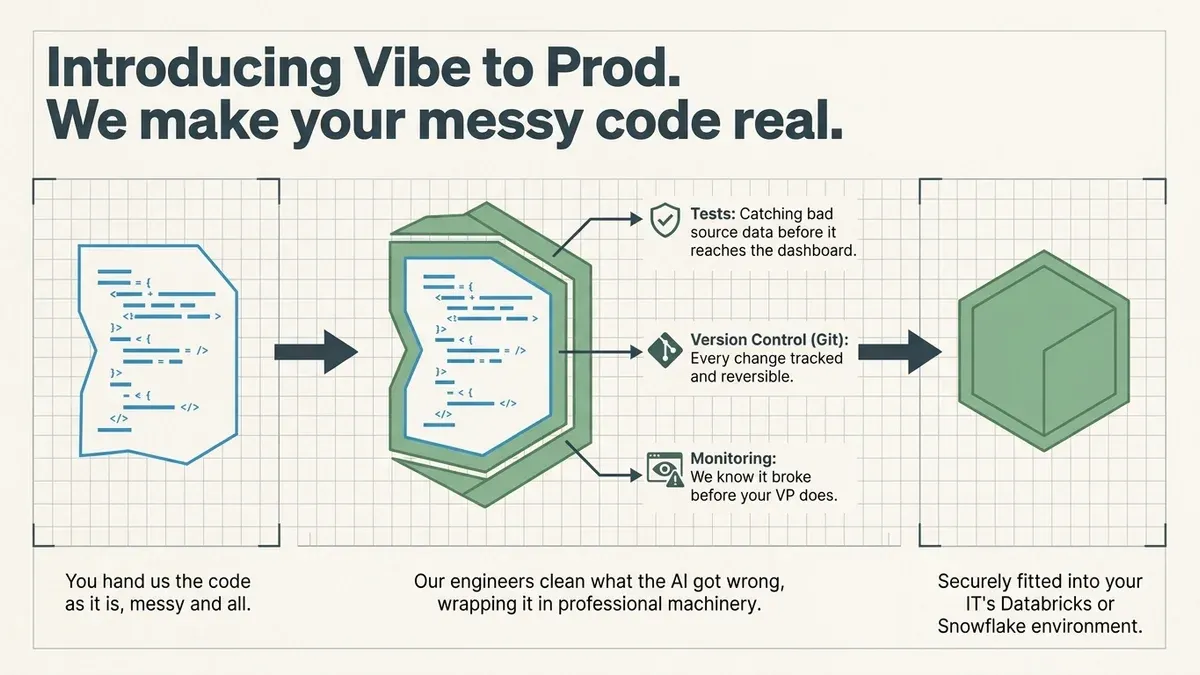
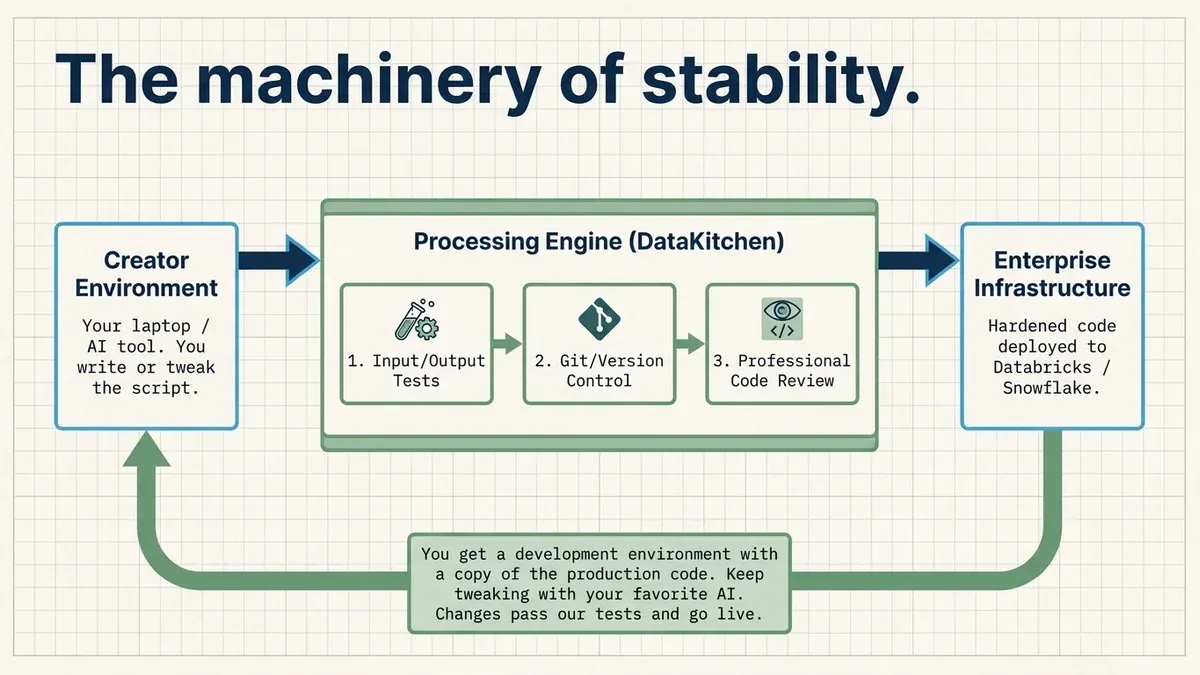
That’s what DataKitchen does. We call it Vibe to Prod. You hand us the code as it is, messy and all. Our data engineers clean up what the AI got wrong, then wrap it in the machinery a professional team would have built from the start: tests on the inputs and outputs, git and version control so every change is tracked and reversible, monitoring so we know it broke before you do, and checks that catch bad source data before it reaches your dashboard. We fit it into your Databricks, Snowflake, or whatever your IT team runs, and operate it from then on.
You get a development environment with a copy of the production code so you can keep tweaking with your favorite AI tool. Changes pass the tests, get a quick review from one of our engineers, and go live. We are experts on efficient data operations.
We’ve done this before. For one biotech we took over code that already existed, rebuilt it, and ran it for a fraction of what the previous vendor charged. The details are in Cadillac or Corolla: cutting a biotech data bill.
You built it. We make it real. Talk to us if you have a pile of scripts that needs someone to mind it and manage it.
FAQ
What are the key points in this blog?
Building a vibe-coded tool is about 20% of the work and running it is the other 80%, which never ends. The scripts, dashboards, and apps that business users build with AI coding tools ship with no tests, no version control, and no monitoring, so they break silently and in public. Keeping going, handing it to IT, and hiring an outsourcer each lose something. DataKitchen’s Vibe to Prod runs what you built while you keep the code and keep building.
Why is building a vibe-coded tool only 20% of the work?
Because everything the tool depends on keeps changing after you ship it. Schemas change, vendors deprecate endpoints, a source system gets migrated, an API token expires every 90 days, a laptop gets replaced. A professional data team has machinery around the code that catches each break before a VP does. A vibe-coded tool has you, remembering to run it and checking the output by eye.
Why do vibe-coded scripts and dashboards break?
All code breaks; the difference is whether anything catches it. A typical vibe-coded portfolio has no tests, no source control, a database password in plain text, and a token that expires on a schedule nobody wrote down. When a column is renamed the dashboard fails silently, and when a join drops 3% of rows nobody knows until finance uses the number to true up bonuses and someone is underpaid.
What are the options when you are stuck running tools you vibe-coded?
Three, and none of them are good. Keep going: babysit the scripts and hope nothing important fails on your vacation, which works until it fails in public. Hand it all to IT: they will queue it, scope a rebuild, and deliver something in 2027 that does less than what you have now. Hire an outsourcer: they take it over by the hour, the code becomes theirs, and the bill has no reason to shrink.
What is Vibe to Prod?
Vibe to Prod is DataKitchen’s service for running the code you built with an AI tool. You hand over the scripts as they are. Our data engineers clean up what the AI got wrong, then add tests on the inputs and outputs, git version control, monitoring, and checks that catch bad source data before it reaches your dashboard. We fit it into your Databricks, Snowflake, or whatever your IT team runs, and operate it from then on.
Do you lose ownership of your code with Vibe to Prod?
No. Ownership of the ideas and the business logic stays with you. You get a development environment with a copy of the production code, so you can keep tweaking it with your favorite AI tool. Changes pass the tests, get a quick review from a DataKitchen engineer, and go live. What moves to DataKitchen is the 2am phone call, the schema fixes, and answering to IT and security.